The Merciful Reign

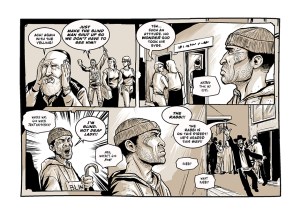
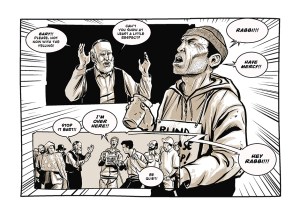
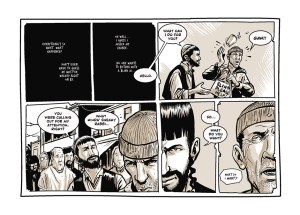
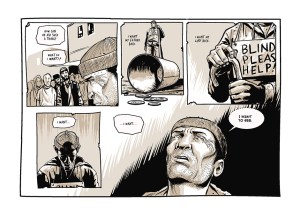
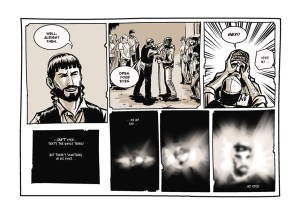
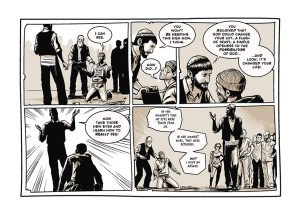
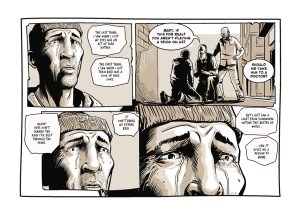
Okay – so, we’re going to be reading Matthew 20:29-34 this Sunday – and instead of my normal post, I thought I’d upload a chapter from Rabbi Encounters that recounts the story (although, it’s actually from Mark’s account – so there’s only one person instead of two). Anyway – enjoy, and be thinking about God’s mercy revealed in this text.

Click the link to read more of Rabbi Encounters.   See you Sunday!

Power and Greatness Reimagined

Image result for drawing looks different when upside down

The drawing above is a classic “upside-down illusion”. The image on the top shows a giant bird clutching a man in it’s beak. However, turn the drawing around and it is an image of a man in a canoe observing a great fish. One of the important features of Jesus’ teachings is that he has persistently turned our pictures upside-down – not to be a contrarian jerk – but in order to show us how the world was really meant to be seen.

The passage we’ll be reading this Sunday are another one of Jesus’ image flips. We’ll be reading Matthew 20:17-28.

In v17-19, Jesus gives his third prediction of what fate awaits him in Jerusalem. This forecast is the most explicit, even including the detail of flogging and crucifixion. Based on the section that is coming up, we know that the disciples don’t get what he’s talking about. They are still assuming Jesus will be taking up a sword, assembling an army and overthrowing the powers that be. Instead of that, Jesus predicts his own death. Based on that, what do we understand the greatest expression of God’s power to be? From Sydney Carton to Harry Potter, humanity seems to intuit the power of self-sacrificial love. How does this impact the mission of the church? How should it define our main activity?

After Jesus gives this revelation, two of his disciples, Jimmy and Jack, get their mom to ask for special privileges when Jesus ascends his throne. Given what he’s just described his throne to look like, they really have no clue what they are asking for.

Jesus uses this as an opportunity to describe how authority is expressed and greatness is revealed in God’s kingdom. Again, he’s turning the picture upside-down and showing the image we were intended to see all along. What do you think it looks like when the greatest among us are the servants? How can a person exercise authority by serving? In what ways does this go against the grain of our normal understanding and aspirations for status and significance in life?

I won’t kid you – this will be a challenging study, but one that I believe is vitally important to our Christian maturation. Hope to see you Sunday!


Grace and Rewards

Image result for fox huntingN.T. Wright, in his “Everyone” commentary on Matthew, shares a story, in typical British fashion, about a fox hunt he had witnessed as a boy (this is not to endorse such a thing, just his account). He described the riders in red coats atop of fine brown horses that blew trumpets and led the way for hunting dogs and riders who were less dashing on more humble horses. As they charged around chasing the fox, the clever animal hid in the bushes and back-tracked after the riders had all passed him. Suddenly, those at the back of the procession looked back to the hill they had just come from and saw the fox behind them. They blew their own trumpet to turn the group around, and suddenly those who were on humble mounts were at the front of the pack, while those on the fine horses were bringing up the rear.

He used that as an illustration of how God, in a very fox-like way, turns the pursuits of life and faith around so that the ones we assumed had it all are suddenly the ones needing to catch up. The last shall be first and the first shall be last. That’s going to be a concept we’ll be considering in our study this weekend.

This Sunday we’ll be reading Matthew 19:27-20:16 – which includes a parable that is unique to Matthew’s gospel. It is the parable of the laborers in the vineyard.

In chapter 19, Pete asks the question that is basically “after sacrificing all we had to follow you, what’s in it for us?”. Jesus does promise a reward to him, but where is it centered, according to v28? Some believe Jesus is speaking literally in his promise of a hundred-fold return of lands and…mothers, etc. What is missing from that list he gives? How does that fit with those who promise a 100 times greater return on your offerings to their ministry? Given the context of v28, what do you think the first/last dynamic is intended to teach us?

In chapter 20 Jesus tells a story about a rich landowner who hires day laborers to pick grapes during the vineyard’s harvest. The story is unsettling in it’s economic implications – but what about it’s spiritual ones? What reason does the landowner give for paying everyone the same amount? What do you believe that is teaching us about our pursuit of spiritual and eternal rewards and the actual source of it?

In v12, what is the chief complaint about the identical pay-stubs everyone had? What does this tell us about the self-perception of the complainers? In v 15 when it says “Or do you begrudge my generosity?”, it literally is asking “why do you give my generosity the evil eye?” Many, if not most, translations read a variation on “are you envious because I’m generous?”. What would the complainers be envious of? They received what they agreed on as a wage. Justice was done…but something else was added – what? Some think its hard to tell from the transcript what the object of the envy is. Some think that they are envious and angry at the landowner. What would they be envying about him?

I find this whole story to be fascinating…hope you do too! See yez’ on Sunday!
The World Turned Upside Down

Image result for the world turned upside down

I remember once finding a track of a live version of a song that I really like by one of my favorite bands. Live versions of songs aren’t always that enjoyable to me, but they do carry an intensity that is never fully captured in a recording session. Anyway, as I played the recording I found myself immediately disoriented. Instead of the opening I was accustomed to, the drum started hammering out a strange and unfamiliar syncopation. I assumed this was the end of another song and the one I expected would start soon, but to my great surprise, I realized that it was in fact the song I was looking for. The band had simply changed the rhythm which had the effect of reforming the melody. The lyrics, instead of being their normal staccato were drawn out in harmonies. It was the same song but it was presented completely differently that what I anticipated and had come to expect. The band had turned the song upside down for me and it was like hearing it all with fresh ears.

One thing that has characterized Jesus’ ministry as we’ve read about it in the gospel of Matthew is the unexpected way in which he takes the world and turns it upside down. Or, we really should say, right side up. Where all of the expectations and norms have pointed in one direction, Jesus comes along and turns the signs completely around. Like the band I mentioned – he played the right song, but in ways that nobody could have anticipated.

In the section we’ll be reading this Sunday, Jesus does this yet again. We’ll be reading Matthew 19:13-26.

As the section opens, Matthew once again has children at the center stage. We mentioned back in chapter 18 what the attitudes were concerning children in the ancient world. Jesus overturns those attitudes and grants person-hood status to those who weren’t afforded that by the surrounding culture. What does that tell us about our own personal value as it concerns God’s view of us?

On the heels of that we are introduced to a young man who has everything going on in his life. He’s young, rich, powerful (according to the parallel passage in Luke 18:18 he’s called a ruler) and according to his own testimony, he’s a decent guy who cares about the law of Moses. He is the picture of success in any culture, including our own. We’ll go into more detail on Sunday about the interaction between Jesus and this dude – but let’s focus on what Jesus tells him. The young man has everything going on for him by the world’s standards, and that is the very place where Jesus places the ax in his response. “Here’s what you lack – here’s what you could do to be complete – sell all your stuff and give it to the poor and you’ll have riches in heaven and you can follow me.” That was a bridge too far for that young man. The Bible has a lot of negative things to say about wealth and the eagerness for riches. Why do you suppose the young man walked away from Jesus at this point? What would you be afraid of losing when it comes to following Jesus?

This is a heavy lesson and one that wasn’t lost on the disciples. They sort of wig out asking who can actually be saved, if this guy who seemed so blessed didn’t earn a spot. That gives Jesus one more opportunity to turn the world upside down as it touches religion. The Broken world’s ideas about religion always center on our ability to earn our salvation by how well we can perform religious duties. Jesus explodes that concept. What do you interpret the impossible for man but possible with God dynamic to mean, given the context of salvation? How does this effect your understanding of what Jesus told the young man to do?

I’m really looking forward to digging into this together – see you Sunday, all you Upside-downzies!