Who Calls the Shots?

This has been an indescribably rough week.  If you haven’t been made aware yet, Karla Jones, who was in the motorcycle wreck with Mike Kern, passed away last night (9/30).  Please keep her family and Mike in your prayers.  These are such difficult passages to walk through, but we trust in God’s grace to comfort and steady them as they go.

This Sunday we’ll be reading Luke 19:45-20:8.

This is the account of what happens immediately after Jesus enters Jerusalem.  He starts cleaning house.  The event leads naturally into chapter 20 and the confrontation with the high priest and rulers.  They know right off that what Jesus has done, both clearing the temple of consumerism and setting up a teaching workshop in it’s place, is a challenge to THEIR authority.

That’s the underlying message of this section.  Authority.  The high priest asks where Jesus got the authority to do all this, and Jesus answers with a question about John the Baptist’s authority….and the lingering question is about resolving just WHO calls the shots in life.

That’s the challenge to us.  Who calls the shots in our lives?  Who is the final authority on value sets and choices?  If we understand the temple concept of the New Testament to be that WE are now the temple of God…what does Jesus’ clearing the temple imply for our own lives?  What tables do we have set up that reflect a value set different from God’s original purposes?  How can we apply this challenge about authority to our own lives?

Those are the directions we’ll be taking.  Hope to see you there.

A Big Misunderstanding

This Sunday we’ll be reading Luke 19:28-44.

It is the description of the event we have come to call “The Triumphal Entry”, where Jesus makes his entrance into Jerusalem amidst the cheering crowds.  The terminology of triumphal entry isn’t in the text, but it’s borrowed from the triumphal marches of emperors and kings when they enter a territory they have conquered.

As you read the text, how does the description of Jesus’ entrance compare to the way you’d imagine a conquering king entering a city?  What contrasts do you see, and how do they inform your understanding of the nature of God’s kingdom at work in this world?

Everyone there was excited, because they were expecting the onset of a political revolt against Rome.  In fact, the scene is so similar to one recorded in 2 Maccabees 2 after Judas Maccabeus liberated Jerusalem from Greek control.  You can read about it here (and take note of v7 for the similarity).  Unfortunately, they totally misunderstood what Jesus was actually doing in establishing His kingdom.  Jesus came to die on a cross, the people were waiting for Him to take up a sword.

In fact, it was probably for fear of sudden uprising and the reprisals it would bring from Rome that prompted the Pharisees to get Jesus to stop the celebration.  What do you make of Jesus’ response to them in v 40, that if “these were silent, the very stones would cry out.”?  Is he saying that the created order will take our place in praising God if we cease?  Or is this a reference to Mick Jagger?  OR, given the tensions and potential for revolt…is he saying something else?  Think about it for a while, in context.

Jesus weeps over the city because they missed the very Messiah they had been waiting for for so long.  Why did they miss God’s peace and the time of their visitation?  What do you think kept them from it…and how does that challenge us in our desire to find God’s peace and wholeness?

Hope to see you Sunday!

Making the Most of the In-Between

I had a great birthday weekend! Thanks to everyone for your kind birthday wishes!

Now it’s back to what we love to do – explore God’s Word and view life from that high plateau! We’re going to continue our study in Luke, reading chapter 19:11-27.

Jesus has everyone’s attention after accepting someone like Zach the taxman, and so he launches once again into story mode. He tells a parable intended to temper everyone’s expectations about how this kingdom of God thing is going to go down.  That’s the purpose of this story…we need to keep that in mind.

The story is about a nobleman who goes to receive his commission to become king of a region. While he’s gone, he entrusts 10 servants with the resources to see that the purposes of his kingdom are advanced in his absence. Also, while he’s gone, the citizens he’s supposed to rule rebel and send a delegation to keep him from being king.  When he returns, he asks for an accounting from his servants as to how they advanced his purposes in his stead, and he deals with the rebellion severely.  You might find this bit of historic context sort of interesting in light of this story.

This is an interesting story with some curious characters used, especially so regarding the one typifying Christ. We need to be careful as to how we interpret and apply this to life.  The most common sermon I hear on this usually draws the most shallow draft from the most obvious conclusion…but I think this parable deserves a little more thought.  What I’ve usually heard is: Jesus is away in heaven, and if you haven’t witnessed enough or tithed enough or whatever, he’s going to be upset with you when he gets back. In other words: Jesus is coming, so look busy!  But is that really the message of this parable?

Clearly, the third servant is meant to be a warning, he’s given a lot of space in the narrative, but a warning about what, I wonder?

What if we were to think about the first two stewards?  What were they doing while their master was gone? Weren’t they just doing their job as usual? Were they acting like people who have no king – or were they behaving as though the kingdom they served was a sure thing?  How do you read this in light of it as being a story that tempers expectations about how long this kingdom project will take?  What if this were an encouragement to hold on, to stay loyal, even though the delay in fulfillment is longer than we thought it would be?  What if this were about loyalty – an encouragement to not lose hope and drift into the attitude of the rebellion, and let our lives stagnate and get smaller in the process?

It’s something to think about anyway.  How do you want to read this passage?

Hope to see you Sunday! This Sunday is our last Surf-N-Grill of the 2011 season!

A Love that Ruins Our Labels

The People of a Second Chance movement is doing a poster series based on the question of who you would give a second chance to.  The images are arresting and so impacting for me, both as an artist and as a passionate proponent of God’s grace.  Who have we decided is beyond the scope of God’s restoring love, or our acceptance?  Those are heart-probing questions we shouldn’t answer too quickly.

This Sunday we’ll be continuing our study in the gospel of Luke, and we’ll read chapter 19:1-10.  It’s the story of Zacchaeus, or Zack to his friends.  (By the by, I did a re-telling of his story in my webcomic Rabbi Encounters, and you can read it HERE)

Zack is the New Testament poster child for second-chancers.  He had everything going against him socially and religiously, he was easy to categorize and label.  Bad guy.  Done and done.  Except that Jesus strolls into town and ruins everything.

Are there people you have trouble accepting, or applying the love of God to?  How does Jesus’ attitude, behavior and words toward Zack speak to that?  Does it change your attitude toward someone if you imagine that Jesus has accepted them?

Have you felt labeled because of your social status or appearance or (you name it)?  What do we learn from Jesus’ interaction with Zack that can help us find our identity in something OTHER than the crowd’s approval?

Jesus’ love ruins our labels, and his grace tramples down all our neat categories as his kingdom invades this world.  How can we work in harmony with that?

Hope you can be there Sunday, should be a good section to explore!

Blind Spots

“More and more people are buying bigger and bigger…, And the bigger the vehicle, the bigger the blind spot.” ~ Consumer Reports article

Blind spots in life are a funny thing.  I remember having a conversation with someone about certain attitudes and behaviors that were creating dysfunction in the church, and agreeing about the problem so wholeheartedly, until it suddenly dawned on me that I was the subject of our conversation.  I was so convinced of my “rightness” that I was blind to my need of correction.

Our preconceived ideas and accepted worldviews can often times become an obstacle to seeing clearly.  That’s something that our text this Sunday will be addressing, as we continue reading Luke 18:31-43.

The disciples are blind to what Jesus is telling them plainly.  Why would this have been so hard for them to understand?  Have you ever been convinced about something concerning Christianity that you came to realize later may not have been a clear insight?  Suffering wasn’t on the Messianic agenda for the disciples, but that agenda would soon be rearranged.

The picture of the disciples in the dark leads right into the story of the blind man whom Jesus heals.  The Blind man is a picture of suffering.  Can you see any ways in which this man’s suffering ended up being helpful to him in the bigger picture, the larger scheme of things?

Does that cause you to stop and reconsider the role of suffering in your own life?

Just some stuff to ponder as we close in on Sunday!  Hope to see you there!

The Good Life

If someone (who is not Kayne West) talks about having the good life, or wanting the good life…what are they talking about?  Actually, what is Kayne West talking about?  Wait…that’s too broad of a subject that nobody can really answer…scratch that.  What are the examples we think of when we hear that so and so is living “the good life”?

“I wanna’ win American Idol because I wanna’ have the good life from now on!” – what do you think that means?

That’s going to be our topic of exploration this Sunday as we tackle Luke 18:18-30.

Jesus weighs in on the good life when a wealthy local official comes and asks him how to get it.  He actually asks Jesus how to inherit eternal life, which held a greater meaning than just “going to heaven when you die”.  For the 1st Century Jewish person, eternal life carried the implication of the fulfilled purposes for Israel – the wholeness of plan and purpose which extends on into eternity.  We could just say “the good life”…life as it’s meant to be.


Here’s some stuff to ponder and weigh in on.  The guy asks what he “should do” to get the life he’s meant for.  What do you think he may have had in mind by that?  Jesus answers with a list from the 1o commandments…does that seem strange to you?   The guy asserts that he’s being doing good at keeping the commandments all along…but it’s interesting that the very FIRST commandment was not on the list that Jesus gave.  Does that give us any clues about why Jesus starts talking about personal finance with him?

Could it be there was an idol in the wings?

What do you think the message is to us in this?  What does Jesus imply about finding a fulfilled life?  What could hold us back from that?

Ok….that should keep us thinking until Sunday!  Hope to see you then!

The Kingdom is Kid’s Stuff

What I know right now is that there are no five year olds reading this post.  That’s not what five year olds do.  They don’t  read blogs…they stare in wonder at frogs, but they don’t read blogs.  They watch garbage trucks drive by and imagine themselves commanding that awesome piece of machinery and they stand transfixed as a butterfly flutters past them.  Never mind that people don’t usually think of garbage collection as a career goal, and most people are way too busy to watch a butterfly….kids don’t care.  Sometimes, the huge rift between a child’s priorities and an adult’s can cause an adult to minimize the importance of a child’s contribution to community…but is that the right frame of mind to have?

Our passage in Luke 18:15-17 is the classic account of Jesus making time for children.  It’s an account that appears in the three synoptic gospels, and it’s repetition does seem to carry a bit of weight.  Kids are important.  It really does say so.  Obviously, Jesus is using this event to make his “bigger picture” point in v17…but his actions tell us something as well, don’t they?

What do you see as the lessons of this passage?  It’s not very long…but it’s message is deep.  How do we “bring” the children to Jesus?  What does child-like faith look like to you? Hope to see you Sunday as we discuss this wonderful story!

Getting it Right

Hey all…we’re going to be picking back up in our study of the Gospel of Luke this Sunday.  We’ll be reading from chapter 18:9-14 and it’s a particularly favorite passage of mine.  It’s the story of the Pharisee and the tax collector, both praying in the temple.

Several things to think about while you read this story:

  • This is the only place where Jesus uses a religious backdrop for one of his parables.  Do you think there is any significance to that, or to his use of the temple as a backdrop?
  • This is once again a reversal of roles/fortunes, because the Pharisees were the God-guys while the tax collectors were generally seen as the devil’s folk. Think of the people who are regarded as the representations of God in our culture, and the people who are normally viewed as a pariah on society, and insert them into these roles as you read this tale. Does it bother you to do that?
  • There is a trap in this parable…a hook hidden in the characters.  What would you think we should be cautious about when identifying a good guy or a bad guy in the realm of religion?
  • What is it that causes the tax collector to go home JUSTIFIED (declared not guilty, restored to right relationship with God)? What did he do, and how does it compare with the Pharisee’s list of achievements?
  • What is the general point of this passage, in your view?

Anyway…that’s some stuff to ponder until we dig into it together this Sunday!  Hope to see you there!  Also, don’t forget that there will be a meeting right after 2nd service with those who are interested in supporting or going on a short missions trip to the Sudan in the future.

Oh yeah…and Burning House is this Sunday too….hope you can make it for that as well!

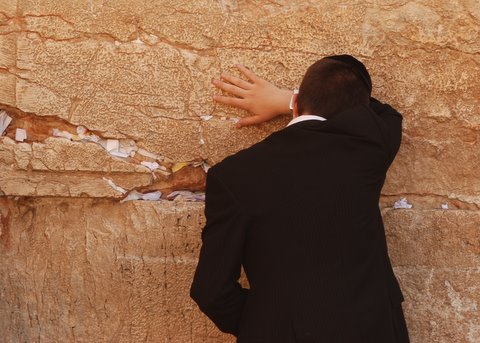
Keep Talking to the Wall

Have you ever had times when praying seemed like an exercise in futility? Where heaven seems silent, and the requests you’ve made fall to the floor making no discernible difference?  How do you feel, if you’ve faced those times?  Ever feel like giving up…ever just stop praying just so you wont get disappointed?  I had a friend who didn’t want to pray about a matter for that very reason;  “If I don’t ask, I won’t feel bad when nothing happens.”

Prayer can be a frustrating experience…but what’s interesting to me is that Jesus seems to anticipate that it WILL be hard.  The parable we’ll be reading in Luke 18:1-8 is one Jesus tells to encourage us not to give up praying, even though things don’t seem to change right away.

It’s a pretty self explanatory story.  What observations do you take away from this story?  What does it mean to you that Jesus compares his followers to a widow?  If God is greater than the unjust judge, what do we understand about God in the contrast?  How do these things encourage us not to lose heart…to keep on praying?

This Sunday is Surf N Grill…lets pray for the weather to be accommodating!  Hope to see you there!

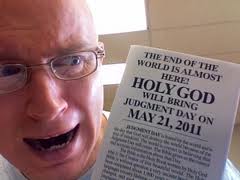
It’s the End of the World as we Know it…(and I feel fine)

From an interview with Harold Camping concerning his prediction of the rapture on May 21st, 2011 in the NYT:

Reporter: If six o’clock rolls around and there are no major earthquakes, are you going to start to get worried?

Harold Camping: It’s going to happen. It’s going to happen. I don’t even think about those kind of issues. The Bible is not — God is not playing games. I don’t even want to think about that question at all. It is going to happen.

You haven’t thought about what you’ll tell your followers on May 22 if the Rapture doesn’t take place?

I’m not even thinking about that at all. It. Is. Going. To. Happen. Because I trust the Bible implicitly, the Bible is God’s word — it’s not from a man, it’s not from an organization of some kind where there’s plenty of room for error. It is the word of God. When God speaks that it is going to happen, the Bible is a very factual book, and God gives many examples of how he has made prophesies and it always has happened in exact accord with what God has prophesied.

I know you’re convinced this is going to happen, but if May 22 comes around and you’re still here, can we talk again?

I can’t even think about that question because you’re thinking that maybe, maybe Judgment Day will not happen. But it will happen, and I believe the Bible implicitly.

On May 24th, Mr. Camping declared that Jesus did indeed come back on the 21st, just spiritually.  Judgment day has been moved to October 21st according to his new calculations.

Ok…the easiest thing to do would be to mock Harold Camping for his failed prophecy…but that’s really not a fair thing to do.  He’s too easy of a target, a caricature of Christian zeal. There’s another good reason not to pile on this guy right now…he’s suffered a stroke.  I’m not jumping on the religious blame wagon to imply judgment on him either…he had a stroke, many people do, and he deserves the dignity of any fellow human in his plight.   I would think the right response to this news would be to pray for him.

The thing is though, his prophecy was public and it drew a lot of attention.  I wonder if I can address his tactics without attacking the man?  I hope so.  A lot of people seem to be really fascinated by end of the world scenarios (most of them seem to be working as program directors for the History Channel). The end of days has always been of interest to the church, and rightly so, because Jesus did talk about it…though I really think the amount of space devoted to the subject at any Christian bookstore is disproportionate to the amount of times Jesus did talk about the end.

Our passage this week is Luke 17:20-37, where Jesus talks about the end! (For the rest of this blog post I dare you not to hum “its the end of the world as we know it” by REM.  If you DO start humming, welcome to my world where that has been a constant ear-worm for the last three days)

Jesus is asked about the timing of the kingdom of God’s arrival by the Pharisees.  They are questioning his role as a possible messiah.  They have things worked out very neatly in their theological training…they’ve probably got charts…and they want to know where all the blood and fire and pillars of smoke are that Joel said would come with Messiah and the end of the age.  Jesus responds about signs…what does he say, and what do YOU take from that?

He next turns to his disciples and warns them that things may get rough…and people will come declaring they know the timetable and location of the end game.  How does he say we should react and respond to them?  What does THAT tell us about end-time hoopla?

The next thing Jesus does is compare the end to two different stories of divine cataclysmic judgment in the Old Testament – Noah’s flood and the destruction of Sodom and Gomorrah. What does he say characterized those days preceding  that sudden judgment?  Do they read like “signs” of impending doom?  What WAS there to tell people in Noah’s day that and end was coming and something new would be in it’s place?  What does THAT tell us about what we should focus on concerning intrigue about the end of history?

Stuff to think about.  Hope everyone has a great holiday weekend!  Hope to see you on Sunday!