Is God Fair?

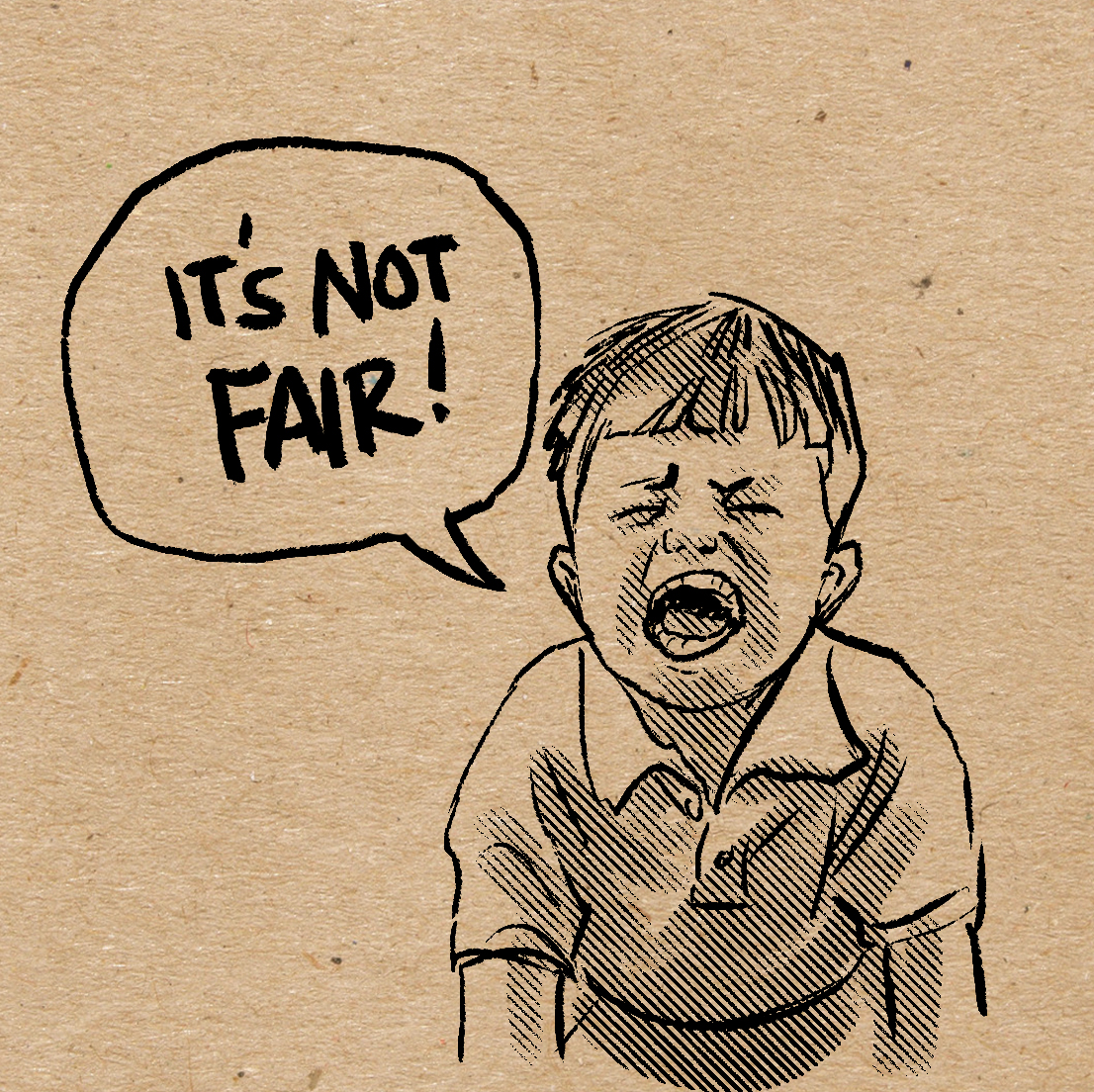
Do you have kids? Do you remember being a kid? When my kids were little, they had an innate sense of fairness that they would share with me at the moment they sensed some form of inequity. Usually expressed in the revolutionary cry of “it’s not FAIR”!

“I need you to do the dishes tonight Jessica.”

“It’s not FAIR! I did the dishes LAST time!”

This would then lead to a long and tedious (to the parent anyway) negotiation about balanced and impartial chore assignments, all of which would lead to me snapping back with “LIFE’S not fair!” That’s the response my parents taught me…and to my delight, I heard my youngest daughter speak those same words to her daughter not long ago. My work here is done.

The thing is, as we get older we become far more cynical about fairness. We encounter way too many situations where the game is rigged and we are helpless – but even then, in our most sardonic state, we still hold out hope that God is fair. Someone may put us at a disadvantage but we hold on to a hope that God knows and will one day vindicate us.

But what if God isn’t fair? Or more frightening, what if his idea of fairness is completely different from ours? What an existential kick in the head that would be!

That’s a concept we’ll delve into this Sunday as we continue our study in Romans, reading ch 9:14-23.

Paul begins right off posing that question. How do you understand his answer? It is very important to read Exodus 32-34 to really get the atmosphere Paul is trying to set this dilemma in. Did you read it? If so…what is the context of God’s statement that He will have mercy and compassion on whom he chooses? At the moment of Israel’s greatest disobedience, God expresses His own personal freedom to have mercy on anyone he chooses to, including the guilty. How does this help Paul work through his initial question?

Paul then uses Pharaoh as an example of God’s sovereign freedom to work through even those who resist his will to accomplish his will. Do you think this was meant to destroy Pharaoh? Is there anything in the text that indicates there was something permanent about Pharaoh’s hardened state of heart? To what end was all this happening? What is the goal of the whole Biblical narrative?

This is a very complex bit of writing by Paul – it will take some careful navigation, which we’ll attempt this Sunday! Hope to see you then!
Redeeming Love

Stories are an integral part of the human experience. They help us define and navigate this often confusing world we exist in. A good story is one where characters evolve as they maneuver through difficulties, struggles and pain. The action rises around the complications until it reaches the climax, then falls to the resolution. The most beloved stories of our present culture follow this arc – and they bring us a lot of joy.

God is a great story teller and our lives are intricately woven into a grand narrative he’s been unfolding through the ages. At least, that’s the way the Biblical narrative seems to set it out. God’s great story also has a resolution, a good ending which puts all of the struggles of the larger narrative in a different perspective.

That’s what Paul will be presenting to us in our passage in Romans this Sunday as we read Romans 8:18-39.

Most scholars put the whole of chapter 8 into a special category of inspirational text, but especially so with the last half of the chapter. Paul hits a high water mark with these words that really don’t get repeated anywhere else in the New Testament.

He begins by expounding on his previous statement about suffering (v17) – reminding us that present struggles won’t even register when weighed against the glory that will be revealed to us. What do you think he means by that statement, what do you understand that glory to be?

There are three participants in the “groaning” Paul describes. Who are they? Why are they groaning, what is anticipated? The third “groaner” (not a word, but I’m sticking with it) is remarkable to me (v26). What does His groaning tell us about God’s priorities and intent?

V28 is quite famous. What confidence are Christians meant to have about the events in our lives according to this verse? Do you read this as God being an architect of trouble, or an artist who can use anything to make something beautiful?

The last section of chapter 8 is so encouraging and beautiful, it hardly needs any commentary. Read it, then read it again. Read it in multiple translations. Linger on the words, play some cinematic orchestral music and read it out loud. What are those words saying to you? How do they effect your understanding of yourself in this difficult and struggle-filled life?

This Sunday, we’ll hear the Lion roar out His love to inspire unshakable HOPE. Can’t wait to see you there!

The Struggle is Real

Have you ever seen one of those experiments where they secretly record what happens when someone encounters a sign which says “wet paint, do not touch”? It’s pretty amazing to see how often people, and especially children, seem compelled to touch what has been forbidden. Come to think of it…have you ever encountered a sign that warns you not to touch or do something? What is the first thought that usually goes through our minds? “I could just do it quickly, what would it hurt?”  I realize there are some personality types that wouldn’t experience this particular temptation, but enough of us do that it becomes a familiar and relate-able trope.

Something in us seems to always feel an urge to go the wrong way, even when we know better.

This has been something that philosophers have puzzled over since philosophers became a thing. It’s also something that the Scriptures give a lot of attention to. Paul will have that as his major theme in the section we’ll be reading this Sunday as we continue our study in Romans. We’ll be reading ch 7:7-25.

Paul once again points out the impotence of the Mosaic Law to change the nature of our lives. Yet, he exonerates the law from any culpability for our condition. Once again he makes the point as to what the Law was able to do. What is it?

He then  launches into a beautifully honest expose of the human struggle to do what’s right, even when we know the right thing to do. What does Paul attribute this to in v 17 and 20? How do you understand his differentiation between “sin” and “I”?

All the way through, we have to keep the context in mind – Paul is asserting that the Law of Moses, or any other religious system of rules, is incapable of rescuing us from our plight.

What will rescue us, according to v25? How do you understand that to be true?

This is a fairly complex bit of Scripture we’ll be tackling this Sunday – but SO worth our time to digest! I hope you can make it!

Freedom

Bob Dylan
The Warfield Theater
San Francisco
November 1st, 1979

Rolling Stone Magazine

The new Bob Dylan tour began on a chilly Thursday evening at the Warfield Theater, a cozy 2200-seater in San Francisco’s Tenderloin district. Outside, grizzled panhandlers solicited; holdout hippies, whose cassette players blared “Gotta Serve Somebody,” tried to scavenge tickets; and dozens of porno theaters and sleazy topless joints advertised their wares in flickering neon. Inside, Dylan sang about salvation.

Regina Havis, one of his four backup singers, began the show with a sermonette on a mother’s faith. There were snide comments from the audience – “I went to church this morning,” “How about some sin?”

…Dylan looked much the same, in his dark jeans, leather jacket and white T-shirt, but he’s changed his way of thinking – that much, at least, is clear. The end of the concert was greeted with both applause and boos, but there were surprisingly few emotional outbursts. As the audience filed out quietly, they were confronted with the words “You’ve Gotta Serve Somebody,” writ large across the back of the illuminated marquee.

Well, ol’ Bobby didn’t get a great response to his album which declared his (then) new-found faith. But the title of his song “Gotta’ Serve Somebody” has found its way into countless sermons on the text we’re going to read this week in Romans…because it is stating exactly what Paul will be stating, just with more electric guitars.

We’ll be reading Romans 6:15-23 in our study. Paul is in a section where he is describing what this new life in Christ is like, and in this passage he uses the uncomfortable illustration of slavery. The slavery of the ancient Roman world was quite different and far less inhumane than the slavery that our country engaged in in oppressing Black people. I think its possible that Paul would have used a different illustration if he could have seen through a modern lense…but that makes it incumbent upon us to use an ancient one.

Either way, it’s still an uncomfortable metaphor because no matter how we understand it, slavery, declaring ownership and control over another human being is just wrong and certainly not part of God’s plan for life. So why this metaphor?

Paul seems to see slavery from the standpoint of submission – submitting to a governing influence over life. That’s how we need to understand it. Paul’s whole point drives home the dualism in Biblical thought – we will serve good or evil, there is no third alternative.

Do you have difficulty with the idea that the Bible does not see you as autonomous? In what way can we understand being free, yet also describe ourselves as slaves to God?

in v19 Paul seems to indicate that who we serve will determine what kind of life we’re living. How has serving God reshaped your life for the better? In what ways have you seen your life spiral when serving some indulgence of this broken world?

The whole thing gets summed up in v 22-23 – one trajectory is leading to death, the other to eternal life. What do you understand eternal life to be, and when do you think it begins? How can eternal life be lived in this present world? What effect would it have on your relationships and expectations in life if eternity were factored into everything?

Don’t forget – we have our normal services of 9am and 11am this Sunday – also a Baby Dedication in the second service! Hope to see you then!


The Family of Faith

This is an image I drew years ago to illustrate a point in one of my teachings. I did a Google image search for “Abraham and the stars”…and this popped up. I forgot that I had uploaded it to my blog. Funny thing…it also popped up on a LOT of other sites as well. Some had taken unfortunate liberties with the image and made the design extra cheesy. I’m not complaining – it was just a quick illustration I did and had honestly forgotten about it. What is really interesting to me though, is how it multiplied…sort of took on a new life of it’s own. It became something that illustrated many points, like the drawing itself was pointing to: Abraham the father of many gentile nations.

Sunday (bring an umbrella) we’ll be reading Romans 4:1-25, and Paul will be revisiting the story of Abraham.

As Paul begins his story of Abraham, he emphasizes how it was that Abraham was made right with God. What was his answer to that question – how was Abraham made right with God? How difficult is it for you to keep from measuring your spiritual value by your religious activity? What do you do to keep your faith in God and not your own good behavior?

Paul does talk about religious rituals such as circumcision, indicating that they are simply a symbol of something that has already been accomplished by faith in God’s grace. What other rituals or works do we sometimes require of others or ourselves before we afford them the status of accepted by God? How can we avoid this practice in our journey with Christ?

When Paul wraps it up, he recounts the sequences of Abraham believing God’s promise even though no evidence supported his hope. What was the promise to Abraham; what was he believing God would give to him? How does Paul’s final statements about the New Testament, largely gentile church provide the conclusion to Paul’s argument? In other words, how is it you and I, believing God the way Abraham did, reveal God’s faithfulness to keep his promise to Abraham? It’s almost a riddle…but we’ll spell it all out on Sunday!

Hope you can make it!

Religion on Trial

Back in the mid 90s I was completely obsessed with watching the OJ trials. I had never really seen the inner workings of a courtroom, apart from what one sees on TV shows like Perry Mason, where somebody finally cracks and gives a confession at the end of the episode. In the world of ancient Rome, civil trials were major source of entertainment. Most people in Rome would have been very familiar with trials argued by two skilled orators, also known as lawyers, that would play out before crowds cheering people. That’s very much like what Paul is setting up in the section that will be reading this Sunday in the book of Romans, as we read chapter 3 verses 1-20. In this scenario, Paul is putting religion on trial. The entire section goes down like a courtroom proceeding in ancient Rome. Paul will play the role of prosecutor, defense and judge as he provides his point, counterpoint and verdict.

In verses 1-8, Paul talks about the advantage that the Jewish people enjoyed as stewards of the revelation of God. What does that mean to you? When you think about trust funds in our modern world – who is the money in the trust for?  What would you think of someone who mishandled that trust? In what ways would that have related to Israel in the time that Jesus had arrived?

Verses 9-18 provides Paul’s conclusion to his story of the broken world, told in two parts. His conclusion is that no one has escaped the brokenness and bondage to sin and death. Why would he be driving that point home so emphatically?

In conclusion to the section that began in chapter 1, v19-20 announces the verdict. Paul reveals the actual nature of the law. What does Paul say the only function of the law or external religious codes is? If you sneak a peek ahead to the next several verses, what is the only means Paul sees leading to real heart transformation and righteousness?

Hope to see you this Sunday!

Perils of the Poser

Probably the most common complaint leveled at the church is that of hypocrisy. While that has always been the case, it nevertheless is something the Bible takes very seriously. Jesus reserved his harshest remarks for those who misrepresented God through religious hypocrisy. The word that is used in the Greek for hypocrisy means “play-acting”. Like an actor on a stage, a poser, playing a role of religious piety instead of allowing God to do the difficult and painful work of reshaping the inner-person.

That’s going to be the topic Paul deals with as we continue our study in the book of Romans. We’ll be reading chapter 2:17-29.

In V17-23 Paul describes how the mission and purpose of the people of Israel was described in various places in the Old Testament. This is who they saw themselves to be. Still, Paul levels some serious questions at them. He makes the statement in v23 “You’re so proud of knowing the law, but you dishonor God by breaking it.” The difference is vital. Have you ever seen food that looked really good on the outside, only to find it’s just a plastic display? Why is hypocrisy so serious that the warning is repeated so often in the Bible about it?

V24 drives home the imperative of this warning. How might people outside our faith blaspheme God because of hypocrisy?

In V29 Paul plainly declares that outward conformity to a code of conduct means nothing to God. What, instead, is God’s intent with our lives? How can we take steps to keep our focus on the only source of real change?

Hope to see you Sunday!

Broken Religion

Newsweek Magazine . 14 August 2006. Excerpt from interview with Billy Graham ~ A unifying theme of Graham’s new thinking now is humility. He is sure and certain of his faith in Jesus as the way to salvation, but when asked whether he believes heaven will be closed to good Jews, Muslims, Buddhists, Hindus or secular people, Graham says: “Those are decisions only the Lord will make. It would be foolish for me to speculate on who will be there and who won’t … I don’t want to speculate about all that. I believe the love of God is absolute. He said he gave his son for the whole world, and I think he loves everybody regardless of what label they have.”

You would think, when a man of Graham’s pedigree made a statement like that, people would lean forward and listen more closely. “This is something to think about…a perspective to contemplate and pray about.” That was, however, not the response.

If you were in the church at that time, you heard the howls of the defenders of the faith. He was labeled a heretic, a universalist and a false teacher. That response prompted my cartoon, posted above. We have curiously morphed from being people of the Good News to doctrinal police and moralists who think they impress God by what they condemn. I suppose the church has done this a lot throughout our long history. It’s something Paul addresses all the way back at the beginning of the church.

This Sunday we’ll be reading Romans 2:1-16 as we continue our study in that book.

When you read Paul’s warnings, what overall theme emerges to you? Do you think Paul is trying to say there is no right or wrong? What would you consider the best defense against adopting a moralist approach to our Christian faith?

The Broken World

This Sunday we’ll be continuing in our study of the book of Romans – a Story to Live From. We’ll be reading v18-32 of the first chapter.

Last week we finished up with Paul describing how God intends to make things right through Jesus Christ. The last half of the chapter is Paul backing up to explain how things have gone wrong. It’s a two part story, which will continue on through chapter 3 where the wonderful conclusion is described. But, before we get to the good ending, we have to navigate Paul’s description of this broken world

Let me warn you, this will not be the most comfortable section of Scripture to read. It’s going to require a lot of maturity on our parts, and a willingness to consider Paul’s words from several different angles. Join me in praying that God’s grace will guide us in exploring this passage – that we will find ways to be faithful to God’s word and be loving towards all people.


Powerfully Good News

“I wish I’d never heard of Christianity” my 15 year old daughter said one day.

“What? Why?” came my shocked response.

“Because then I wouldn’t know that I was breaking all the rules.”

Her answer stunned me. I had been a pastor for only a few years, but I saw myself as the great champion of grace. I was the “grace guy”, I spent most of my teaching time talking about how God’s grace saves us through faith, apart from works. How had my daughter come to the conclusion that Christianity was about keeping the rules?

I’ve come to realize that there is a learning curve to this message. For my daughter, living under my roof and therefore required to function within the scope of my convictions, her perception of Christianity was linked to my house rules. I did my best to explain the distinction, but it would be years before she caught my drift. That is the strange dichotomy that exists between salvation by grace through faith alone and the good works God created us for. The church has had an uneasy history of trying to manage that dance, often falling to one extreme or the other like a drunkard walking home.

For the Apostle Paul, it always came down to faith – but that faith was placed in something transformational.

We’re going to be reading Romans 1:8-17 as we continue our study in that book this Sunday.

The word “faith” is used several times in that section of Scripture. It’s important to understand the greater impact of that word. It is  pisitis in the Greek – and is translated a variety of ways. Trust, believe, faith, faithfulness. It is more than just an intellectual assent to a proposition, it means a truth embraced and then lived by.

That being the case, in v8, Paul says the Roman’s faith was talked about all over the world. What would have been on display that would cause people to notice their faith? How has your faith in Christ made a noticeable difference?

In V11, Paul wants to encourage their faith and have his own faith encouraged by them. What do you think that would look like? How can we apply that to our life in community with the church?

The most famous verses of this passage are v16-17, where Paul makes a grand statement concerning his boldness in representing the gospel. We’ll go into this in more depth on Sunday – but notice how Paul says that the Good News is the power of God for salvation. Not a message about that power. How do you understand his meaning? In what way can you imagine the story of Jesus’ death and resurrection being God’s present power? What does Paul say it takes to unleash that power in our lives?

This is a story to live from. It is God’s transformational power at work in this world. I get why Paul is so stoked about it! See you Sunday!