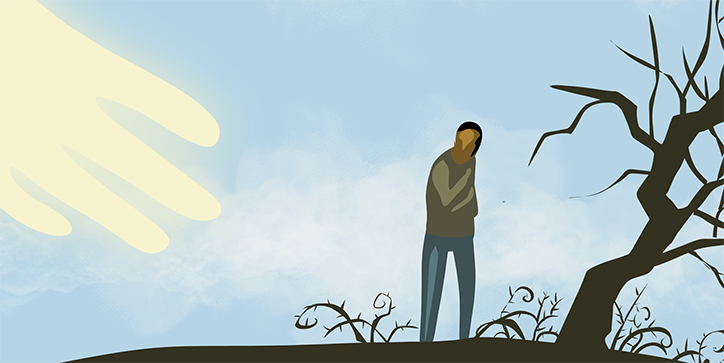
It’s Palm Sunday!

This Sunday and next we’ll be taking a break from our study in Genesis and we’ll turn our attention to Holy Week.

Palm Sunday is a day we remember Jesus’ triumphal entry into Jerusalem the week before he was crucified. We’re going to be looking at that event, and consider what the Gospel is communicating about what kind of King Jesus is. We’re in an election year, and I can’t think of a better time to re-orient ourselves about whose Kingdom claims our highest loyalty, and what characterizes citizens of that Kingdom.

After Palm Sunday, we’ll be observing Good Friday, and I’m working on a series of paintings that illustrate the day of Jesus’ sacrifice for us. It will be sort of like a Protestant’s version of The Stations of the Cross (narrowed down to six stations).

We’ll have them set with Scriptures and prayers that help us reflect on Christ’s sacrificial love for us. The worship band will be leading in songs, and we’ll culminate the evening with a live/interactive painting. I’m hoping you can join us for that!

Next Sunday will be Easter – with our annual Sunrise Service on the beach at Pineapple Willy’s restaurant starting at 6:15 AM – then a 10 AM service at the church building.

I hope you can join us for these events – and more importantly, I hope the meaning of this season fills your heart with hope!

The Ordering of Environments

We’ll be continuing our journey back to the beginning this Sunday, as we read Genesis 1:3-13.

Last week we looked at the start of the narrative in v2 – that while the story begins after there is already stuff – that stuff was chaotic and uninhabited…or formless and void. Over this chaotic stuff, the Spirit of God was circulating as the agent of this new creation in process.

As we read through the first three days of creation, we will have to puzzle through some things. In v3, God declares that there should be light – but what is the light that’s being described? The sun doesn’t get put in place until day four (v16). Notice the names God gives the light and dark – “day” and “night”. What clue might that give us as to what is being described here? Day and night are usually are markers for….what?

On the second day strange things happen…strange, at least, for us as 21st Century readers. What do you think is being described when the text speaks of “the waters of the heavens” and “the waters of the earth” – and where is the space between them? Don’t worry, we’ll be talking about this in detail on Sunday.

Day three gives a bonus creation at the end of it. Dry land emerges as God gathers the chaotic waters into a designated holding place. Then, as a bonus, trees and plants and seed bearing plants begin to emerge. This is likely a reference to the kinds of plants that are used agriculturally for crops that can feed larger numbers of living things.

Everything is set in place – lovingly and carefully. At the end of each act of creation, God sees something. What is it? What does that tell us about God’s attitude toward the creation he’s made? What do we begin to learn about the character of God as we read this account of his careful planning of environments for living things?

I hope you can join us this Sunday as we explore this amazing book!

Obstacles to Creation

This Sunday we’ll be continuing in our study of the first chapters of Genesis. John Walton shares an illustration that I find very helpful in changing my frame of view when it comes to deciphering the first book of the Bible. He imagines a person coming into a play that’s already begun, and when he sits down he asks the person next to him “How did it begin?” He’s not expecting the person to explain the process of playwriting or casting or how the set was built and from what materials – he wants to know what’s happening in the story.

That may be the issue with us when it comes to Genesis – the book is answering the question of how it began by explaining the setting and describing the characters. We, as modern Westerners, are puzzling over the stage construction.

There is a big difference between the meaning of the universe and the construction of the universe.

How difficult is it for you to try and read Genesis differently? Do you find your modern cosmology trying to take over as you read the text?

I don’t want to alarm you at the pace at which we’re going in this study, but this week we’re only going to get to verse 2 of Gen 1.

As you read over that verse, what would you describe as obstacles to creation that need to be removed? What is the condition of the earth? Read John 3:6-8. Do you see any connection with the imagery from Gen 1:2? Who seems to be the Agent of God’s creative power?

I’m looking forward to this bit of Scripture – I hope you can join us this Sunday as we explore it together!

Genesis – an Introduction

This Sunday we’ll begin a new series, tackling the first 3 or 4 chapters of the book of Genesis. Genesis has long been considered a dense forest to traverse, and certainly, during the 20th Century it has become a battleground between competing worldviews.

I’ve been really drawn to the chronicle of Biblical origins. I’m recognizing more and more how the Genesis story affects the entire narrative of the Scriptures. The threads of Genesis run straight to the Gospel and the New Testament and provide patterns that help us unlock what sometimes seem like obscure texts.

In Genesis we glimpse the Kingdom of God, and we recognize that our hope isn’t in something that’s never been, but in the return to something we’ve never known, but is how it all began. In Genesis we find out where we started from, and hence can more easily see where we’re going.

This Sunday we’ll begin our study with an introduction and a quick look at the first words of v 1.

If you’re interested in preparing for this exploration – sometime before Sunday, take the time to read chapter one of Genesis. It’s a short chapter – so take your time. Read it, if you can, in several different translations. Take note of words that get repeated (that’s one way to start identifying patterns). Jot down observations or thoughts you have about the text. It’s great stuff to meditate on.

I’m super excited about this study – I hope you can join us, Sunday morning at 10 AM.

Ash Wednesday 2024

So…I know tomorrow is Valentine’s Day, but I really can’t help the timing, it wasn’t up to me. Ten years ago we did an Ash Wednesday service at Eastgate, and I found it to be a very moving and spiritually nourishing experience. I said back then: “We need to do this more often”….but time gets away from us. So, this Wednesday we are re-visiting that ritual from long ago. Ten years ago I also wrote an explanation of the service, which I’m going to repost here, to help explain the purpose of this service.

I grew up in a decidedly non-liturgical home.  We were evangelicals, but my father was ordained in the Methodist church, so I’m a bit confused as to why we were so far removed from liturgies…but, such is the case for me.

[Tomorrow] is Ash Wednesday, the first day of Lent for most Western Christian churches who observe liturgical calendars.

I have never observed Lent in my whole life.  I honestly didn’t even know for sure what it was until a few years ago.  Lent, in case YOU don’t know either, is a period of forty days prior to Easter, where the Christian, in imitation of Christ’s forty day wilderness temptation, observes a time of penitence, fasting, charity and prayer.

People practice the denial of self in a great variety of ways during lent.  Some abstain from certain types of food…I have one friend who gave up deserts for forty days (and consequently lost a lot of weight).  It was very meaningful for him.  I had another friend who quit watching TV for forty days.

Having grown up completely outside the reaches of liturgical observances, recently I’ve become quite fascinated with them.  Several years ago, I began the practice of praying the “daily office”, from the Celtic Daily Prayers book.  It has had a profound effect on me.

Tomorrow is Ash Wednesday, and for the first time ever (second time) we will have a small Ash Wednesday service..

What is this about, you ask? Ash Wednesday is a practice that began in the middle ages – intended as a time for followers of Christ to prepare their hearts for Easter. The main thrust behind the imposing of ashes on a forehead is summed up in REMEMBER, REPENT, and RETURN.

REMEMBER – that we are mortal – from dust we were created and to the dust we return. Material wealth, plastic surgery, advances in science…none of these things can prevent our inevitable death. The ashes connect us with the reality of our finite, human condition.

REPENT – acknowledge that we don’t do this Christian thing very well, and commit our hearts to change. It does the heart a world of good to come clean with God and admit our struggles to him, and appeal for his help in our resolve to live the life he intended for us.

RETURN – the ashes are brushed on the forehead in the shape of the cross. We are mortal and destined for the dust – but the cross changes everything. The cross of Christ, the love of God in action is the only means by which we now have hope of everlasting life. The ashen cross on our forehead urges us to leave off our pursuits of lesser lovers and  return to the only source of life there is.

The meeting will be quiet and contemplative. We’ll begin at 6 PM with a brief explanation, then a worship song. After that, as Matt continues to play, we’ll invite people forward to have the ashes imposed on the forehead. We’ll be handing out a sheet with meditative prayers on it, covering the themes of remembrance, repentance and returning. As you wait for the ashes, you can meditate on and pray those prayers. Feel free to stay for the whole service, or leave after you receive the ashes, it’s entirely up to you.

“How long do I have to wear the ashes, Rob?” Again, that’s entirely up to you – what’s important is the state of our hearts, not what we have on our foreheads. This is just a time for a visceral, tangible reminder of who we are in Christ, and an opportunity to draw closer to Him as a community.

I hope you can join us, Wednesday the 14th, at 6PM.

The Mission Continues

I still remember one of the most often repeated phrases I heard after Hurricane Michael was: “I just can’t wait for things to get back to normal”. It was an understandable sentiment. Whenever we go through times and circumstances that push us out of our regular patterns in life, as when life is hard and confusing, we just want to get back to something familiar so we can try and reorient ourselves. It’s a typical response.

We’re going to be reading about Jesus’ disciples doing just that as come to the final chapter in our study of the Gospel of John this Sunday. We’ll be reading John 21:1-25. Peter and six other disciples don’t quite know what to do with themselves after all of the events that unfolded in Jesus’ execution and then mind-blowing resurrection. They probably had hoped that the skies would rain fire and Rome collapse in a blaze…but none of that stuff happened. Instead, life seemed to just go on and Jesus only seemed to pop in on them sporadically, and I’m sure it all felt really surreal. It makes sense to me that they wanted to get back to what they knew how to do, fishing.

However, now that Jesus is on the loose, things done under their own initiative seem to result in frustration (v3). Have you ever experienced that? Have you ever not known what God is up to and so in exasperation just decided to go back to old habits and patterns you had before meeting Christ? What were the results, and what can we learn from that?

Jesus’ interaction with Peter is, to me, one of the most moving scenes in all of the Gospels. What significance do you see in Jesus inviting Peter to confess his love for Jesus three times? How could this interaction provide a sense of closure to Peter? What can that tell us about our own failures and Jesus’ intent?

Jesus doesn’t just let Peter say words, he commissions him with a way of demonstrating his love for Christ. How does Jesus indicate a love for him is revealed? Is it something we can do in isolation, and if not, what does that tell us about our Christian priorities?

Jesus finishes his instruction to Peter by commanding him to follow. What does it mean to you to follow Jesus? What does it look like for a 21st Century American Christian?

I’ve really loved this gospel. We’ll have one more study after this Sunday where we wrap up all the themes we discovered. I hope it’s not the last time you visit this gospel…we barely scratched the surface of it. I truly hope you go there often, and go looking for Jesus in those words.

I hope you can join us this Sunday at 10 AM!

A Very Present Jesus

This Sunday we’re going to be reading John 20:19-31, which finishes up the chapter. This chapter brings us to the end of the Book of Glory, with only the epilogue (ch 21) remaining. In this chapter we’ll be reading about Jesus’ appearance to the rest of the disciples and to Thomas – and we’ll be considering the ramifications of the risen Christ in the midst of his followers.

Jesus shows up in the middle of a locked room. He is obviously present in a new kind of physicality, one that is not hindered by normal obstacles. Think about that locked door and the symbolism of it. What kind of doors do we lock in life…and how effective are they in keeping Jesus out?

The first thing out of Jesus’ mouth is the common greeting: Shalom. It means peace, wholeness, stability of life. John is using this event to convey the meaning of Christ’s presence, which is with us still – and how his presence brings with it wholeness and fullness of life. In what ways have you found stability, wholeness and well being in the presence of Christ?

Jesus commissions his followers to do the same thing he’d been doing. That would be unthinkable if he didn’t follow it up by giving the Holy Spirit to empower us for such a task. How can we start developing habits of following the Holy Spirit’s lead to do good and help the oppressed in this world?

V23 is a strange command. Whole ecclesiological frameworks have developed around the way people interpret what Jesus says here. There’s a conservative interpretation that I’m persuaded by (I’ll share it Sunday) – what do YOU think he’s saying?

The account of Thomas is awesome to me. I love that dude. Do you think Tommy was doubting Jesus, or the testimony of the other disciples? How did Jesus interact with Tom: rebuke, anger, irritation, compassion, care…? What was the first thing he said to him? Do you think that Jesus is angered by our questions or honest skepticism?  Do you believe that doubt and sincere searching is debilitating to faith, or can it actually encourage and enhance faith? How might Jesus’ interaction with Thomas inform your view?

I hope you can join us this Sunday, I think we’ll have a lot of good stuff to chew on!

A New Creation

The creation account in Genesis begins in the dark: “In the beginning God created the heavens and the earth. The earth was formless and empty, and darkness covered the deep waters. And the Spirit of God was hovering over the surface of the waters.”. God intervened and spoke light, order and life.

All of that went wrong when a man and a woman stood in a garden and rejected God’s rule. As a result, darkness, chaos and death again captivated the scene.

The gospel of John echoes a lot of those themes in his account of Jesus, and maybe none more so than in the section we’ve come to in our study of John. We’re going to be reading John 20:1-18 this Sunday, the account of Jesus’ resurrection from the dead.

The main purpose of John’s gospel, as he explained in chapter one, is to let us know that all that Jesus did and taught was revealing what God is like and what God is up to – and here in his resurrection we see it in full bloom: redemption; new creation….RESURRECTION!

As you read this account, put yourself in the place of Peter and the DWJL (the disciple whom Jesus loved) – how do you think you would have reacted to Mary’s news? What would you think was going on initially?

V9 says Pete and the DWJL returned to their own home (literally, to themselves). What ways do we turn back to ourselves when we go through dark and confusing times?

Mary was inconsolable. She was on task: find the corpse of Jesus and get it re-buried. She was so miserable and fixated on that problem that she didn’t even realize the solution to her dilemma was standing right in front of her. What can that tell us about how we perceive our troubles – how should resurrection and new creation affect our expectations?

Jesus and Mary are pictured standing in a garden – what does this harken back to? What is this image revealing to us about what has happened in Christ’s resurrection?

If I asked you who the first evangelist, ambassador, teacher and missionary of the gospel was…who would you say? I know who v 18 says it was.

This is the landing place that all of John’s gospel has been leading us to – I really hope you can join us this Sunday as we dig in and explore this passage together!

The New Normal

This Sunday we are going to continue our study in the book of John chapter 19 verses 31-42. These verses are exciting because the Old Testament has been laying bricks on a road that led to this very moment. John has been adding to that by continuing to pave the way with every story and detail he has included in the gospel. 

What we find in these verses is a continuation of John wasting no words or adding unnecessary information. There are so many connections to the Old Testament that are linked in this section of verses alone. There are several notes that mention different prophecies being fulfilled, but even beyond that we see a wide variety of stories coming to fulfillment.

In remembering that every word is included for a reason, what do we notice with the time of year that the crucifixion takes place? Do we see significance in that? What about the landscape of the area where the tomb is located? What Old Testament stories come to mind in reading the scenery that is mentioned? What about the fact that both blood and water flow out of Jesus when the spear is thrust into his side? What stories does Jesus mention about his blood? What times does Jesus mention offering water to people?

These should be the most depressing verses found in the Bible, but they’re not. Hope, fulfillment, a plan to make things right, and the inability to fail are written all over this story. We invite you to join us this Sunday at 10:00AM as we study these verses and find the hope that overflows from these words and into our hearts. 

It is Finished

I love it when I’m able to finish a project. I just recently finished up a book cover illustration for a friend of mine, and I experienced a great sense of satisfaction (as well as relief) that the artwork was acceptable. There is something wonderful about bringing a project or a mission to it’s proper close. That being said, I find it so hard to relate those feelings to what I read about when Jesus brings his project to a close, in the passage we’ll be reading this Sunday.

We’ll be reading John 19: 16-30 – it’s the account of Jesus’ crucifixion. It’s not pretty. It’s painful and hurtful and tugs at the heart. There is nothing about it on the surface that indicates victory or success, and yet, at the end of this section Jesus announces “it is finished”. It is an expression of accomplishment.

The question we’ll be asking is: WHAT was finished? Jesus doesn’t say, and neither does John, at least on the surface.

I know that the entire New Testament is fairly dedicated to answering that question, so it’s not as though we are left in the dark. But as far as THIS passage goes, I believe the seeds for the New Testament’s theological garden are planted in John’s account of Jesus’ death.

I’ll give you a hint, and let you parse it out yourself. John identifies the kind of branch they use to offer Jesus sour wine – it’s hyssop. What is significant about that, and how would John use that to interpret what is happening to Jesus?

Jesus tells John (the disciple whom Jesus loved) to look after his mother – to take her in as his own mother – changing the dynamic of their relationship there at the foot of the cross. What could that tell us about what Jesus accomplished on the cross?

Pilate put an inscription above Jesus’ cross which read “Jesus of Nazareth, the King of the Jews” – it was written in the three dominant languages of the known world. Pilate meant it as an insult, but what if God conscripted his mockery to make an announcement? How would this multinational/multicultural declaration of kingship help us interpret what Jesus finished on the cross?

There’s a lot for us to unpack in this text! I hope you’ll join us as we dig into it together!