This week is called Holy Week in most church traditions. The first Thursday after Palm Sunday is observed as Maundy Thursday. People sometimes tilt their heads in perplexity when they hear the title Maundy Thursday, because they think one’s trying to say “MONDAY Thursday”…which makes no sense. But it’s not Monday, it’s Maundy (mawn’-dee). Of course, that makes no sense either. What is a “maundy”? You know what’s really fun? It goes so far back that we don’t know precisely where that term originated or its precise meaning. Many scholars believe that this word came down to us after passing through Old English and Old French transliterations of the Latin word “mandatum”, which is the first word in the sentence: “Mandatum novum do vobis ut diligatis invicem sicut dilexi vos”
There. That clears it up.
Unless you don’t know Latin. The above phrase reads: “A new commandment I give unto you: That you love one another, as I have loved you, that you also love one another.” Jesus’ new commandment, or mandate – mandatum, given at the Passover Meal he ate with his disciples, and which he re-purposed for the New Covenant.
So, another way of naming this holy day could be Mandate Thursday – the day on which Jesus celebrated his final Passover and instituted the sacrament of communion and gave his great commandment – that we love one another.
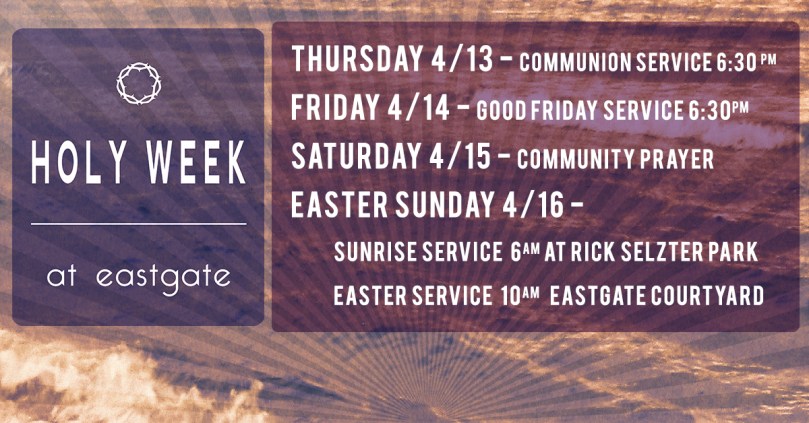
This Thursday at 6:30pm we’ll walk through the Passover with Jesus and his disciples – with our eyes, ears and taste buds. We want to be there in that upper room.
The Friday before Easter is called Good Friday – the day that commemorates Jesus’ arrest, trial and crucifixion. Some have questioned why we’d call it good Friday when so much bad happened. Remembering what was said last Sunday helps with this: “The disciples thought God was losing. They stood witnessing the greatest victory in history, and thought it was a loss. They saw the forgiveness of all humanity’s damning sins, and they wept and despaired because they had lost the plot, they confused a governmental victory for an eternal victory.” The historic events that took place that day were, indeed, horrifying. But the glory that resulted from his sacrifice makes this not just a GOOD Friday – but the greatest and the best Friday of all.
This Friday at 6:30pm we will have a Good Friday service of worship and a live art project with interactive elements which remind us of what Jesus has done for us in his death on the cross.
Saturday is traditionally a day of prayer and fasting in anticipation of Easter. We’re inviting everyone who’d like to, to join in to prayer and fasting (skipping a meal or two, or however God may direct you). I’ve written three prayers – morning, noon and evening – to help guide you in prayer if you need it. You can get them here: COMMUNITY PRAYERS 2017
Easter is the big day! N.T. Wright says in his book Surprised by Hope:
“[Easter] ought to be an eight-day festival, with champagne served after Morning Prayer or even before, with lots of alleluias and extra hymns and spectacular anthems. Is it any wonder people find it hard to believe in the resurrection of Jesus if we don’t throw our hats in the air? Is it any wonder we find it hard to live the resurrection if we don’t do it exuberantly in our liturgies? Is it any wonder the world doesn’t take much notice if Easter is celebrated as simple the one-day happy ending tacked onto forty days of fasting and gloom? It’s long overdue that we took a hard look at how we keep Easter in the Church, at home, in our personal lives, right through the system. And if it means rethinking some cherished habits, well, maybe it’s time to wake up. That always comes as a surprise.
…we should be taking steps to celebrate Easter in creative new ways: in art, literature, children’s games, poetry, music, dance, festivals, bells, special concerts, anything that comes to mind. This is our greatest festival. Take Christmas away, and in biblical terms you lose two chapters at the front of Matthew and Luke, nothing else. Take Easter away, and you don’t have a New Testament; you don’t have a Christianity; as Paul says, you are still in your sins. We shouldn’t allow the secular world, with its schedules and habits and para-religious events, its cute Easter bunnies, to blow us off course. This is our greatest day. We should put the flags out.”
At Eastgate, we “put the flags out”. We start with our sunrise service at 6am on the beach (at Seltzer Park). The Sunrise Service is the Protestant version of the Catholic and high church’s Easter Vigil. The Easter Vigil lasted all night until sunrise – but Protestants in the 1700’s seemed to prefer just waking up early to re-enact what happened on the day that Jesus rose from the dead. I kinda’ like that better too. To me, there’s nothing like gathering in the pre-dawn light, in that cool salt air, to joyfully announce, through prayers, songs and liturgies, that death ain’t what it used to be! Jesus is alive!
Then we bust loose at 10am in the courtyard in front of our Eastgate building. We just don’t want to be contained within four walls when we celebrate something of this magnitude! We want to to shout it out in the open, JESUS IS ALIVE, he’s making ALL THINGS NEW! We incorporate joyful music, kid’s performances, artwork, story telling, beach-balls, party poppers and bubbles into our celebratory worship! If you come, bring a lawn-chair or a blanket. Then we EAT! We have a potluck lunch – our meager imitation of that great wedding feast we anticipate, when our risen Savior brings heaven and earth together, forever.
I’m gettin’ pretty stoked just thinking about all this! Hope you are too!
He is RISEN!
He is RISEN INDEED!
 Do you like weddings? What is the craziest wedding you’ve ever attended or seen? It seems like every culture has a different approach to weddings and the rituals associated with them. This Sunday, as we continue our study in Matthew, we’ll be reading about the unusual wedding rituals of ancient Palestine as we study chapter 25:1-13.
 Hey all – this Sunday we’ll be reading
 Being not too far out from the old April 15th deadline I’m guessing we’ve all paid our taxes for the year, or at least made some sort of arrangement to. How do you feel about paying taxes? I’m thinking most of us don’t have too much heart ache about it being we’re a democracy and receive various benefits as a result..What if though, tomorrow Russia came in, forcibly took over our country and demanded we pay them tax as the reward for having stolen our land?