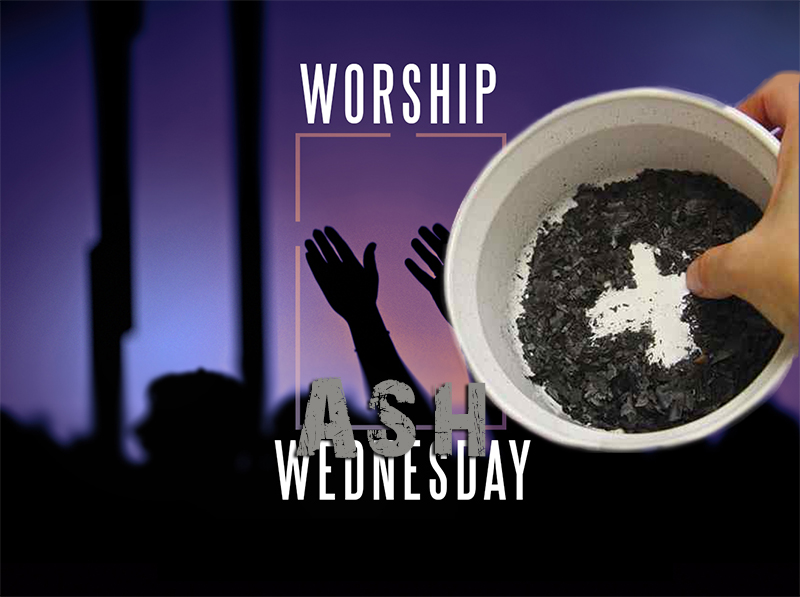
Ash Wednesday

ash wednesdayI grew up in a decidedly non-liturgical home.  We were evangelicals, but my father was ordained in the Methodist church, so I’m a bit confused as to why we were so far removed from liturgies…but, such is the case for me.

Today is Ash Wednesday, the first day of Lent for most Western Christian churches who observe liturgical calendars.

I have never observed Lent in my whole life.  I honestly didn’t even know for sure what it was until a few years ago.  Lent, in case YOU don’t know either, is a period of forty days prior to Easter, where the Christian, in imitation of Christ’s forty day wilderness temptation, observes a time of penitence, fasting, charity and prayer.

People practice the denial of self in a great variety of ways during lent.  Some abstain from certain types of food…I have one friend who gave up deserts for forty days (and consequently lost a lot of weight).  It was very meaningful for him.  I had another friend who quit watching TV for forty days.

Having grown up completely outside the reaches of liturgical observances, recently I’ve become quite fascinated with them.  Several years ago, I began the practice of praying the “daily office”, from the Celtic Daily Prayers book.  It has had a profound effect on me.

Today is Ash Wednesday, and for the first time ever we will have a small Ash Wednesday service during our Worship Wednesday meeting.

What is this about, you ask? Ash Wednesday is a practice that began in the middle ages – intended as a time for followers of Christ to prepare their hearts for Easter. The main thrust behind the imposing of ashes on a forehead is summed up in REMEMBER, REPENT, and RETURN.

REMEMBER – that we are mortal – from dust we were created and to the dust we return. Material wealth, plastic surgery, advances in science…none of these things can prevent our inevitable death. The ashes connect us with the reality of our finite, human condition.

REPENT – acknowledge that we don’t do this Christian thing very well, and commit our hearts to change. It does the heart a world of good to come clean with God and admit our struggles to him, and appeal for his help in our resolve to live the life he intended for us.

RETURN – the ashes are brushed on the forehead in the shape of the cross. We are mortal and destined for the dust – but the cross changes everything. The cross of Christ, the love of God in action is the only means by which we now have hope of everlasting life. The ashen cross on our forehead bids us to leave off our pursuits of lesser lovers and  return to the only source of life there is.

The ashes are supposed to be made of burned palm fronds left over from the previous year’s Palm Sunday service….which, as you know, we didn’t do. However…I did just trim all my palm trees whose fronds were dead from the freeze – so I’m burning those and bringing the ashes.

I think this could be a meaningful service for us. If you’ve never observed Lent – this might be the right launching point. Myself, I’m going to observe it through daily meditations. If you have the You Version Bible app for your phone or tablet, you should check out the daily reading plans they have for Lent. I’m going to use the “Lent for Everybody” by N.T. Wright – but there are others to choose from.

Hope you can make it tonight – and I pray that all of our hearts are more finely tuned to God’s redemption.

Some Only Heard Thunder

Have you ever heard an audible voice from heaven giving you direction? I never have – though I know people who have had that experience. I used to think that if I could just hear God shouting out of the clouds letting me know he was there that I would never doubt again.

We’re going to see from our passage this Sunday that its really not that simple. Well be reading John 12:27-43. This passage includes a supernatural event like I described above, but it certainly doesn’t have the result one would expect.

As we read this passage let’s consider the reactions of the people towards Jesus. I believe there are some pitfalls we can observe and try to sidestep in our own journey to discover more of God and his ways.

For one thing – there were three distinct reactions to the voice from heaven. One, of course, was John who obviously heard the voice of God clearly enough to record for us what the voice said. What were the other two reactions? What do you suppose made the difference in what people heard in that noise? I find it interesting that there is often so much ambiguity when we encounter the divine. I think if a person is determined to do so, he or she can always find a way to rationalize what others perceive as a supernatural event. God seems intent on moving in such a way that he’s easily hidden if someone doesn’t want to see him. I also think there’s a bit of heart-testing in that ambiguity. How open minded are you when it comes to God encounters?

The other thing that I notice in v34-36 is a doctrinal barrier. In v34, the people don’t actually say “the Law says“…what do they say instead? How would you explain their problem with Jesus and the law? How well do you know the doctrines that you hold to absolutely? What are your doctrinal convictions based on – what is written, or what you’ve learned? In what ways could God get obscured by our doctrines. How can we be faithful to our convictions and still be open minded?

Finally, the last verse of this section (v43) is very telling. How can loving the praise or glory that comes from men (that is, the validation and affirmation that we crave so deeply) end up interfering with our loyalty to God? What measures can we take to prevent that from happening in our own experiences?

Should be an interesting study – hope to see you then!

The Unlikely Route to Life

We’re going to be reading John 12:12-26 this Sunday.  The main theme that ties this section together is that Jesus seems to do and say the opposite of what we think he should. The section begins with v12-22, as Jesus comes into Jerusalem in what has been called his “triumphal entry”.

It’s a familiar scene to us, if we’ve been around the Bible at all, or at very least have seen movies about Jesus…but do we ever think about the particulars of this event? For instance, why are the people waving palm branches? There is some interesting information about palm branches found in this article – I encourage you to read it, and keep this passage in mind as you do.  If you read the article you realize what waving the palm branch would have meant, at least to the Romans guarding the city. What do you think their reaction would have been? Does that tell you why the religious leaders were concerned?

There is actually a great deal of historic background that goes along with this event – in the Maccabean Revolt which happened nearly 150 years before Jesus was born, the Jewish people routed the Greek (Seleucid) occupiers – and upon re-entering the city and temple, the people all waved palm branches in celebration of this victory over gentile oppression.

With that in mind…what do you think the people of Jerusalem were anticipating with Jesus coming to town?

How surprising then, when Jesus starts talking about dying in v24. That’s not normally how kings rise to power, is it? We certainly wouldn’t call Saddam Hussein a victor, would we? But Jesus is pointing us in a direction that is opposite to the flow of the patterns of this world. What appears to be the devastating power of Roman authority exercised in crucifying Jesus is actually it’s defeat – and the route to life for all who believe.

This would be true not only for him, but he broadens the application in v25-26, sweeping us into it’s scope. We will follow this route, and according to Jesus, find life; real, eternal life. But what will this look like when lived out? How do we disentangle ourselves from the tyranny of ego? It has to be more than just putting a landscape picture on our FB profile.

I propose it comes down to motive. What motivated Jesus to lay down his life in order to bring fruit into our lives? How can we emulate that same motive, and how will that differ from the patterns of this world’s system?

This will be a challenging study – so….take this advice from Samuel L. Jackson.

The Right Way to Worship

Have you ever been in a church setting that made you uncomfortable? I sure have. I’ve been in attendance when people were running through the aisles and also places where the sterility of the environment was stifling. If you’ve experienced anything like that, have you ever found yourself judging the people or system in which the experience took place?

This Sunday we’ll be examining John 12:1-11.

The scene that John describes is one that would have been awkward and uncomfortable in our culture to be sure, but in actuality it would have been weird in Jesus’ day too.  Back in Luke 10, Mary upset her sister Martha by defying ancient protocol when she sat out with the men to learn as a disciple while her sister conformed to the domestic expectations of the day. Here again, Mary behaves in a way that for some people viewing it, might have cast her in an unsavory light. Letting down her hair to wipe Jesus’ feet, pouring out an entire box of oil when just a dab would have done…these were actions that were out of sync with the expected norm, and it created a reaction.

How do you think you would have reacted to Mary’s behavior? Who reacted negatively to this action? What seems to be the most important issue for him? What seems to be important to Mary?

All of the different characters and all of their responses. Who do we relate to the most in this section? The Chief Priests react with their one-note response…they want to kill someone. Let’s hope you don’t relate to thatMary sacrificed a very expensive box of oil to pour out on Jesus. She also sacrificed her dignity and reputation. All because she wanted to demonstrate to Jesus her love for him. How much of Mary do you see in your approach to worship? How much of Judas?

This should prove to be a challenging study this week! Hope to see you there!


When Dreams Die

It’s the sad refrain of a broken world: “If only”. “If only he’d entered the freeway five minutes sooner…”, “If only I would have kept my mouth shut…”, “If only the lab results had shown it…”, ….. “If only God had heard my prayers…”.

We live in a world that is painful and confusing so often, and for people who want to seek after God, adding to that pain and confusion is the regular complaint that one prayer or another has gone unanswered. It’s very tempting to assume that God has forgotten, doesn’t care, or has no plan at all for us in the vast scheme of things. If you’ve ever felt that way, please know that you’re not alone. Every honest seeker of God will wrestle with this at some point in the journey.

We’re going to be reading a large portion of text this Sunday, John 11:1-44, which sheds a remarkable light on the subject of delayed answers in prayer.

The text plainly says that Jesus loved this family, yet it also says because Lazarus was sick, Jesus waited two more days to head to Bethany. Does that seem like the behavior of someone who loves someone else? His reasons for delay are somewhat disclosed in v15 – does this give us any clue as to why God sometimes allows our prayers to seem unanswered? How can we view an apparent silence from heaven differently in light of this?

When Jesus arrives both women confront him with “If only you’d have been here”. In answering Martha, Jesus makes his 5th statement of “I am”, calling himself the resurrection and the life. He was revealing that in some mysterious way, the future hope of God’s plan of redemption was reaching back to the present and infusing life with abundant possibilities, beyond what we can see (HT N.T. Wright). But this wasn’t just a theological exercise for Jesus – he isn’t portrayed as a dispassionate observer of human plight. V33, 35 and 38 make that abundantly clear. If Jesus is the fullest revelation of God and God’s heart toward the human race – what do these verses tell us about him? Even in what looks like an unanswered prayer, even in the midst of broken dreams, what can we discern about God?

When Jesus wants the stone rolled away, pragmatic Martha resists. The whole thing stinks too much. She seems to want to forget and move on. Jesus does not. The stone over the tomb is the ultimate emblem of resignation. It’s too far gone, there is no more hope. Jesus says, “Take that away, I’m not done here.”

What happens next is one of those too good to be true moments. It forecasts what Jesus himself will soon experience and the hope of Easter morning. But it serves also as a parable for us. What are the bleak situations or dreams that have died which we’ve rolled a stone of resignation over? Even though Jesus didn’t respond when we wanted him to, and things don’t look the way we expected them to…can we allow for the possibilities of him bringing new life in ways we never thought of? Have you experienced this already? Have you faced some pain and seeming disinterest from heaven, only to find that God has revealed some new and unexpected life in ways you hadn’t anticipated? What lessons about God, his patterns and his heart toward us can we learn from this text?

Hope to see you on Sunday!

Divinely Jesus

This Sunday we’ll be examining John 10:22-42.

John provides the setting for this section, informing us that it was winter and during the Feast of Dedication. That means its a good three months after the last time frame we were given, the Feast of Tabernacles. John, remember, isn’t as interested in a chronological account as much as he is in grouping things thematically. This particular holiday provides a symbolic backdrop for the drama to unfold before. The Feast of Dedication is known today as Hanukkah. You can read about the history of this festival HERE.

In this section, Jesus makes the most perspicuous statement about his identity and nature that we’ll find in all the gospels. In v 31, Jesus claims to share a unity with God the Father – which is difficult to read as anything but a self-identification of divinity.

The embrace of Jesus as deity is what ties us to historic Christianity and orthodoxy – but its more than that. If Jesus weren’t divine, then all of the ways he describes his relationship to his sheep would become meaningless outside of his immediate time-frame. He could know and lead his sheep that were with him 2,000 years ago – but if he was just an ordinary human then we in the present have no shepherd. We would merely be followers of an ancient ideal – an impersonal history.

However, with the embrace of Jesus as God (not understanding it, mind you, but embracing it), all of his descriptions of his interaction with his sheep are in full effect in the present tense.

As you read this section, look at how he describes his relationship to his sheep. What does he promise to provide? Could he provide this to us if he were simply a good man, or even a prophet? What promise encourages you the most in this section?

The religious leaders understood what Jesus was saying in v31 and react accordingly. In response to an immediate threat, Jesus quotes Psalm 82:6 . John Piper believes that this was a deflection on Jesus’ part – meant to show that there is Scriptural precedent for identifying oneself with God.  N.T. Wright, on the other hand, believes Jesus meant this as a contrast – that the judges of Israel were given the task of rightly representing God’s ways on the earth (hence they are called “gods”), but failed to do so. Jesus, however, has done so perfectly and has every right to claim the place of being united with God’s divinity. He sees it as Jesus pointing out their hypocrisy and failure to see how God was dedicating a new temple right under their noses.

Again the leaders want to arrest him, but as they encircle him and lunge for him, he’s gone and they end up grabbing each other (at least, that’s the way a cartoonist imagines it). Kevin Barron points out that Solomon’s colonnade was on the eastern side of the temple mount, so he may have slipped out through there and escaped the clutches of religion through the….East….gate.  heh.

As it relates to the deity of Jesus, what do their attempts to stop Jesus and his message amount to? If Jesus is God, what can stop him or his message today?

It’s an interesting passage and should prove to be a compelling study. Hope to see you on Sunday!

Follow the Shepherd

WORK: BIBLE ARCHAEOLOGY: young boy shepherd with flock

This Sunday we’ll read another set of Jesus’ statements of “I Am” – in this case, “I Am the door” and “I am the Good Shepherd”. We’ll be reading John 10:1-21 where Jesus gives a discourse that provides a contrast to the corrupted religious system that had just rejected the formerly blind man, and Messiah who went to find him.

The story is the closest thing to a parable that we find in John’s gospel, and it uses imagery that would have been familiar to the first hearers but which is almost totally foreign to us.

He describes a practice of shepherding where there appeared to be a common sheep pen used by multiple shepherds. This pen would likely be a circular stone walled enclosure with one gap which would be guarded to ensure the security of the sheep. The shepherds would be known by the gatekeeper, and their sheep would follow them by the sound of their unique call, or whistle, or a tune played on a flute.

This good and proper practice is contrasted with sheep rustlers who sneak over the fence to steal sheep – forcing them to go with them.

Then Jesus changes the metaphor, where HE is a door for the sheep. This still stays within the shepherd mold as well. Shepherds would sometimes sleep in the gap of the enclosure, as the first line of defense against robbers or predators that might threaten the sheep. He would literally become a door to the pen.

He talks about motives – the motives of hired hands and the motives of a good and true shepherd.

All of this is meant to contrast the values and purpose of the kingdom of God over against a religious system. As you read this description by Jesus,what are the main characteristics of his relationship to his followers? In what ways can a religious system manifest the characteristics of the robbers Jesus described?

Jesus seems to be trying to encourage people like the formerly blind man that religion may reject them, but it doesn’t really matter. Following Jesus is where real life is found. But this begs the question…how do we KNOW we’re following Jesus and not a religious system? How can we discern what or who we’re following by the clues Jesus gives us in this story?

This is an important issue to consider. I’m looking forward to digging into this on Sunday – hope to see you there!

Blinded by Religion

Imagine a beautiful day at the beach, the sand is white and the water is emerald. There are people all over the beach, playing Frisbee and sunning themselves, but nobody is in the water. There’s a lifeguard tower, but next to it is a big sign that reads “NO SWIMMING”. Suddenly, there is the sound of someone crying for help out in the water. The lifeguard stands up and picks up a megaphone and shouts through it “This is your fault, you didn’t obey the sign!” and sits back down.

Abruptly, a person moves through the crowd and dives into the water without hesitation, rescuing the drowning person and bringing him back onto the beach where they both collapse and greedily take big gulps of air. The lifeguard and beach-goers crowd around, but no one celebrates the rescue or calls the man a hero.

The Lifeguard steps forward and says to the rescuer, “How dare you break the rules! Can’t you read the sign? No swimming is allowed! Now get off this beach and never come back!”

Absurd, right? But that is the same sort of thing that happens in our text for this Sunday, John 9:13-41.

This is honestly an entertaining passage – it reads like a Shakespearean comedy. There is witty dialogue, imbecilic folly, but also pathos and drama. It’s a great story with a powerful message.

As we read this passage, it’s easy to identify with the man healed from blindness. It’s the oft repeated theme of the powerful oppressing the weak, and it reveals the absurdity of obsessive rule-keeping. But as members of the church in 21st century America, we need to recognize in the folly of the religious leaders a cautionary tale about the symptoms of religious blindness.

In v14 we find out why the healing of this man is controversial at all – it took place on the Sabbath. No work was to be done on the Sabbath day – and according to the Talmud, kneading was a forbidden work – something Jesus did when squishing his spit together with dirt to make a paste of mud. An activity that required the use of three fingers stirred up a tempest that ended with one man being excommunicated from the hub of Jewish society, the synagogue.

We could wag our heads at these religious leaders and wonder how they could be so blind…but as the modern church, do we have similar blind spots? Can you think of any examples where the rules of what we might consider righteousness have become more important than people? Have you ever witnessed the church pushing the requirements of holiness at the expense of people?

As you think about it, why did John include this story in the good news about Jesus? What do you think his purpose is; what is he trying to reveal about the religious order of that day contrasted with the plan of God as it unfolded through Jesus?

How can we keep ourselves from succumbing to religious blindness? How would you rewrite the Pharisee’s story if they were truly able to see?

Can’t wait to cover this one…hope to see you Sunday!

Family Traits


Is there anyone in your family that you resemble? It’s interesting to me as I observe my family that we all carry certain traits that are easily discernible and identify us as belonging to each other.

In the passage we’ll be reading this Sunday Jesus will be discussing family traits, though not biological or genetic ones. We’ll be tackling John 8:31-59, the last installation of a very long conversation/argument that Jesus has with the leaders and the crowds while in Jerusalem.

As the discussion opens, what does Jesus point to as our source of true freedom? How does that compare to what most people think freedom is? The Israelites were outraged that Jesus would infer that they weren’t already free people (which is odd, considering that there were probably Roman soldiers standing guard over this increasingly hostile crowd). They considered themselves part of the covenant people simply because they had the right last name and were part of the Jewish race. Yet Jesus equates freedom from sin with adoption into a family – we are freed from our bondage to a broken self will and elevated to the status of family members with God. In other words – being born as a descendant of the people of promise doesn’t automatically make a person part of the family – one must commit one’s self to Christ. How does this play out in our present day church environment? How can people make the mistake of thinking they are right with God when possibly they are not?

Jesus then makes a sharp delineation between families – indicating that those who are rejecting him and his teaching are showing off the family resemblance – only they’re revealing they’re part of the wrong family. How we respond to Jesus reveals our family traits. How will our lives reflect our response to Jesus?

In the last section, Jesus makes the profound statement “Before Abraham was, I AM.” – equating himself with God and inspiring the crowd to want to stone him on the spot. It’s an awesome thought to me that Abraham looked down the corridors of history in anticipation of Christ’s day and rejoiced…it reminds me that being part of a family with God has always been his design. God wants family, not drones of religion. How can we be inspired to live in a way that shows off the family resemblance? Consider what ways we can reflect God’s character in our lives as we begin a new year.

Hope to see you Sunday!

The Contrasts of Christmas

Hey all – it’s the Sunday before Christmas, so we’ll be taking a break from our study in John, and we’ll be reading the Christmas story from Luke 2:1-20. In contrast to all the ways the broken world around us understands who’s important, who’s accepted and what meaning there is in life, the Christmas story reveals the improbable way God goes about unfolding his plans…and the unlikely people he uses.

Hope to see you there  – and,

Christmas 2013