
How to Make God Laugh

Have you ever been on the beach when the morning mist is still thick and wet in the air? It seems so dense and impressive, muting colors and dampening sounds. Yet, give it until about 9:30 or 10 o’clock in the morning and the mist that was so present simply dissolves in the heat of the sun. That is the picture James paints for us to describe the temporal nature of life in the passage we’ll be reading this Sunday – James 4:13-17.

As you read these verses, do you think that James is anti-planning, or against establishing a for profit business? What can we understand his point to be about making plans?

Have you ever had great expectations about something you wanted to accomplish or experience, only to have it all fall through? What did you feel in those moments? How does Jame’s counsel help us to respond well to times of frustrated planning?

V17 almost seems out of place, until you put it in the context of the warning that life is short and planning in light of God’s purposes is vital. In light of how short life is, what is the message of v17 to you?

James pulls no punches, but that’s ok, nobody said maturity would come easily.  Looking forward to exploring this with you on Sunday…hope to see you then!

God’s Plan for Conflict Resolution

Fighting and conflict just seem to go with the territory of human interaction, don’t they?  If you think about times in your life when things aren’t going your way or you don’t get what you want – what is your reflexive response to that? If there is another person involved in the frustration of your desires, how do you normally react to him or her? In my experiences, conflict of some kind is sure to follow such circumstances.

This Sunday as we read James 4:1-12, we will explore God’s plan for conflict resolution.

As you read the first 3 verses, what does James indicate as the source of interpersonal conflict? Does that sync with your own experiences?

Growing up in church culture I had continually  heard James’ warning about “friendship with the world” as an admonition about the music I listen to or the TV shows I watch or the clothes I wear, but that really doesn’t seem to fit the context, does it? Given the context of fighting and quarreling, what do you understand “friendship with the world” to mean?

I find it really interesting that the motive James points to for correcting our approach to conflict is all relational. Marriage, friendship and a Creator who is jealous over our lives provide a much deeper motivation than a  code of conduct with the threat of punishment. Have you ever had a friend who suddenly started treating you like an enemy? How did you feel – and does that help you understand God’s perspective when our choices defy his will?

James finishes off the section by giving some solid direction for how we can approach relational conflicts differently. How would you summarize his basic solution in v7-10? Can you see a way that following this pattern would resolve a conflict between people – how would that work?

V11-12 remind me of a quote from Joseph of the Desert Fathers:  “If you want to find tranquility wherever you are, then, whatever you’re doing, say, ‘Me? Who am I anyway?’ and judge no one.” Can you imagine a life like that, and does it sound tranquil to you? What steps can we take to realize these truths in our lives?

Looking forward to exploring this on Sunday – hope to see you there!

The Right Kind Of Wisdom

“A good example is the best sermon.”

This quote from Ben Franklins’ “Poor Richards Almanac”, could well have been inspired by reading the book of James.

This Sunday we’ll be reading James 3:13-18  where the theme begun in chapter two continues, but now James zeroes in on the topic of wisdom.

As with faith, James tells us that true wisdom is functional.  It must have a practical demonstration in the lives of those who embrace it.

As you read this passage, what essential trait does James describe for wisdom that comes from God?

How does James describe wisdom that lacks that essential trait?

If you use v 17-18 as a guide, how would you describe wisdom as James sees it?

Read 1 Cor 13 – what, if any, correlation do you see between what Paul says and what James says in our passage?

Looking forward to exploring this further with you on Sunday!

Lashing the Tongue

Like trying to put toothpaste back in the tube after squeezing it out, words are things we wish we could take back sometimes, but can’t.  I remember once back when I was a teenager and I worked as a stock clerk in a department store. We had a manager there that nobody liked, and behind his back he was the target of some of our cruelest comments. I remember one time so vividly, where I was in the break room imitating him, and then finished off with the snarky comment “I want to be just like him when I grow up.”.  It was sarcastic and mean spirited and it got a great laugh from everyone in the room.

Later that day the manager I was lampooning asked me to do something, and just as I was leaving he said “I hope I’m not like you when I grow up.”.  My blood froze. I didn’t turn around to look at him or acknowledge what he said, but just the way he said it I knew someone hadn’t ratted me out; he had heard my remarks himself. Most likely he was outside the break room and heard me…heard the laughter as well.  That moment has had a lasting impression on me – and I wish I could say that it changed my speech habits from then on. It didn’t. I’ve had plenty of words to regret since then…but that’s not going to stop me from a determination to control my words in a way that cooperates with what God is up to.

Language is such a powerful gift that God has given us, and James puts the focus on our speech habits in the passage we’ll be reading this Sunday, James 3:1-012.

Why do you think James gives this warning to teachers just before he challenges us on how we communicate with each other?

Like most of James’ writing, it needs very little explanation (I’ve been wondering lately if the best way to teach James would be to read the passage out loud, then sit in silence for about 10 minutes and let everyone absorb it).  What ways have you experienced the destructive power of words? How have you felt when words were used against you? How have you felt when you realized your words were the problem?

V9-12 are very interesting to me. I’ve often had this presented to me as “if your words are rotten, your heart is rotten too!”. But I’m not exactly sure that’s what James is saying. He’s using pictures of contradiction. How can lemons be growing on apple tree? The New Testament picture of a believer’s heart is one of redemption. If any man is in Christ he’s a new creation, the old stuff is gone, all things are new.  If we consider that salvation and redemption mean our inner person has been renewed, even though we have to struggle with old habits and patterns from our old lives – does that effect how we read v9-12?  I’d be interested in hearing your thoughts.

This is a challenging section of Scripture….be prepared to wrestle this Sunday!  Also, it’s Surf-N-Grill time again! If you haven’t been baptized and want to make that commitment this Sunday, come see me between 1st and 2nd service in the coffee house and let’s talk about it!

A Functional Faith

In the section of James we’ll be reading this Sunday we’ll encounter what is the most famous quote from the entire work: “Faith without works is dead.”

Martin Luther wrote in his introduction of James concerning this section, ““This defect proves that the epistle is not of apostolic provenance.”. For him, what James says concerning justification was irreconcilable with what Paul wrote. When James says “we are justified by works and not by faith alone”, Luther in essence shouts “Sole Fide…by faith alone!”

After thinking about this whole thing for about 500 years, most reasonable Biblical scholars have calmed down a bit and have realized that James and Paul weren’t arm-wrestling for soteriological dominance…they appear to be making points from two different sides of an issue. One points toward justification, explaining how it is NOT determined, the other points from justification, explaining how it is DEMONSTRATED.

I was talking with my friend Dennis the other day about the amazing designs he does for advanced scuba technologies, and I pondered that for all of his incredible ideas, none of them are real until a diver puts one on and uses it.  Up until that point, it’s theory.  It can be an awesome breakthrough idea that will change diving forever…but until someone is using it, its just an idea. Get the correlation there?

Based on v19 we realize that faith isn’t just having an orthodox doctrine or a strong emotional response to truth since demons have those things as well. What DOES a Jesus shaped faith look like in James’ description of it? Look at the examples he uses and consider how those examples translate to your own life.

I find James’ words really challenging, do you? I have to start looking at my life and wondering about my priorities. I contemplate my plans and dreams and consider who is at the center of them in the long range. From the place where we are right now…how can we be more active in demonstrating our faith in Christ?

It’s also important to  find that balance between being confident in Christ’s sacrifice for salvation, and being convicted to move forward into maturity.  It may be helpful to think about salvation and justification less judicially and more relationally.  If a husband or wife considers the marriage licence to be the most important bond between them, they may be tempted to think through the bare essentials of what they must and must not do in order to keep that contract intact. But if they understand that marriage is a life lived for their partner, they will always strive to please the one they love. The contract is not the motive of lovers.

Anyway, it’s stuff to excogitate on until we explore it on Sunday.

An Impartial Love

StephenBaldwin.jpgHave you ever noticed how the church falls all over itslef to cozy up to some celebrity who merely mentions that “Jesus seems okay”?  We have a strange duality in our response to Hollywood. On one hand we blame them for every evil known to man and for the intentional corruption of our youth. On the other, there are few things we get more excited about than the revelation that one of these famous “insiders” is allied with our cause.
This is nothing new. It’s gone on since the days of Augustine when the famous philosopher Victorinus publicly converted to Christianity and the church in Rome got the vapors they were so stoked.  The obvious reason for our celebration over celebrities is the great amount of influence and credibility we imagine that they will add to Jesus’ gospel! After all, that’s what Jesus did – he scoured the cities buttering up and winning over the most influential people he could find to provide a sense of legitimacy to his movement……oh wait.  Sorry, I was thinking of someone else, a politician maybe.

A rich man, a type of celebrity did come to Jesus asking to follow him once. Jesus didn’t seem impressed.

This Sunday we’ll be reading James 2:1-13.

Once again, James’ words need very little explanation. The point is clear: Don’t show favoritism towards one person because of what they may have to offer and dishonor someone else who has less. Love impartially.  Nobody is better than anybody else because the same mercy covers us all.  Pretty straightforward.

But historically, we’ve seemed to have a hard time getting that right. Our emphasis at Eastgate on casual meeting style sort of diminishes the tendency to parade our bling on Sunday mornings. It would be difficult to discern a difference between the median and the rich in our gathering.  As a leader, I have no clue what anyone may give to the offerings so that avenue for knowing a person’s economic status is hidden from me and negating any influence it may have.  That doesn’t mean we are immune from showing favoritism.

Considering our present culture, and even our church culture at Eastgate, what are some ways we could fall into the trap of showing favoritism?  Who might we be tempted to prize and who might we be tempted to disregard?  If we consider what James is saying to us, how can we keep this from happening in our community gatherings?

Good stuff to ruminate on. See you Sunday!

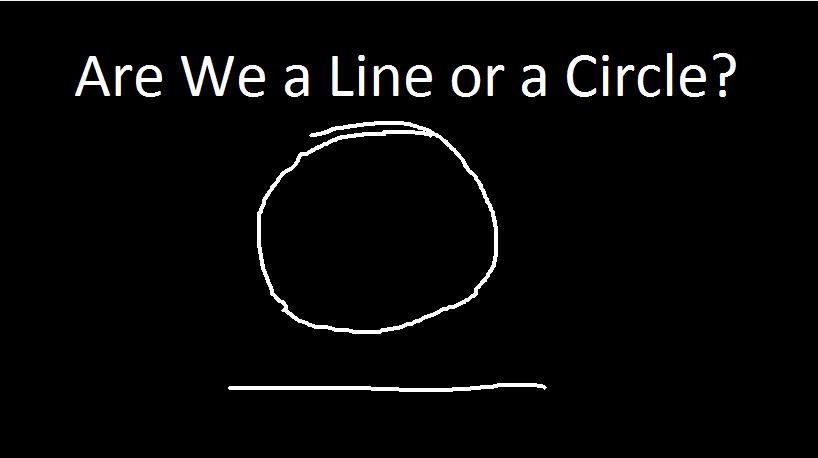
Are We a Line or a Circle?


“Let the children come to me. Don’t stop them! For the Kingdom of God belongs to those who are like these children” -Jesus (Luke 18:16 NLT)

Family gatherings often have their best moments of connection and reconnection at the dinner table. When there are too many people and not enough chairs the standard operating procedure seems to be to create a kid’s table. This way the adults can have their own conversations unhindered. Besides, the kids usually want to be on their own anyways! Inevitably, this leads to two different tables with two different experiences.

Sounds like the church, doesn’t it? We tend to have adult church and kid’s classes. The result tends to be kids that graduate from high school without knowing the church. Research continues to show that the more integrated a child is in the adult church, the better likelihood he or she has of maintaining that status once graduated. Essentially, research says that while it is still appropriate and necessary to have youth meetings, real and full community must cross age demographics.

Real, full community isn’t just acknowledging that children come to Eastgate, rather it means investing time and effort into their lives. It means inviting them into your circle rather than just sitting shoulder-to-shoulder in rows and lines on Sunday mornings. Real, full community isn’t passive, rather it is actively and intentionally seeking out ways to participate in the lives of each other-including children.

Youth are scary. It is totally okay to admit that. They dress funny, they walk funny, and they listen to funny music. They smell weird, they talk weird, and they act strangely. We can feel ill-prepared or ill-suited to be in their lives. But, as followers of Jesus, it is our responsibility to be in their lives. Their lives may even be dependent upon it.

Wednesday we will take a look at why we should do this and how we can do this. We will examine the difference between community in a line and community in a circle. Hopefully, we will be a church family willing to invite the kids over to our table and to our experiences. And hopefully we will be better equipped and more confident to respond to God’s call for us to neighbors and siblings to the demographic most often avoided.

Kids, parents, grandparents, childless friends, and all will hopefully leave with a more full view of community and a more pragmatic take on creatively living within the construct of this community.

Looking forward to conversing with you all about this!

Cole

Just Do It

This Sunday we’ll be looking at James 1:22-27.

When we left off last time, James made the statement that the word implanted in us was saving our souls. It seems as though this next section is a qualifier on that statement – a sort of means for testing the veracity of that claim.  How is the word saving, redeeming our lives and identities?  James is quick to let us know that the only way that redeeming agent of the word is active is when we are active in living out what it says.  This is challenging.  Martin Luther rejected this epistle because it sounded to him as though James were contradicting Paul about salvation by faith alone, apart from works.

But is that really what James is saying? Is he really trying to say that we are saved by DOING something? My contention is that he’s not saying that, but rather, he’s trying to keep us from falling into the trap of drifting along on the currents of this broken world and assuming that because we’re associated with God’s word we are experiencing redemption.  Remember, salvation and redemption are not just aspects of some heavenly destination at the end of life, they are meant to be characteristics of our present journey.  God is redeeming ruined things, making beautiful things out of broken ones.  Our challenge is to live in harmony with that ongoing redemption.  That is what I believe James to be saying.

As you consider this passage, what are some ways that we can hear the word without really doing what it says?  I’ve known some very zealous believers who had their theology down to a tee, but who didn’t really embody what this word says.

How do you think the word of God is like a mirror? When he talks about “religion“, the word he’s using in the Greek connotes “worship practices”.  How does James seem to describe acceptable worship in this passage – and how does it compare with your worship practices?

If you were to sum up what James is getting at, how would you word it in one sentence?

Heavy stuff, I know.

The Quick and Slow Road to the Good Life

Ever get angry? I’m writing this for humans to read, so I’m going to assume your answer is an affirmative.

Ever get angry and react badly towards the people around you – ever say things rashly that hurt others and made circumstances that much worse?  Again, humans, so I’m assuming, yes.

In the wake of those kinds of outbursts, when feelings are hurt and tensions are high, how does life feel? I mean, does it feel like the good life to you when misunderstandings are ruining relationships and you and others around you are reeling in pain?  Speaking for myself, I don’t characterize those as “good times”.

It appears God has something else in mind for our lives. It will require discipline and a willingness to be humble – but it sounds like a good life to me.  James gives us some practical steps for our journey toward the good life in God in the passage we’ll be reading this Sunday, James 1:19-21.

It’s just a few short verses in which James does not over-elaborate.  “Listen up, shut up and calm down.” If Paul were writing this it would have taken three chapters.

Is it easy or hard for you to really listen to someone else, or gather all the facts before responding? Are you more prone to reacting from your emotions or is it easy for you to keep your cool? When you have been successful in listening in order to understand, have you found it made a difference in how things turned out?

V20 is profound to me. I feel like I need a tattoo of that somewhere on me…maybe my forehead. What do you believe James is saying in that verse?

V21 – how do you think the “implanted word” is “saving your soul”?

Just a few short verses that contain a lifetime of instructions for living.  Should be fun to explore on Sunday.  Hope to see you then!


Resisting Temptation

How easy is it for you to “just say no”?  I’ve been a follower of Christ for several years and I can say that there are areas of my life that have radically changed – but I can also say, very honestly, that I have never stopped being tempted to fall back into old patterns.  I can also say, very honestly, that resisting temptation has never come easily nor have I always been successful. That’s just the reality of it.  From my experience so far, temptations to sin never cease to show up and it is always a challenge to resist them.

James will address this issue in our study of his letter this Sunday. We’ll be reading James 1:13-18.

Verses 13-15 paint a vivid picture, don’t they? Right off the bat, he tells us in no uncertain terms who bears the responsibility of our choices. Who is it that he points to? As you read this, is there anyone missing in his explanation of how temptation and sin develops in our lives?  Does that provide any information about why the responsibility of our choices rests where it does?

The process of desire conceiving sin and sin growing into death is a fairly unsettling image. I suppose he’s trying to make his point as emphatically as he can. I don’t believe we should read this as an intimation that if a Christian slips or commits willful sin that he or she has lost salvation, or is in any way facing physical death for it. Instead, I see him as trying to make as clear a picture about the nature of the sin we’re tempted to play with as he can.  In essence he’s posing the dilemma: “Why would you cooperate with what is trying to kill you?”  In the midst of being tempted to choose an action, attitude or thought that is not in sync with God’s character…how hard or easy is it for you to associate that with death?  Do you see that as something that would be helpful?

I absolutely LOVE verses 16-18.  After Jimmy sets up this fairly bleak picture of death, and we innately feel our own sense of weakness in this scenario, suddenly there is light streaming from above us and the Hero arrives on the scene.  Have you ever struggled with the idea that God is upset, or at least irritated with you because you still struggle with some temptations?  As you read James’ description of God’s role in all of this, do you see him as an irritated perfectionist or a powerful and caring Ally?  Does it make a difference how you imagine God when you are struggling with temptation?  If you’re fighting a temptation does it help to think of God as someone yelling at you “Do BETTER!”, or to think of Gandalf appearing at sunrise on the eastern hills of Helm’s Deep to change the tide of battle?

It appears that how we view God is of upmost importance when it comes to our success in resisting temptation. James warns us: “Do not be deceived!” just before he begins his description of the character and action of God in our times of temptation.

Let me leave you with a quote from Eugene Peterson:

“It is wicked to tell a person that God is an angry tyrant storming through the heavens, out to get every trespasser and throw him into the lake of fire. It is wicked to tell a person that God is a senile grandfather dozing in a celestial rocking chair with only the shortest of attention spans for what is going on in the world. It is wicked to tell a person that God is a compulsively efficient and utterly humorless manager of a tightly run cosmos, obsessed with getting the highest productivity possible out of history and with absolutely no concern for persons apart from their usefulness. 

If we believe that God is an angry tyrant, we are going to defensively avoid him if we can. If we believe that God is a senile grandfather, we are going to live carelessly and trivially with no sense of transcending purpose. If we believe that God is an efficiency expert, we are going to live angry at being reduced to a function and never appreciated as a person.

“It is wicked to to tell a person a lie about God because, if we come to believe the wrong things about God, we will think the wrong things about ourselves and we will live meanly or badly. Telling a person a lie about God distorts reality, perverts life and damages all the processes of living.”   (From the book “Traveling Light”, by Eugene Peterson)

God is here to change the tide of battle in our struggle against sin.  How cool.

See you all Sunday!