Living Our Future Hope – Right Now!

sunriseHey Everybody…sorry, but I’m back from vacation.  I had a great refreshing from our King, and I’m stoked and ready to get to the stuff God’s given us to do.

This week we’re going to finish up 1 Thes, and we’ll study chapter 5, verses 11-28.

Paul is wrapping up his thoughts, and giving his final exhortations to the young church in Thessalonians.  He’s just come off of reminding them about the great future hope we have in Christ’s return to set everything right.  He used Jesus’ resurrection as the basis for our hope…that since Jesus rose from the dead, we know that same kind of restoration is in store for us…so be stoked!  So, we have this past event of the resurrection, and this future hope of restoration…but what do we do in the meantime?  That’s what Paul expounds on.

We, as the church, are called to live lives that reflect and actually demonstrate that future hope right here and now.  Not through big movements or grand outreach schemes…but as Riley and Dan both reminded us of last Sunday and Wednesday, through the everyday activities we pursue as children of that great HOPE!

In v11-13, Paul talks about community.  How should we live out our hope in community?  What will characterize it, according to what Paul says there?

In v14-15 he describes how we look after each other.  If you were to summarize what he’s saying there, how would you do it?  Why does this behavior toward each other represent something different from this fallen world?

V16-18 we are pointed toward a proper understanding of life’s events.  God’s will is revealed for our lives…what is it? 

v19-22 provides instruction about the work that the Holy Spirit is doing in our midst as a community.  Paul warns us not to close Him out…and what is it that the Holy Spirit is doing among us according to these verses?

V23-28 finishes up Paul’s thoughts.  We have a hope in a restoration that has begun at Jesus’ resurrection, and v24 tells us why we can be sure of that hope.  What does it say?  What must we remind ourselves of, when times are tough, and our temporal future is uncertain?  What IS certain?

Looking forward to being back this Sunday!

Hopeless Predictions

This Sunday we’ll be reading 1 Thes 5:1-11.  (In the Message)exploding-earth1

The church in Thessalonica obviously asked Paul (through Timothy) how much longer until Jesus returned.  Facing the difficulties they were enduring, it only seems natural that they wanted a timeline…a date on the calender that they could fix their hope on. 

The Thessalonians were part of a long line of Christians who became overly fascinated with setting a date for Christ’s return.  People have been setting dates for Christ’s return for about 2,000 years.  None of them have been right, by the way.  Why do you think there is such a desire to do this?  Why do we get so infatuated with knowing when the world will end?  What does Paul say about this kind of intrigue in v1-3?  How does that inspire hope in us?

Paul goes on in v4-7 to make a contrast between people of the day and people of the night.  What do you think his point is in this contrast?  To help interpret  this analogy, we need to consider the twin metaphors of sleep and drunkenness.  The opposite of that would be to live as someone who is awake and sober.  V8 basically explains what that looks like in real life.  What three elements of life does Paul prioritize in v8?  

To live in a way that is ready for Christ’s return…do we need to calculate the days of Daniel’s prophecy…or keep a close eye on the United Nations…or write letters to be sent to loved ones after we are raptured?  What does v8 tell us about a life that is anticipating the end of the age….what should we be doing?

Paul again encourages us to comfort each other with this stuff in v11…and I think v10 gives us a big clue about why this IS comforting.  Does it comfort you?

See you Sunday!

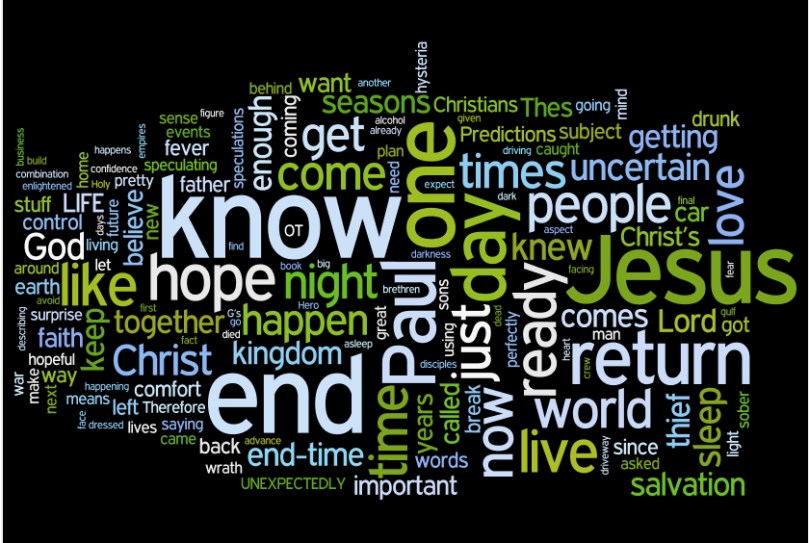
Also…I did a “Wordle” of my finished teaching notes…and this is what came out:

hopeless-predictions

Christians Ain’t Normal

goofy47We’re going to be looking at 1 Thes 4:1-12 this Sunday.  (The Message version)

When Tim came back with his report about the young church in Thessalonica, he obviously saw that they had some things “lacking in their faith”, as Paul stated last chapter.  That is, there were things they weren’t so clear on…things they hadn’t learned yet, or didn’t understand…and even things that needed to be changed in their lifestyles that would more properly reflect the faith that they had embraced.

So, Paul sets about to encourage them.  They were under a lot of pressure from the people of their society to revert back to their former lifestyles.  All Christians face that pressure, even if its just through the constant bombardment of popular media…we are all under pressure to be “normal“.

But Paul reminds the Thessalonians that Christians just ain’t that way…normal, that is.  That’s basically what he’s getting across in v1-3a (especially in 3a).  When you hear the word “sanctification”, what does it make you think of?  That word is intimidating…and I may be way oversimplifying the concept…but it carries the idea of being “set apart” from the normal practices and attitudes of the world, and set apart to God’s character and values.  In other words…we are no longer normal by the world’s standard.  (So…obviously, this means “normal” from the world’s perspective…not God’s)

Now v3-5 Paul talks about how a Christian’s attitude toward sexuality deviates from the normal pattern of the world.  How is it different?  How important does this seem, as you consider Paul’s wording?  Does this seem like a “petty” issue to you, based on these passages?

In v6-8, while the wording in English seems to indicate the same context as the previous verses…the original isn’t quite that clear…and I feel safer taking the straightforward meaning of “defraud” , which means to take advantage of or steal from…or cheat.  We can apply those concepts to sexuality, but not as directly as we could to our business dealings.  I could be wrong…but I think Paul has changed the subject, moving from our attitudes about sex to our attitudes about personal gain.  If that’s the context, how is a Christian’s attitude toward personal gain a deviation from the world’s norm?  Which number does the world tell us to look out for?  Again…does Paul seem to consider these insignificant matters that we can take or leave?

In v8-10 Paul comes back to the subject of brotherly love.  He indicates that they already walk differently from the world’s norms in this area, but he wants them to increase in the expression of it.  Why not just say “good job” and leave it there?

V11-12 provides the last example of how a Christian should live, and it provides another incentive besides just being pleasing to God (which is our primary motive)…what is it?  What does living this way do?

Stuff to ponder….see yer’ Sundee.

Come to the Table – Mark 14:12-26

Wow, we had a great discussion going last week!  Thank you to all who participated.  I might need to mention that I may be lifting some of this conversation and using it in our teaching time, I hope that’s OK.  I think this is a great way to expand the exploration and make it interactive to some degree.  This is putting the technology we have to good use, IMO.

OK…so our passage this week will be Mark 14:12-26.

As we read this passage, we can see the unifying theme to these verses.  What is it?  What is happening all through this section?

If you were to take this section, and break it into chunks, you would have v12-16, v17-21 and v 22-26.  It’s interesting that each of these vignettes tell a different sub-story, yet all together, they describe the whole event.

In v12-16, Jesus sends His disciples to get a room prepared for them all to celebrate the Passover.  Mark spends a lot of time on this detail.  One thing that interests me is that they waited so long to get this room.  Jerusalem is swollen with pilgrims from all over the country…it’s like spring break on the beach.  I wonder how easy it is to come down to the beach the night before spring break starts and just get a room?  As we read this…what is this sub-story telling us?  How do we apply what we learn from this story to our own lives?

In v17-21 Jesus breaks the news that not all of the disciples are who they seem to be.  There is a traitor in their midst.  It’s a dire warning, and certainly not what the disciples were expecting for diner conversation.  What is their reaction to this news?  How do they feel, what do they say?  How do we apply this to our own lives?

Finally, in v 22-26 Jesus takes the Passover meal in a whole new direction.  Jesus took portions of the meal and applied them symbolically to Himself, and the events that were about to unfold.  In v24-25, there is a word that gets repeated.  What word is it?  What does it tell us about the effect of Jesus’ death on us?  What is the lesson we learn from the Lord’s Table?

Stuff to think about.  Have a great week, see yer’ Sundee!