God’s Kingdom Revealed

We recently redid our kitchen – well, we hired someone to redo our kitchen. I remember all the planning and sketches Robbie and I did as we thought up our new space. Then the construction began and the project began to take shape – and it’s quite exhilarating to see a project we’d imagined for so long start to take shape in reality. This Sunday we’ll be reading the last part of Matthew chapter 4 , where Jesus begins his public ministry and we begin to see what the Kingdom of God is like in practice.

In v15-16, Matthew identifies Jesus’ work as a fulfillment of a prophecy given by Isaiah, 600 years earlier. Light dawning on people living in darkness is how the action of the kingdom of God is described. What is your impression of this metaphor? What do you think it means, and how does that inform your understanding of God’s purposes for humanity?

We then read about Jesus’ first disciples. We’ll be unpacking the dynamic of rabbis and talmidim (disciples) on Sunday morning – but succinctly put: if these guys were working in the family fishing business, it was because they didn’t measure up for normal rabbinical activities. Yet Jesus chooses these fishermen to be his close associates who will set out to imitate him. What does that tell us about God’s rule in action? Who is it open to, and what action does he call his disciples to (v19)?

V23-25 provide a summary of the excitement that was building around Jesus. What is it that he is becoming famous and sought out for? What is this revealing about God’s reign in practice – what is the mission of God’s kingdom? In all three of these examples, what is it about this that makes it good news?

Looking forward to this study! Happy Father’s day in advance – I hope you can join us!

Staying the Course

We’re coming back to our study in the gospel of Matthew, reading chapter 4:1-11 this Sunday. In stepping into the human experience, Jesus faces temptation to leave God’s intended path for him. In fact, the account of his temptation in the desert is a sweeping overview of the nature of our temptations. Do you ever feel bad for being tempted by things you feel you should have conquered by now? Remember this: Jesus was tempted too. What does that tell us about how we should understand our own temptations? There’s an old saying, attributed to Martin Luther, that states we’re not responsible for the birds that fly overhead, only the one’s we allow to nest in our hair.

The first temptation that is presented to Jesus is found in v1-4. It wasn’t wrong or evil for Jesus to be hungry. He certainly was given power to do miraculous things with bread – he’ll supernaturally provide enough bread to feed thousands of people out in the desert later on in this story. Why was this suggestion to make bread from stones a temptation to sin? Jesus quotes Deut 8:1-3 – read the whole context. Did Israel go hungry in the wilderness? Who provided for them? How does that help us understand what “living by God’s word” means?

Next Jesus is tempted to jump from the highest point in the temple (v5-7). Again, this is similar to something Jesus will do later on – he won’t walk on air, but he’ll walk on water, defying the laws of physics. What is the temptation to sin in this suggestion of stepping out in faith that God will rescue him? What clue do we get from Jesus’ response in v7?

The final temptation recorded in this account is in v8-11. Once again we have the contrast of human kingdoms with God’s kingdom. Worship me, the devil says, and you will be King of kings. Interesting, since that is ultimately what Jesus is called – and the last book of the Bible says in Revelation 11:15 that the kingdoms of this world will become the kingdoms of our Lord. Why is this a sin if it’s the fulfillment of his destiny anyway? What does Jesus have to go through in order to be exalted? What sort of King of kings and Lord of lords does it make him when he was willing to die for us?

In each of these temptations there is a forecast of something Jesus will ultimately do. The difference is in how it gets fulfilled, and by whom. Where do we look for our fulfillment as human beings? A lot of things in this world promise fulfillment and wholeness – but Who holds the true source of wholeness? What has your experience been in looking for fulfillment in the things we can grasp for in this broken world? How can that instruct us?

I think this will be a challenging, yet hopeful study! Hope you can join us on Sunday!

Preparing the Way

Remember how, before Hurricane Michael, when the storm season came around we only gave it our mild interest. Post-Michael, I haven’t yet met someone who doesn’t follow Mike’s Spaghetti models with grave intentionality between June and November. Experience and expectation really goes a long way in shaping our responses to the warnings we get from NOAA.

As we continue our study in Matthew this week we’ll be reading chapter 3.  We’re going to be introduced to a human GFS model – John the Baptist, who will be announcing the arrival of the Messiah and the launch of God’s kingdom invasion.

As you read John’s message, what does his major theme seem to be? What is he calling people to do? What do you think his instructions meant to a Jewish person living in the first century? What does that mean to us, as 21st Century Americans? What sort of radical changes have taken place in your life as a result of embracing the Good News of Jesus?

The Pharisees and Sadducees show up too, and John doesn’t give them the greeting they are accustomed to. What does he seem to highlight as the problem with these religious leaders? Why does he call them “the offspring of snakes”? Thinking back through the Biblical narrative, do you remember a forecast of “the offspring of the serpent” bruising someone’s heel? There’s going to be a lot to unpack in this section that I’m really excited about!

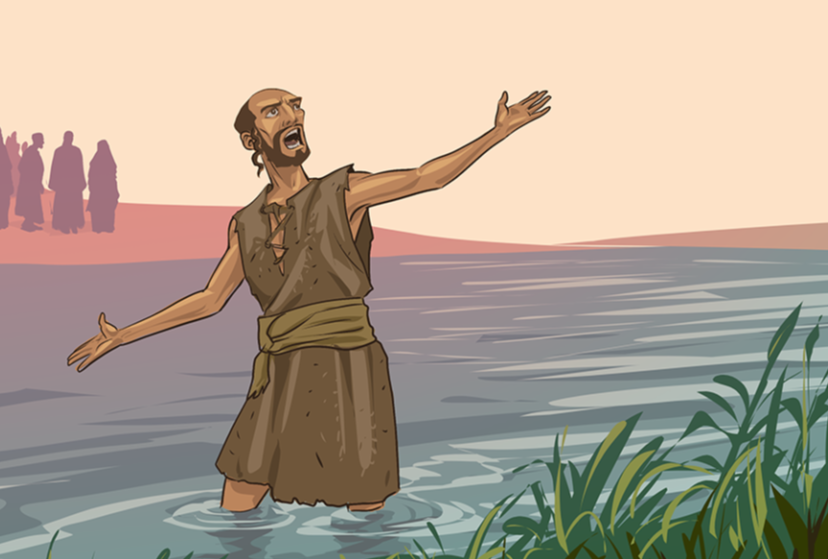
When Jesus shows up he does something that surprises everyone, including John. He gets in line for his turn to be baptized. John is nonplussed. “You’re the Messiah, come to save us from sin…I need to be baptized by you…what do YOU need to repent of?” It’s a puzzling scene to this day. Jesus said he needed to do it to, in the Greek, “fulfill all righteousness”. In other words – the righteousness, the setting things right that God intends comes through a Messiah who stands in the river with humanity, identifying with them, protecting them in their corrupted, vulnerable state. What does this tell us about what it means to “fulfill righteousness”?

I’m so stoked to dig into this text – Hope to see you Sunday!

Reactions to the King

There’s a famous optical illusion drawing that, depending on how a person perceives the image, shows an elderly woman or a young lady with her head turned away from us.

You can see it here – and what’s fascinating is while one person may see a young lady and another an older person, the image itself is unchanged – only our perception and interpretation of the image.

We’re going to be continuing our study in the Gospel of Matthew this Sunday, and we’ll be reading about some very different reactions and responses to the news that the Messiah King had been born in Israel. It was perceived as either good or bad news, depending on what a person may have felt was at stake in the arrival of a new King.

We’ll be reading Matthew 2:1-23.

The text introduces us to some characters that we’ll have to try and get familiar with.

We’ll meet King Herod (or Herod the Great) who was the Roman puppet ruler over Israel at that time. We’ll also meet the Magi, or Wise Men as our modern translations call them. They are apparently court astrologers who travel from the East because they observed astronomical phenomena that they interpreted as the portent of the arrival of an important King.

We’ll also hear from the religious scribes, the keepers of the Torah. All of these people react to the news of the birth of Messiah – and all of them react differently. What do the Magi state as their intentions? What does Herod say he wants to do compared with what he does? Who is this text portraying in a positive way, and who is negatively represented? What might we infer from that?

We’re going to pay attention the the tension and conflict that emerges as Jesus comes on the scene and consider what that tells us about the world we live in, as well as the condition of our own hearts.

It will be both a challenge and an encouragement! Hope you can join us this Sunday at 10 AM!

The Lord’s Requirement

“What does God want and how does he want us to live?” That’s a pretty common question posed in the theater of most religions, and our study of Micah brings us to God’s answer to that question with stark clarity. And, spoiler, it isn’t outward religious behavior.

We’ll be reading Micah chapter 6 this Sunday. The scene begins like a cosmic courtroom where God presents his case against his people, reminding them of how often he had been faithful to them. Remembering the blessings we’ve received from God seems to be an important way in which we remain close to God’s purposes. How easy is it for you to forget the ways in which God has been faithful to you? How might we better keep those blessings in view during the trying times of life?

The response from God’s people to his charges is basically to ask “Fine, what do you want from us anyway?”, followed by a list of various religious practices and sacrifices they could attend to.

God’s answer is straightforward. As you read his answer, how do you interpret “do what’s right”? The word that’s used carries a strong social aspect – doing what’s right by others. What are some obstacles we face in doing what’s right by others. The second part of God’s expectations is to love mercy – which means an unqualified kindness shown to our fellow person. How do these two, doing what’s right and kindness, go together? It’s been said that injustice and inequality grow where kindness shrivels. What are some practical ways in which we can start intentionally practicing these two qualities of doing right and being kind?

It’s also very important to recognize that religious performance was summarily brushed aside by God. When it comes to the values we pursue in life, does it seem like God looks at our religion or how we treat others to evaluate our faith?

This study may make us somewhat uncomfortable as the Scriptures probe our deeper motives; however, I promise it will resolve with great hope! I’m looking forward to digging into this together!

The Cost of Idolatry

This Sunday we’ll be digging into the first chapter of Micah, the Minor Prophet. We’ve stated before that this book, like all the works of the Old Testament Prophets, contains some difficult and harsh words. I will again be reminding us that we must read any of these prophecies through the lens of the revelation of who God is in Jesus. We’ll talk some about how we go about applying these Scriptures as well.

As you read through this opening chapter, you’ll notice that great, cosmic imagery is employed to reinforce just how serious the situation is. Imagine the opening like a trial, where God calls witnesses to hear his complaint about how his covenant people have been using the freedom they had.

The list of complaints will be extensive as the book goes on – but in the opening salvo, we have a description of high places in Jerusalem. That is our clue that identifies idolatry as the first issue God brings into focus. We’ll talk about idolatry on Sunday – what it means and how it can affect us, even in a modern age where it’s unlikely anyone is bowing down to a carved statue somewhere.

Idolatry is a big issue in the Scriptures – a main source of trouble all through the history of God’s people. If you’ve ever been near a church, you’ve likely heard sermons on this problem before. What’s your natural reaction to hearing that we may have idols still lurking in our lives? If you are warned to get rid of an idol, no matter what form it may take, do you feel encouraged, condemned or something in between?

What if the cure for idolatry wasn’t about getting our act together or trying to be a better Christian? What if it were something deeper, something we need to realize about our identity? I’m persuaded that the first chapter of Micah gives us a clue as to how God can cure “the incurable plague” that has often hounded his beloved people. I hope you can join us as we consider this on Sunday – I think it will be a great encouragement to us all!

Am I good enough for God to use?

The Bible gives examples of all sorts of people God uses to carry out His divine plan. Studying these different stories and people can lead us to question whether we are as great as these examples or possibly good enough for God to use.

Last Sunday, we completed our study in Corinthians and learned about the hot mess church. Before moving on to the next book study we will spend a few weeks on topical studies like this one. This week, we will examine the types of people that God works through and discover what that means for each one of us today.

The main example we will examine is Esther. Being familiar with her story and this book of the Bible will help us compare her story not only with others in the Bible but also with our own. I highly encourage you to read through the story of Esther in the Bible. Also, if you get the chance, I also encourage you to watch the Bible project video linked below that summarizes it beautifully.

We hope to see you this Sunday at 10:00AM as we study this topic and scripture together.

Resurrection; The Substance of Salvation

We’ll be returning to our study of 1 Corinthians after taking two weeks away from it for the holidays. We’ll be reading 1 Cor 15:35-58 – Paul’s concluding thoughts concerning the doctrine of the resurrection.

In the first part of chapter 15, Paul was corrective in his discussion about the resurrection – pointing out how intimately Jesus’ resurrection was tied to our own stories. In Paul’s thinking, Jesus’ experience was a model for what God intended to do for all of his people, hence, the general resurrection was a mandatory belief.

I do find it fascinating how very little time or thought our modern, Western church gives to this idea. N.T. Wright wrote a very insightful book on this topic, called “Surprised by Hope”, which I highly recommend reading.

For the last half of the chapter, Paul points both to nature and the Biblical narrative to make his case for the holistic nature of the resurrection. I really like his argument as it touches nature. What are we witnessing every spring as winter recedes? If God is the author of reality as we perceive it, what might he be trying to tell us in this cycle of seasons?

Going to the biblical narrative, Paul asserts a new Adamic role for Jesus. His logic seems to be, if we all face the certainty of death through Adam’s sin, doesn’t it stand to reason that we all get in on Christ’s resurrection life through Him?

As Paul has elaborated on this subject, has it influenced how you perceive an afterlife with God? Paul finishes on a high note, in v55 he rewords a prophetic poem from Hosea 13, flipping the meaning of that oracle into a forecast of triumph for God’s people. How can we start incorporating a more robust hope for resurrection into our faith worldview?

I’m really stoked about getting into this section of 1 Corinthians – I hope you’re able to join us this Sunday at 10 AM!

Resurrection; The Sum of all Hope

I know, I know….you’re thinking: “Rob! It’s almost Christmas, not Easter!” I realize that. But I would also argue that the themes of Easter should be something that resonates with followers of Jesus no matter what time of year it is. As we’re going to be reading in our text this Sunday, the resurrection of Jesus is the very heart of our faith and hope. We’ll be continuing our study in 1 Corinthians this Sunday, reading chapter 15, verses 1-34.

I’ll warn you right off, this is a fairly complex and dense bit of theology that Paul delves into as he comes to the close of his letter. It might behoove you to read the passage in a few different translations – but especially take a look at Eugene Peterson’s “The Message” version – because while it may overly simplify some of the concepts Paul is advocating, it most certainly provides a readable overview of this thoughts.

As you read it over, how important does the resurrection of God’s people seem to be for Paul? Does it match your own passion for that subject? If not, why might that be? How much space does the resurrection of the saints take up in your spiritual worldview? Clearly, for Paul, everything hinged on that idea.

Paul indelibly tethers Christ’s experiences to the future plans for His followers. In Paul’s thinking, our beliefs about what happened in the past have a profound effect on our present and our future when it comes to the resurrection. I’ll be honest, the string of Paul’s logic feels so foreign to me as someone who has grown up in the Evangelical church. Our matrix has always been: “Believe on Jesus and you will go to heaven when you die and avoid eternal punishment in hell.” It just feels like that reasoning couldn’t be further from Paul’s thinking about mortality and eschatology. In fact, how many times does Paul reference “going to heaven or hell” in his presentation of the central core of the Gospel?

That’s really something to ponder for a bit. The more I ponder it, the more I start to ask, “What have we been thinking?”

If you’re really interesting in tackling a big topic, I hope you’ll join us this Sunday at 10 am as we dig deeply into Scripture.

Order From Disorder

What should we do when we encounter scripture that makes us uncomfortable? Sometimes I’ve read scripture that leaves me squirming in my seat and unsure if I should continue reading or close the book for good. Maybe it’s when God sends a flood to destroy all of humanity except for one family, maybe it’s the violence we are confronted with in the Old Testament, or maybe it’s the verses that Paul writes about slavery and women. 

When this uncomfortable confrontation happens, and I believe it will happen for anyone who reads scripture, we are faced with a choice. Do we close the book for good? Do we pretend we didn’t read that part or pretend those verses are not in the Bible?

We can choose to walk towards God or away from God in our confusion. It seems that walking away would be an easier route. It certainly takes less work and it requires less trust.

Or, do we take the road less traveled? Do we choose to move towards God, even in our confusion? 

Personally, I have found God and scripture to be more than capable and strong enough to withstand my questions, doubts, and feelings of confusion. I have also found that when we begin to understand that God is big enough for our questions, something else begins to happen. The uncomfortable scriptures morph from a haunting of unknowns to a mysterious adventure waiting to unfold with God at our side. 

This week we will be reading 1 Corinthians 14:26-40, which are famous verses for this exact reason. Read them and you’ll know why immediately. We invite you to step towards the uncomfortable scriptures and join us this Sunday at 10:00AM as we study God’s word together.