“Priorities Under Pressure”

When times are hard, and life seems to have the pressure set at “11”, it’s easy sometimes to forget what comes first.  I know in my own experiences, whenever there’s a problem, I have a tendency to fixate on that problem, and treat it as though it’s the most important thing in the world, until it gets solved.  But is that the right procedure for handling life’s difficulties?

We’re going to continue our study in 2 Thessalonians, and read v1-5 of chapter 3.  (In the Message)

In the first verse, Paul asks the Thessalonians to do something…pray.  What does that tell us about our priorities during times of stress?  What obstacles are in our way to praying?

Combining v1-2…what does Paul ask them to pray about?  What does THAT tell us about our priorities in life?  What is the most important thing in the world for the Christ follower?

In v3-4, Paul expresses his confidence in God, that he will continue doing his work in the people of the Thessalonian church.  Based on what he says, what else is our priority as a Christ follower?

Finally, v5 has Paul praying for them again.  Its a neat kind of rhythm to this…like breathing, or a heartbeat, how the prayer goes from one to the other.  What is his final request for the Christians there?  What is OUR priority, based on his hope for them?

Stuff to ponder.

Hanging in There

Ever need a good pep talk?  Clearly, Peyton Manning is probably not the place to start looking for one, but all of us need a good encouraging word now and anon.

This Sunday we’ll be looking at 2 Thes 2:13-16 (and in the Message), and I believe that’s what Paul is doing with his closing thoughts to the church in Thessalonica…giving them a pep talk.  Mind you, it’s a pep talk that’s pretty deep and rife with theological implications that have been studied and debated for 2,000 years…but a pep talk none the  less.  In a way, Paul is saying “look, I know that times are hard for you, and people keep predicting the end of the world for you…but hang in there.”  Then he gives them some reasons and ways to hang on.

In v13-14, Paul sets up the foundational encouragement for them.  What do you get as encouragement from these two verses?  Based on these verses, what can you remind yourself of when times are tough and you need something to hang on to?

V15 gives us a straightforward encouragement to do something in our “hanging on”.  What is it?  What do you think Paul is talking about, and how would we apply it to our day and age?

V16-17 tells us that God is the source of something to us?  What is it?  What should it result in concerning our state of mind and heart?

Ok…stuff to chew on.  We’ll talk about it more on Sunday.

Don’t Believe the Rumors

Whoops!  Had some skin cancer removed this week…and I’m such a weenie about it, it threw my whole schedule off.  Sorry about that.

Sunday we’ll be reading 2 thes 2:1-12 (the Message)

Once again, Paul is trying to calm the Thessalonians down after they’ve been zapped with end-time fever.  What is it that they are afraid has happened?  Have you ever felt left out of something…if so, what emotions did it inspire in you?  What does Paul do to calm them down…what does he encourage?  As you read the whole 12 verses…who has the upper hand in the events that are going to one day unfold?  What is there in this that can encourage a Christian who is concerned about the end of the age?

See you Sunday.

God is not Mad at You

Cause everybody knows

If you don’t mind your mother’s words

A wicked wind will blow

Your ribbons from your curls

Everybody moan everybody shake

The shankill butchers wanna catch you

Awake

~The Decemberists, “The Shankhill Butchers”

The concept of “retribution” is the fuel that drives almost every pagan religion, ancient or modern.  You find it as the driving force behind the concept of karma, as well as many other forms of religion.  If you do bad things, bad things will happen to you.  If you do good things, good things will happen to you.  A person measures his or her status among the gods or fate by the circumstances they face in life.

The thing is…this kind of mindset has influenced many Christian’s thinking…and often we don’t even realize it.  We’ve incorporated the law of retribution into our understanding of God and the gospel when we start trying to estimate God’s acceptance of us based on what’s happening in our lives.  A great example of it is found in the (waining) “Word/Faith” doctrines.  This teaching says that if you have enough faith in Jesus’ power, you’ll be financially rich, free from sickness and enjoying the good life.  If a person is sick, or struggling financially or in any way, it’s a sign that you don’t have faith, or there is some hidden sinfulness in your life.  It’s a crock.

Even if we don’t fall for egregious errors like the aforementioned…we sometimes slip into this way of thinking in more subtle ways.  We start thinking “God must be happy with me because everyone got the flu but I didn’t”…or conversely, “God must be punishing me because I lost my job.”…a Christian version of Karma.  While it’s true, God will sometimes use our circumstances to guide us, or communicate a message to us (sometimes being very distinct from ALL the time), His acceptance and love for us is an entirely different thing.

A person could point to the Old Covenant and say “Israel was sent into exile because God was mad at them”…but that’s not entirely accurate.  Israel had forsaken their national relationship with God, and God got their attention in a big way through the exile…but it’s made clear that this is for their ultimate benefit.  The book of Job stands as a startling revelation that the law of retribution is not the standard means by which God deals with His people, even though Job’s friends thought it was.

All this to say that this week we’ll be reading 2 Thes 1:1-12, as we continue our series “Looking for Hope in Uncertain Times”. (2 Thes 1 in The Message)

This is the 2nd letter Paul writes to this fledgling church, several months after his first letter.  Things have not gotten better for the Thessalonians, and in fact seem to have grown worse.  Which leads to the inevitable question that most of us would ask…”Is God mad at me?”.  Paul’s opening remarks seem to be trying to put them at ease, letting them know that God isn’t mad at them…and that there are some other ways of looking at trouble that comes into our lives that help us understand why we face those things.

V1-2 provide Paul’s greeting.

In V3, Paul is encouraged because he sees something happening in them, something growing.  This is one of the reasons we face trials…so that we will grow.  What is it that is developing with them, and how would we relate it to our own troubles.

V4-5 indicates something else Paul is aware of concerning this church.  The perseverance they demonstrate during hard times makes something happen…what is it?

Paul warns that Justice will come one day (V6-10), that oppressors will have to answer for their acts of hatred.  So, he’s letting them know that things will be made right one day…and that is the day he points toward to provide them with hope.  What are we looking forward to in v7?  So what does that tell us about life here and now?  Based on what he’s saying here, if bad things happen to us, does it mean God is mad at us?

Finally, in v11-12, Paul makes the most alarming statement in the context of suffering as a Christian I think anyone could make. How would you summarize what he says in these verses?  How would you brace it against your own life and experiences?

See you Sunday!  

Living Our Future Hope – Right Now!

sunriseHey Everybody…sorry, but I’m back from vacation.  I had a great refreshing from our King, and I’m stoked and ready to get to the stuff God’s given us to do.

This week we’re going to finish up 1 Thes, and we’ll study chapter 5, verses 11-28.

Paul is wrapping up his thoughts, and giving his final exhortations to the young church in Thessalonians.  He’s just come off of reminding them about the great future hope we have in Christ’s return to set everything right.  He used Jesus’ resurrection as the basis for our hope…that since Jesus rose from the dead, we know that same kind of restoration is in store for us…so be stoked!  So, we have this past event of the resurrection, and this future hope of restoration…but what do we do in the meantime?  That’s what Paul expounds on.

We, as the church, are called to live lives that reflect and actually demonstrate that future hope right here and now.  Not through big movements or grand outreach schemes…but as Riley and Dan both reminded us of last Sunday and Wednesday, through the everyday activities we pursue as children of that great HOPE!

In v11-13, Paul talks about community.  How should we live out our hope in community?  What will characterize it, according to what Paul says there?

In v14-15 he describes how we look after each other.  If you were to summarize what he’s saying there, how would you do it?  Why does this behavior toward each other represent something different from this fallen world?

V16-18 we are pointed toward a proper understanding of life’s events.  God’s will is revealed for our lives…what is it? 

v19-22 provides instruction about the work that the Holy Spirit is doing in our midst as a community.  Paul warns us not to close Him out…and what is it that the Holy Spirit is doing among us according to these verses?

V23-28 finishes up Paul’s thoughts.  We have a hope in a restoration that has begun at Jesus’ resurrection, and v24 tells us why we can be sure of that hope.  What does it say?  What must we remind ourselves of, when times are tough, and our temporal future is uncertain?  What IS certain?

Looking forward to being back this Sunday!

Hopeless Predictions

This Sunday we’ll be reading 1 Thes 5:1-11.  (In the Message)exploding-earth1

The church in Thessalonica obviously asked Paul (through Timothy) how much longer until Jesus returned.  Facing the difficulties they were enduring, it only seems natural that they wanted a timeline…a date on the calender that they could fix their hope on. 

The Thessalonians were part of a long line of Christians who became overly fascinated with setting a date for Christ’s return.  People have been setting dates for Christ’s return for about 2,000 years.  None of them have been right, by the way.  Why do you think there is such a desire to do this?  Why do we get so infatuated with knowing when the world will end?  What does Paul say about this kind of intrigue in v1-3?  How does that inspire hope in us?

Paul goes on in v4-7 to make a contrast between people of the day and people of the night.  What do you think his point is in this contrast?  To help interpret  this analogy, we need to consider the twin metaphors of sleep and drunkenness.  The opposite of that would be to live as someone who is awake and sober.  V8 basically explains what that looks like in real life.  What three elements of life does Paul prioritize in v8?  

To live in a way that is ready for Christ’s return…do we need to calculate the days of Daniel’s prophecy…or keep a close eye on the United Nations…or write letters to be sent to loved ones after we are raptured?  What does v8 tell us about a life that is anticipating the end of the age….what should we be doing?

Paul again encourages us to comfort each other with this stuff in v11…and I think v10 gives us a big clue about why this IS comforting.  Does it comfort you?

See you Sunday!

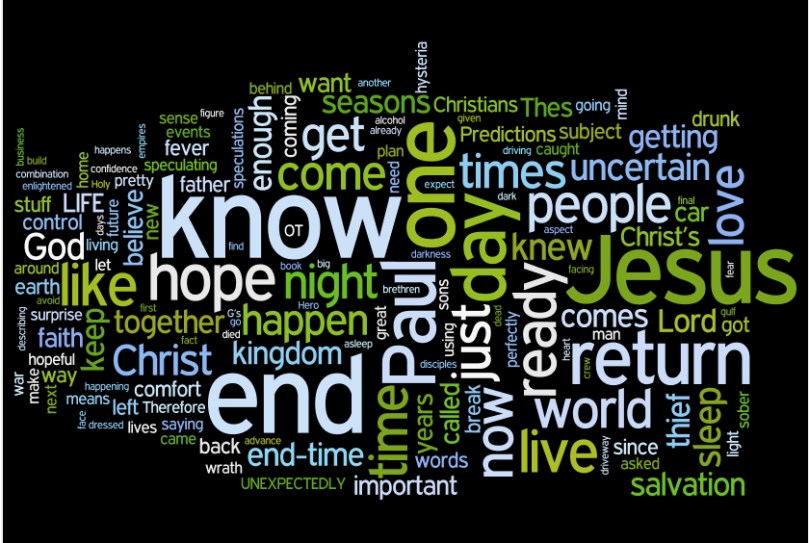
Also…I did a “Wordle” of my finished teaching notes…and this is what came out:

hopeless-predictions

The Ultimate Hope in Uncertain Times

Man…the post below is so encouraging…I love seeing our young people engaged in the exploration of who Christ is.

rapture1This Sunday, we’ll be looking at 1 Thes 4:13-18.  (The Message version)

As we remember, the church in Thessalonica had just been planted, when Paul and company had to leave town under threat of violence.  That meant that these new Christians didn’t have much time to learn a very detailed theology or set of doctrines which could define their faith.  On top of that, they were now facing pressure and persecution for believing in Jesus as the Christ.  When Paul sent Tim to find out how they were doing, we glean from the verses we’ll look at that they had some questions about what they should believe…and what they were waiting for.

The Christians of the early church were all expecting that Jesus was going to return any minute, they had no idea it would take as long as it has.  For them, the pressures they were facing made sense if Jesus were just about ready to burst on the scene.  But then, before Jesus had time to come back, some from their group died.  “Now what?” they may have asked?  Do they miss out?  Did Jesus fail in their case?  Did they mess up somehow?

Paul sets out to answer these questions they apparently posed, and gives them a crash course in eschatology.  In v13-14 Paul says that he doesn’t want them to be sad like people who have no hope.  That small statement is huge in it’s implication!  What is the greatest threat that mankind faces?  What is the strongest threat any tyrant can impose upon a people?  With that quick phrase, Paul tosses finality out the window, and effectively pulls the rug out from under death’s imposing presence.

What does Paul cite as the basis for this hope? (v14)

V15-17 are the foundational verses that support the doctrine of “the rapture” of the church.  How do you interpret what he’s writing there, in light of the context of comforting people who were concerned about their deceased loved ones?   What is the emphasis of v17, in your opinion?

Paul indicates how this doctrine should effect them, in v18.  What effect does the doctrine of the end of this world and Christ’s return have on you?

Stuff to ponder.  See yer’ Sundee.

Christians Ain’t Normal

goofy47We’re going to be looking at 1 Thes 4:1-12 this Sunday.  (The Message version)

When Tim came back with his report about the young church in Thessalonica, he obviously saw that they had some things “lacking in their faith”, as Paul stated last chapter.  That is, there were things they weren’t so clear on…things they hadn’t learned yet, or didn’t understand…and even things that needed to be changed in their lifestyles that would more properly reflect the faith that they had embraced.

So, Paul sets about to encourage them.  They were under a lot of pressure from the people of their society to revert back to their former lifestyles.  All Christians face that pressure, even if its just through the constant bombardment of popular media…we are all under pressure to be “normal“.

But Paul reminds the Thessalonians that Christians just ain’t that way…normal, that is.  That’s basically what he’s getting across in v1-3a (especially in 3a).  When you hear the word “sanctification”, what does it make you think of?  That word is intimidating…and I may be way oversimplifying the concept…but it carries the idea of being “set apart” from the normal practices and attitudes of the world, and set apart to God’s character and values.  In other words…we are no longer normal by the world’s standard.  (So…obviously, this means “normal” from the world’s perspective…not God’s)

Now v3-5 Paul talks about how a Christian’s attitude toward sexuality deviates from the normal pattern of the world.  How is it different?  How important does this seem, as you consider Paul’s wording?  Does this seem like a “petty” issue to you, based on these passages?

In v6-8, while the wording in English seems to indicate the same context as the previous verses…the original isn’t quite that clear…and I feel safer taking the straightforward meaning of “defraud” , which means to take advantage of or steal from…or cheat.  We can apply those concepts to sexuality, but not as directly as we could to our business dealings.  I could be wrong…but I think Paul has changed the subject, moving from our attitudes about sex to our attitudes about personal gain.  If that’s the context, how is a Christian’s attitude toward personal gain a deviation from the world’s norm?  Which number does the world tell us to look out for?  Again…does Paul seem to consider these insignificant matters that we can take or leave?

In v8-10 Paul comes back to the subject of brotherly love.  He indicates that they already walk differently from the world’s norms in this area, but he wants them to increase in the expression of it.  Why not just say “good job” and leave it there?

V11-12 provides the last example of how a Christian should live, and it provides another incentive besides just being pleasing to God (which is our primary motive)…what is it?  What does living this way do?

Stuff to ponder….see yer’ Sundee.

Truths About Troubles

Just a quick reminder, we’re having a meeting after 2nd service ( 1-18-08 ) for anyone interested in getting an update on Eastgate finances, hearing our present state and future plans, and meeting the supervisors of the various ministries we have currently in place.  Hope you can make it.

42-21352842This Sunday we’ll be reading all of 1 Thessalonians 3.  Also read it in The Message version.

In this section, Paul is recounting why he sent Timothy to them, what he heard from Timothy that encouraged him, and what his prayers are for them.  In this section, we get an insight into what Paul was concerned about for them as they went through the hardships of persecution for their faith….and I believe his concerns reveal some truths we need to keep in mind concerning the troubles WE face, as 21st Century, American Christians.

In v1-3, Paul is relieved that they weren’t thrown by the fact that they faced troubles.  He reminds them about the reality of hard times…what does he say about them?  How do we apply that to our OWN lives, as we face hardships?

In v4, Paul is relieved that their troubles didn’t result in something undesirable.  What is it?  What does that encourage us to be on guard about when we face difficult circumstances?

In v5-9 Paul goes over the good report that Tim gave him…and in v11-13, he tells the Thessalonians what he’s praying for concerning them.  What is the heart of his prayer, in v12?  What do we take then, as the priority of our journey, even in hard times?

Stuff to think on.  See you Sunday!

Learning to “Talk the Walk”

communicationn-copyYou may think I have the title backward.  “Isn’t it usually ‘walk the talk’, Rob?”  Yes..usually…the idea being that we don’t want to just talk about our beliefs without putting them into practice.  But as we finish our study in Colossians this Sunday, we’ll find that Paul puts an emphasis on talking. 

We’ll be reading all of chapter four, but our focus will largely be on verses 2-6. (The Message version)

We could break v2-6 neatly into two sections: v2-4 and v5-6.  The first kind of talking Paul mentions is talking to God.  Prayer.  It’s often an uncomfortable subject because so many feel inadequate when it comes to prayer…or struggle with a sense of condemnation because they automatically think they don’t “do it enough”.  That’s a brilliant strategy by our enemy, because the results of that is usually the avoidance of prayer on our part, until a crisis happens.

What have your experiences in prayer been?  Have you learned to find a comfortable means of communicating with God?  Everyone’s experience will be different, I’d love to hear yours.

Paul says to “continue” in prayer…that word means to be devoted to, or constantly attentive to something.  Like…when you’re watching a football game, but you have to fix a snack, you work on the sammich, but also listen to and snag glimpses of the game as you pile on the lunch-meat.  Or…maybe a nobler example would be more suitable: if you’re a parent, and your child is sick in another room, you may go about your work and deal with other issues…but there is part of you that is constantly on vigil, attentive to your child’s sounds and possible needs.  Right?

THAT is how Paul said our conversations with God should be.  What does that tell us?

Part of what Paul asks them to pray for is wisdom for him, to know how to talk to people about the gospel (v4).  Does that strike you as interesting, and even a little surprising?  Paul needs to know how to talk about Jesus?  Maybe, or more appropriately, he needs to know how the gospel should be presented?

Which leads us to v5-6, which deal with how WE present ourselves, and communicate with people.  Does anyone else have trouble reconciling a “bullhorn” evangelist with v6?  Maybe it’s just me, but somehow, the two seem incongruent.

As you read Paul’s final, personal greetings, is there anything that catches your attention that you’d like to hear expounded on?  I’m planning on skimming it…but if there’s something of interest in there to someone besides a historian who is intrigued with fitting the puzzle pieces together, I’d be glad to touch on it.

Anyway…hope you’ve enjoyed Colossians.  See yer’ Sunday!