The Promise is Certain

When someone swears an oath, like the way we are asked to when giving testimony in a court of law, what are we trying to emphasize by that oath?

We are often disappointed and disillusioned by promised that are never kept. From advertisers to politicians, we are alarmingly accustomed to claims and promises that are never fulfilled. That’s less a cultural problem than it is a human one.

What can that do to a person’s sense of hope or anticipation? I truly believe that the fallen-ness of our world is what makes our faith so fragile, why a trust in God’s promises is such a struggle.

This Sunday we’ll be reading Hebrews 6:13-20 where the writer will address this issue and encourage us to keep on believing.

He uses two main platforms on which he calls us to build our trust: God’s character and his oath, or word.

What aspect of God’s character does the writer highlight? How can the story of God’s promise to Abraham (Gen 12, 22) help to reinforce that aspect of his character? What would be meaningful about the promise to Abraham for these Jewish readers so many years after the fact?

Considering why we ask for an oath from someone, and considering God’s nature, do you think it was necessary for God to swear an oath to Abraham? Why do you think he did it? What does that tell us about God’s attitude towards us, and his desire for us to believe?

This will be an interesting, albeit complex, study. I hope it encourages us all in our faith! See you Sunday!

Shipwrecks and Snakes

This Sunday we’ll be continuing the story of the Apostle Paul and a ship tossed in a storm. We’ll be picking up where we left off, reading chapter 27:27-28:10.

We’ll be following the same theme of reading the account as an analogy for how we respond to the stormy times we go through in life.

There are several theories that float around as to why Paul warned that the sailors shouldn’t leave the ship. Why do you think he gave that warning? If you were on a ship in peril, how would you feel if you saw the one’s who knew how to steer it to safety trying to sneak away?

When Paul encourages the sailors, soldiers and prisoners to eat, what does he do when he holds the bread? How do you think being thankful for what God has already provided help to encourage our attitude during times of stress?

When they finally get off that sinking ship and get to shore, you’d think that would have been enough trials for one lifetime. Yet the very next thing Paul gets to encounter is a snake dangling off his wrist. The people of Malta are expecting a specific reaction from Paul, but it doesn’t happen. Paul is not poisoned by this trial. How can we keep from being poisoned by the difficult situations we face as Christians? What would a watching world say about you as they observe the way you handle troubles in life?

All of these circumstances lead up to the point where Paul is able to minister to the people of Malta. How has God used disaster in your life for ministry?

I think this study will be an encouragement – hope to see you there!


Fair-weather Fans and Faithful Followers

Have you ever had a fair-weather friend? You know, someone who is happy to be your pal until it may cost them something or it is somehow inconvenient. Then they are nowhere to be found. Jesus had and still has his share of those types of friends, as we’ll see in the passage we’ll be exploring this Sunday – John 6:60-71.

Jesus has gone off the deep end in some people’s estimation, talking about eating his flesh and drinking his blood – a clear violation of Old Testament law. Jesus was speaking figuratively…but even still, it was just too uncomfortable for many of his followers…..so they quit following.

Jesus didn’t soften what he said or chase everyone down and beg them to stay with him. Does that surprise you at all? What does it tell us about aspects of the gospel as over against our own perception and will? What elements of the gospel disturb you or rub you wrong? When Jesus says we have to lose our life to find it…or demands that we take up a cross to follow him…or insists that we forgive people who mistreat us? What about where he tells someone to sell everything and follow him? We like to think about miracles and grace and Jesus loving the outsiders….but there is all this other stuff about eating his flesh and dying to self that sometimes rubs us wrong.

So what do WE do in those instances? We may not ever admit to walking away…but do we shut out those hard claims of the gospel on our lives? Through a thousand little choices do we reclaim our lives from Jesus?

Peter’s response to Jesus is beyond wonderful to me.

“Where we gonna’ go?” What has the gospel brought to your life that you think you could replace through some other pursuit? How can we remind ourselves of what’s really important when we’re tempted to return to our old lives, piece by piece?

Peter said “we have believed and have come to know you are the Holy One of God.” What do you see as the difference between believing and coming to know? What does this tell you about the nature of following Jesus?

It should prove to be a convicting yet encouraging exploration of the Word this Sunday – hope you can be there!

From Majesty to Messy

I don’t believe it properly represents Christ to burn books as a protest, or as a means of “venting”, as Dr. Terry Jones explained his reasons for desiring to burn copies of the Q’uran on the 9/11 anniversary. I honestly believe it is not only a poor example of Christianity, it is pretty much the antithesis of what Christ represents.  Anti-Christ, you could say.  I’m not saying that to stir up more anger and controversy about the proposed book burning…I’m saying it because Dr. Jones reminds me that we as the church don’t always do a very good job of representing who Jesus is, or what He’s all about.  A quick glance at church history tells us that.  It’s pretty much been that way from the beginning.

We’re looking at Luke 9:37-45 this Sunday.

The disciples of Jesus didn’t do a very good job representing His power to the people back then either.  It’s sort of endemic to our faith.  Jesus prays, we go to sleep.  Jesus reveals the glory of heaven, we want to build tents.  Jesus gives us power and authority to advance His kingdom, and we just can’t seem to get it to work like He does.  It’s been 2,000 years of this same show.

Yet…what is the result of this story.  What happens, and what do we learn about Jesus and ourselves?  What is His final statement to them in this section…and why does he bring THAT up again?  Those are some interesting thoughts to ponder as we prepare to explore this together.  Let me hear your thoughts!

Our Inadequacy is Christ’s Abundance

This Sunday we’ll be exploring the events described in Luke 9:10-17.  The astute reader may worry that I’ve skipped verses 7-9 in our studies…but we’re just putting those aside, and we’ll be dealing with them next time.  Our focus this week will be on the miracle of the loaves and fish.

This appears to be an important miracle, because all four gospels recount the story of it.  Early Church art often used the imagery of loaves and fish as symbolic of God’s provision, and even the gospel itself.  We have been exposed to the telling of this miracle so much that it tends to get lost in the shuffle of telling the story of Christ, but it has a very important message contained it.

There are several parallels to the Old Testament that are most likely intentional.  Jesus in the wilderness, providing food for His followers, like Moses in the wilderness providing Wonder Bread (manna) for the children of Israel; or the multiplication of resources yielded to God like the story of Elijah and the widow of Zarephath.

As you read this story, what distinctions do you see between the way Jesus responded to the people and the need and the way the disciples responded?  Consider the overall setting and circumstances, that the disciples had just come back from their own ministry tour and were probably worn out…does this possible detail impact the story in any way?  If you apply this story to your own life as a servant of Christ…what lesson can you glean about meeting the needs of the world around you?

Should be interesting…hope to see you Sunday!

Who is the King?

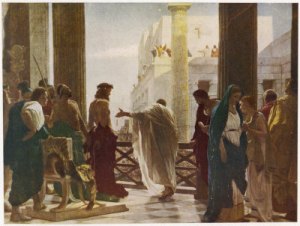
Pilate offers Jesus to the crowd

We’re going to continue in Mark this Sunday…we’ll be looking at Mark 15:1-20.

The Jewish leaders have concluded their judgement of Jesus, and believe Him deserving of death.  They, however, don’t have the authority to put someone to death because they are under Roman rule.  Their difficulty is now to convince the Roman governor, Pilate,  who has jurisdiction over Jerusalem to condemn Jesus to the death sentence.

They have condemned Jesus as deserving of death because of blasphemy, but they know that will never wash with a Roman ruler.  So, they focus on the one thing sure to get Pilate’s attention, and that is the claim to be the King of the Jewish people.  Why would that get Pilate’s attention?

When Pilate asks Jesus about this claim, Jesus, in the original language, says essentially: “That’s what you say.”  Why does Jesus seem so non-committal in His answer?  Maybe John’s version of this encounter sheds some light on it: John 18:36-37.

Things get exposed in glaring detail the nearer we get to the cross.  Pilate sees why the religious leaders want Jesus killed (v10).  What were their motives?  Why THOSE motives?  What does this tell us about their thought of Jesus as king?

What does Pilate marvel at (v5)?  Why do you think this causes him to wonder in admiration?  What was he looking for in a king?

Why did the crowd choose the way they did?  What made the difference between Jesus’ entry into Jerusalem and this moment?  What were they looking for in a king?

Why do the soldiers treat Jesus the way they do?  What has them so riled up?  What possible motive can they have for this level of cruelty?  What do they reveal about their view of Jesus as king?

What is the center of this trial?  What is the crucial question asked?  Have we asked that question when it comes to our lives? 

See you Sunday!