A Rest From Religion

I remember back in high school hearing about the Exxon oil spill in Alaska and feeling so bad for all of the wildlife that was hurt as a result. In fact, I was so affected by what had happened that I decided I would never get gas from an Exxon gas station again.

One day, I came home bragging to my dad about how much I cared for the environment. I told him that, in my effort to avoid going to an Exxon station, I had driven around for almost an hour until I finally found a gas station I thought was good enough for my environmental convictions.

I remember my dad saying, “I want to make sure I understand this. You avoided Exxon and other gas stations because you care about the environment, right?”

I proudly responded, “Yep!”

To which my father said, “What about the harm you do to the environment by wasting an hour’s worth of gas to find a gas station that’s really not that different from the ones you were trying to avoid?”

Yeah… I hadn’t thought about that. In my effort to do the right thing, I had actually worked against my original goal. Today, I just use whatever station is closest, but I often think back on that moment as a reminder of how easy it is to get caught up in the details and lose sight of the bigger picture.

Why do you think it is so easy to focus on rules or appearances instead of the real purpose behind them?

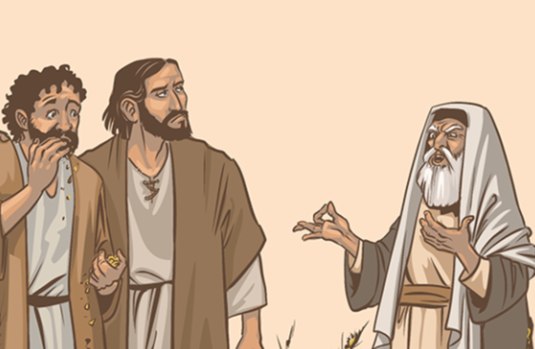
This Sunday, we will be looking at some verses where Jesus is confronted by Pharisees who interpret the law of rest in a way that actually causes more work. Matthew presents a contrast between the heart of the law that Jesus shows us and the rigid religious structures the Pharisees worked so hard to keep in place.

As we read Matthew 12:1-21 together, think about what differences you notice between the Pharisees’ approach and Jesus’ teaching. What might it look like for us to live by the heart of God’s law rather than getting caught up in rigid structures?

I invite you to join us this Sunday at 10:00AM as we read and reflect together on how this passage might apply to us today.

Freedom in Relationship

I know we’re all waiting for this hurricane season to conclude…but God alone controls these things, so we’ll put it in His hands. In the meantime, we will be praying for those who suffered loss in the last hurricane, and let’s stay alert as to how we can assist.

This Sunday we’ll be continuing on in our study of 1 Corinthians, reading ch 10:1-22.

The overall theme of the last several chapters has been our freedom in Christ and what we do with it. We’ve been encouraged to see to it that our Christian liberties aren’t used in ways that harm each other, and now Paul draws the circle tighter, reminding us that we want to exercise our freedoms in ways that are safe for ourselves as well.

In the passage, Paul points to Israel’s history to make his point. When they were led into freedom by Moses, they didn’t manage that freedom well. It’s reminiscent of his warning back in chapter 6: “I’m allowed to do anything…but not everything is ________.” Israel fell into idolatry, sexual immorality and complaining – similar things that Paul warned the Corinthians that they were dangerously flirting with. In what ways can we be careful with our Christian freedom so as not to harm ourselves?

There’s a pretty famous passage in our text this week, where Paul says “He will not allow the temptation [we face] to be more than [we] can stand.” – which is often transliterated as “God won’t give you more than you can handle”…which is exactly not what Paul is saying. We’ll unpack that and try to gain a bit more clarity by untangling that verse on Sunday.

Paul finishes the section by contrasting the Lord’s Table (what we refer to as the Communion Ceremony) with the table of demons. He’s talking about a partnering fellowship – reminding us that we can’t go two different directions at the same time. In our time and culture, we aren’t usually tempted to go participate in pagan sacrifices – but what are some ways in which we could find ourselves invested and partnering with forces that are at odds with God’s intent for life in this world? That will be some challenging stuff to ponder.

Hope you can join us this Sunday as we dig into God’s word together!

Staying Free

One major fear that gets posed whenever Christian freedom is discussed is the concern that it can lead to an antinomian lifestyle – a life with no constraint, living lawlessly. I’ve heard that fear expressed to me many times over the years. Martin Lloyd Jones, the old Welsh minister, famously said that if we aren’t accused of preaching lawlessness, we aren’t preaching grace the way Paul did. He’s right – Paul got accused of that a lot, and had to qualify his emphasis on grace many times in his letters.

This Sunday we’ll be reading Paul’s great rallying cry that boldly proclaims the main theme of his letter to the Galatians. We’ll be starting chapter 5, reading vs 1-12.

Paul states his main thesis in v1a – We are FREE! That’s a statement that carries a lot with it – first, it assumes that at one point, we were not free. Think back through the letter to the Galatians – what has Paul been emphasizing our freedom concerning? Read ch 1:4 to get one perspective of our rescue. Ch 3:10-13 gives another aspect of what we are freed from.

Freedom is sort of a loaded word. Loaded, I should say, with our pre-determined definitions of what it means. Our country, the United States has freedom as it’s centerpiece. How do we as Americans normally define freedom? How would you characterize freedom based on what Paul says we are free from? What differences, if any, can you identify? Which sort of freedom should take precedence in our lives as Christ Followers?

In v1b, Paul exhorts us in light of the thesis. What does he tell us we must do concerning our freedom?

In vs 2-12 of the chapter, Paul elaborates on how we can go about fulfilling that exhortation. As you read those verses, what jumps out to you as practical advice for living free in Christ? The last part of v6 is terribly important. It’s the way that antinomianism, lawlessness, is counteracted when it comes to our freedom.

What do you believe it means that our faith is expressed in love? Love for whom? What will that look like when lived out in real life situations?

I think this will be a really challenging study – I hope you can join us, either in person or online via Facebook or YouTube. We are no longer requiring pre-registrations – but we are asking that we continue wearing masks during the singing portion of our service.

The danger is still real, as we see in the recent development with our President. Please keep him in prayer for a full recovery.

The Sign in the Wine


Our passage for this Sunday is John 2:1-12 as we continue our study in the Gospel of John.

It’s a very famous story – Jesus doing the remarkable thing of transforming ordinary water into extraordinary wine. It is the opening story in a section of stories that have the theme of the old being replaced by the new.

According to v11, why does John include this story in his gospel?

The function of a sign is to reveal where something is – this sign that Jesus does reveals, according to John, the glory of Jesus. His glory is the reality that he is the Son of God bringing God’s reign of grace and truth to this world (1:14).

So – of all things, Jesus chooses THIS setting and THIS miracle as his first sign to reveal what the kingdom of God is coming to do. I find that really interesting. What does this sign reveal to you about the nature of God’s inbreaking kingdom? How does it compare with the way the church represents the kingdom of God – is there a difference?

Think about the nature of water and the nature of wine – what can we discern about God’s presence in the world that is revealed in that contrast? Think about the amount of wine that Jesus creates – what does that tell us about the life God has in mind for us?

The water jars were used for ritual purification. Jesus looks at those reminders of human uncleanness and re-purposes them completely. What lesson does this sign teach us about the nature of what God is up to in our lives?

Have there been times in your life when the wine ran out? How about now? What does this sign encourage you to do about it?

Hope to see you on Sunday!