The Ruin

Have you ever done a diet, say restricting carbs or something? I don’t know if it’s your experience as well, but the moment I decide to cut out carbs the only food I ever think about is full of carbs. “Just don’t think about it, Rob.” – Heh….for me, the moment I’m told not to think about something the only thing I can think about is whatever I’m not supposed to think about. Can I get an “amen”?

I wonder about that forbidden tree in the Garden of Eden – the one tree the first humans were told not to eat from and I wonder if they had that experience too: “All these fruits are great! They’re the BEST!….I wonder what the fruit tastes like on the one we shouldn’t eat?” They were in an idyllic environment, so it’s hard to say if that was a thing, but it didn’t take a very hard push to get them to that tree.

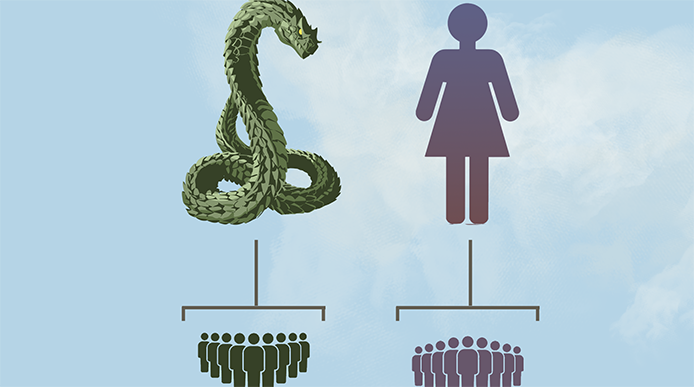
This Sunday we’ll be reading about when everything got ruined – Gen 3:1-7.

How well does a talking snake sit with you intellectually? Is that a hard one for you, and is that easy to accept? I know it’s different for different people. We’ll discuss the nachash, the snake, on Sunday and consider some possibilities.

The text describes the snake as “crafty” – some translations say “cunning” or “subtle”. We usually assign a negative spin on that description, however, a quick word search indicates that it is often used in a positive context, especially in Proverbs. A negative or positive connotation comes down to how that ability is used. What might that tell us about the nature of sin, since the origin of sin is the theme of the text?

In the dialogue that follows, the snake asks a question which the woman answers and the snake concludes the dialogue. Read that exchange very carefully. What jumps out to you, if anything? Read the divine command in Gen 2:16-17 – how does the snake’s quotation match up with God’s words? How do Eve’s corrective quotation match up to the original wording? What do you observe about this – what can it teach us about how we view or interact with God’s words?

The snake suggests that God has been holding out on the humans. He tells them they will achieve something if they take matters into their own hands – what does he say they’ll become? How does Gen 1:26-27 reflect on what the snake was offering? What could that tell us about the nature of temptation?

Read Gen 3:6 with 1 John 2:16 – what parrallels can you find between Eve’s consideration of the fruit and John’s warning about what the world offers?

I’m really looking forward to this study – I hope you can join us. We’ll be observing the communion ceremony after the teaching!

The Rescuing Counterpart

This Sunday is Mother’s Day and coincidentally enough, in our study we’ll be reading about the very first mother, the creation of Eve. We’ll be continuing our study in Genesis, reading ch 2:18-25.

Once again, I want to remind us to manage our expectations when we come to a study like this. Remember, Genesis isn’t a modern science text-book – it is sacred spiritual literature – and we are approaching it to discover its theological truths. We’ll be reading about the creation of a counterpart for the human (Adam), and we’ll consider what this part of the story is trying to tell us. Whole fields of ideology on gender and gender roles have been derived from this section, for good or bad. Issues of gender are in the foreground of the text, but whether or not they’ve been well understood is another matter.

As you read the text, you’ll see we are confronted with another obstacle, maybe even crisis, since it is described as “lo-tov” – not good. What is it? God determines to resolve or eliminate the obstacle by providing a “helper”, which was “just right/suitable” for him.

The word “helper” in the Hebrew is EZER. Now, if you’re interested, click HERE to look at the word and a concordance list of all the times that word is used in the Hebrew bible. As you examine the passages, how might it indicate what an EZER is – that is, is it describing a subordinate who assists, or something else? Does its usage elsewhere inform you about the nature of the EZER God provides for the solitary human (Adam)?

When it describes the EZER who is “suitable” for Adam, that word is NEGED in the Hebrew, meaning “in front of, or opposite of”, like a mirror. Again, does that seem to imply someone inferior, superior, or an equal?

We’ll look at the woman’s formation, and the deep sleep Adam goes into, and consider the significance of that. Adam began alone, then the one became two, for the purpose of becoming one again. While this certainly has the marriage relationship in view, this idea spills over into a variety of relationships, not least of which is the one we have with the church in Christ. There is a pattern being revealed in this – one which carries through the entire biblical narrative, landing at John 17 and arching like an arrow through the NT epistles.

This has the potential of being an intense study – but one that can be inspiring, albeit, challenging to some of our pre-loaded assumptions about the nature of humanity as God has made us. I hope you can join us this Sunday at 10 AM!

Origin and Destiny in Eden

Do you remember the old Mad Magazines, how the inside back page was an Al Jaffe cartoon that had an image on it which, if you folded it in, created another image which was a commentary on the first. I used to love those things. In many ways, the book of Genesis, if we metaphorically folded it to touch the book of Revelation, operates similarly. We begin and end in a Garden…and everything in between functions to elaborate on that hope. The imagery of the first few chapters of Genesis unlock the meaning of the imagery used in the rest of the Biblical narrative.

 We’ll be returning to our study in Genesis this Sunday, looking at Gen 2:8-17.

In Gen 2 we are introduced to the Garden of Eden, Adam (the human) in connection with it, and the two trees in the center of it.

Most of us have picture book ideas in our heads about the Garden of Eden – an image of an entire world in a tropical paradise setting and nothing unpleasant anywhere around. But the Genesis narrative doesn’t really validate that picture.

For instance, as you read v8; is all the land Eden? Is all of Eden a garden? Was the human “formed” in the garden? All of this implies that there is something outside that paradisical space. Isn’t that intriguing? Eden was an anomaly in the midst of non-paradise. A project begun to which we will return.

On Sunday we’ll look at the significance of the river that comes from Eden, and where it flows to.

What do you make of the trees and the warning God issues to the human? What is the first part of God’s command? Do you find it interesting that God leads with an invitation to enjoy what he’s made? Does that influence your understanding of the warning God concludes with?

If the human was made from dust (stuff of mortality), what does the Tree of Life represent to him? The forbidden tree is not the Tree of Good and Evil- it is something else – what word comes before good and evil? How would you interpret what that means?

We have a really interesting study in front of us – I hope you can join us this Sunday as we dig into this together!

The Mission Continues

I still remember one of the most often repeated phrases I heard after Hurricane Michael was: “I just can’t wait for things to get back to normal”. It was an understandable sentiment. Whenever we go through times and circumstances that push us out of our regular patterns in life, as when life is hard and confusing, we just want to get back to something familiar so we can try and reorient ourselves. It’s a typical response.

We’re going to be reading about Jesus’ disciples doing just that as come to the final chapter in our study of the Gospel of John this Sunday. We’ll be reading John 21:1-25. Peter and six other disciples don’t quite know what to do with themselves after all of the events that unfolded in Jesus’ execution and then mind-blowing resurrection. They probably had hoped that the skies would rain fire and Rome collapse in a blaze…but none of that stuff happened. Instead, life seemed to just go on and Jesus only seemed to pop in on them sporadically, and I’m sure it all felt really surreal. It makes sense to me that they wanted to get back to what they knew how to do, fishing.

However, now that Jesus is on the loose, things done under their own initiative seem to result in frustration (v3). Have you ever experienced that? Have you ever not known what God is up to and so in exasperation just decided to go back to old habits and patterns you had before meeting Christ? What were the results, and what can we learn from that?

Jesus’ interaction with Peter is, to me, one of the most moving scenes in all of the Gospels. What significance do you see in Jesus inviting Peter to confess his love for Jesus three times? How could this interaction provide a sense of closure to Peter? What can that tell us about our own failures and Jesus’ intent?

Jesus doesn’t just let Peter say words, he commissions him with a way of demonstrating his love for Christ. How does Jesus indicate a love for him is revealed? Is it something we can do in isolation, and if not, what does that tell us about our Christian priorities?

Jesus finishes his instruction to Peter by commanding him to follow. What does it mean to you to follow Jesus? What does it look like for a 21st Century American Christian?

I’ve really loved this gospel. We’ll have one more study after this Sunday where we wrap up all the themes we discovered. I hope it’s not the last time you visit this gospel…we barely scratched the surface of it. I truly hope you go there often, and go looking for Jesus in those words.

I hope you can join us this Sunday at 10 AM!

A New Creation

The creation account in Genesis begins in the dark: “In the beginning God created the heavens and the earth. The earth was formless and empty, and darkness covered the deep waters. And the Spirit of God was hovering over the surface of the waters.”. God intervened and spoke light, order and life.

All of that went wrong when a man and a woman stood in a garden and rejected God’s rule. As a result, darkness, chaos and death again captivated the scene.

The gospel of John echoes a lot of those themes in his account of Jesus, and maybe none more so than in the section we’ve come to in our study of John. We’re going to be reading John 20:1-18 this Sunday, the account of Jesus’ resurrection from the dead.

The main purpose of John’s gospel, as he explained in chapter one, is to let us know that all that Jesus did and taught was revealing what God is like and what God is up to – and here in his resurrection we see it in full bloom: redemption; new creation….RESURRECTION!

As you read this account, put yourself in the place of Peter and the DWJL (the disciple whom Jesus loved) – how do you think you would have reacted to Mary’s news? What would you think was going on initially?

V9 says Pete and the DWJL returned to their own home (literally, to themselves). What ways do we turn back to ourselves when we go through dark and confusing times?

Mary was inconsolable. She was on task: find the corpse of Jesus and get it re-buried. She was so miserable and fixated on that problem that she didn’t even realize the solution to her dilemma was standing right in front of her. What can that tell us about how we perceive our troubles – how should resurrection and new creation affect our expectations?

Jesus and Mary are pictured standing in a garden – what does this harken back to? What is this image revealing to us about what has happened in Christ’s resurrection?

If I asked you who the first evangelist, ambassador, teacher and missionary of the gospel was…who would you say? I know who v 18 says it was.

This is the landing place that all of John’s gospel has been leading us to – I really hope you can join us this Sunday as we dig in and explore this passage together!