
Identity Issues

One thing about human society throughout history is, we love to label stuff…especially people. It’s usually born from a quest of trying to get a grasp of who our fellow human is by generalizing them. It’s easier to interact with someone if we can fit them neatly into our categories. But this is, of course, a broken way to relate to people. In our study of Matthew, we’re going to read a theme that is carried over from last week…that of people trying to get a handle on who Jesus is. We’ll be reading Matthew 12:38-50.

In the last section, Jesus challenged those who heard him to make a decision, one way or the other, and neutrality was not an option.  Carrying the theme through,  Jesus knew there were a lot of people wanting more proof that he was Messiah via some supernatural sign from heaven, so he did what any self-respecting Messiah would do; he called them all evil.  Kinda’ cool if you think about what terrible marketing that is.

Jesus mentions the “sign of Jonah”, which has had a lot of people theorizing about its meaning for the last 2,000 years.  There are some obvious parallels between Jonah and Jesus and his resurrection.  What do you think the “sign of Jonah” is?

Why would the people of Nineveh and the Queen of the South, both pagan, gentile peoples, have a place to condemn Jesus’ generation of chosen people?

How did Jesus identify who his family of chosen people are? What do we make of that when it comes to understanding our own identity as followers of Jesus?

There is some really profound insight about who Jesus is and who we are in this section – I hope you can join us as we explore this text together!
Choosing Sides

We live in an extremely polarized society. Everyone seems to want to divide up into teams. Usually these divisions are along socio-philosophical lines. But some choices we are confronted with have big consequences.

We’ll be considering that in our study of the Gospel of Matthew this week.

In our text we’ll be reading this Sunday, Matthew 12:22-37, we are confronted with a choice between two worldviews. It’s a fairly uncomfortable passage, but it’s there, and we need to wrestle around with it and see how it will shape our lives.

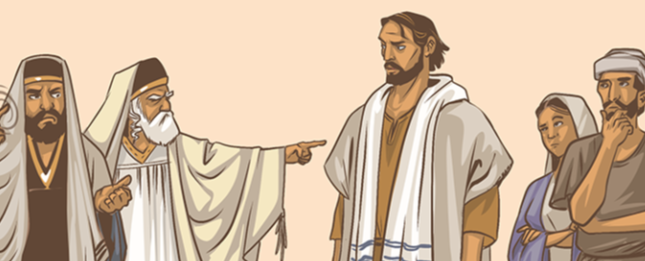
As you read the text from v22-24 you see right away that Jesus has a polarizing effect on people. There are two very distinct opinions forming about him. Jesus will latch onto that and develop a picture of the world in stark contrasts between good and evil.

Jesus’ counter argument from v25-30 starts with a logical premise that brings to the surface the dualistic view of this world. There is a kingdom of our enemy, the devil, and there is a kingdom of God. He clearly portrays these at odds with each other and in conflict. His logic is pretty simple: why would the devil be working at cross purposes against himself? Which reveals something about the nature of Jesus’ mission. In fact, v29 pretty much describes what Jesus is up to. Who do you think the “strong man” is? What is the house and what is the plunder that is taken (put it in the context of what started this whole thing in v22 – the healing of the demon possessed man)?

V31-32 has had the effect of scaring some people, especially those new to the faith. They worry that Jesus is describing some partially identified way of sinning that can never be forgiven if committed. Have you ever worried about that? Just to put your mind at ease, that’s not what he’s trying to say. He’s talking about how the Pharisees were claiming that the devil was the source of Jesus’ work. If they reject Jesus and the salvation that’s offered, there’s no other way offered that provides forgiveness. We’ll unpack that more on Sunday.

V33-37 deals primarily with our use of language. The words we speak and the way we communicate reveals something about ourselves. How can we see to it that the words we communicate are in harmony with the purposes of God’s kingdom in this world?

Hope to see you this Sunday!