
Staying the Course

We’re coming back to our study in the gospel of Matthew, reading chapter 4:1-11 this Sunday. In stepping into the human experience, Jesus faces temptation to leave God’s intended path for him. In fact, the account of his temptation in the desert is a sweeping overview of the nature of our temptations. Do you ever feel bad for being tempted by things you feel you should have conquered by now? Remember this: Jesus was tempted too. What does that tell us about how we should understand our own temptations? There’s an old saying, attributed to Martin Luther, that states we’re not responsible for the birds that fly overhead, only the one’s we allow to nest in our hair.

The first temptation that is presented to Jesus is found in v1-4. It wasn’t wrong or evil for Jesus to be hungry. He certainly was given power to do miraculous things with bread – he’ll supernaturally provide enough bread to feed thousands of people out in the desert later on in this story. Why was this suggestion to make bread from stones a temptation to sin? Jesus quotes Deut 8:1-3 – read the whole context. Did Israel go hungry in the wilderness? Who provided for them? How does that help us understand what “living by God’s word” means?

Next Jesus is tempted to jump from the highest point in the temple (v5-7). Again, this is similar to something Jesus will do later on – he won’t walk on air, but he’ll walk on water, defying the laws of physics. What is the temptation to sin in this suggestion of stepping out in faith that God will rescue him? What clue do we get from Jesus’ response in v7?

The final temptation recorded in this account is in v8-11. Once again we have the contrast of human kingdoms with God’s kingdom. Worship me, the devil says, and you will be King of kings. Interesting, since that is ultimately what Jesus is called – and the last book of the Bible says in Revelation 11:15 that the kingdoms of this world will become the kingdoms of our Lord. Why is this a sin if it’s the fulfillment of his destiny anyway? What does Jesus have to go through in order to be exalted? What sort of King of kings and Lord of lords does it make him when he was willing to die for us?

In each of these temptations there is a forecast of something Jesus will ultimately do. The difference is in how it gets fulfilled, and by whom. Where do we look for our fulfillment as human beings? A lot of things in this world promise fulfillment and wholeness – but Who holds the true source of wholeness? What has your experience been in looking for fulfillment in the things we can grasp for in this broken world? How can that instruct us?

I think this will be a challenging, yet hopeful study! Hope you can join us on Sunday!

The Ruin

Have you ever done a diet, say restricting carbs or something? I don’t know if it’s your experience as well, but the moment I decide to cut out carbs the only food I ever think about is full of carbs. “Just don’t think about it, Rob.” – Heh….for me, the moment I’m told not to think about something the only thing I can think about is whatever I’m not supposed to think about. Can I get an “amen”?

I wonder about that forbidden tree in the Garden of Eden – the one tree the first humans were told not to eat from and I wonder if they had that experience too: “All these fruits are great! They’re the BEST!….I wonder what the fruit tastes like on the one we shouldn’t eat?” They were in an idyllic environment, so it’s hard to say if that was a thing, but it didn’t take a very hard push to get them to that tree.

This Sunday we’ll be reading about when everything got ruined – Gen 3:1-7.

How well does a talking snake sit with you intellectually? Is that a hard one for you, and is that easy to accept? I know it’s different for different people. We’ll discuss the nachash, the snake, on Sunday and consider some possibilities.

The text describes the snake as “crafty” – some translations say “cunning” or “subtle”. We usually assign a negative spin on that description, however, a quick word search indicates that it is often used in a positive context, especially in Proverbs. A negative or positive connotation comes down to how that ability is used. What might that tell us about the nature of sin, since the origin of sin is the theme of the text?

In the dialogue that follows, the snake asks a question which the woman answers and the snake concludes the dialogue. Read that exchange very carefully. What jumps out to you, if anything? Read the divine command in Gen 2:16-17 – how does the snake’s quotation match up with God’s words? How do Eve’s corrective quotation match up to the original wording? What do you observe about this – what can it teach us about how we view or interact with God’s words?

The snake suggests that God has been holding out on the humans. He tells them they will achieve something if they take matters into their own hands – what does he say they’ll become? How does Gen 1:26-27 reflect on what the snake was offering? What could that tell us about the nature of temptation?

Read Gen 3:6 with 1 John 2:16 – what parrallels can you find between Eve’s consideration of the fruit and John’s warning about what the world offers?

I’m really looking forward to this study – I hope you can join us. We’ll be observing the communion ceremony after the teaching!

Tempted to Evade

If you’ve ever dieted, either to shed a few pounds or because of health reasons, what is the main thing you think about whilst denying yourself of some type of food? I can’t speak for you, but I know that most of the time all I see are visions of corn-dogs dancing in a chorus line singing “We taste great with MUSTARD!”. That’s a fascinating thing about the human experience: we have strong urges and desires for whatever it is that is that is generally not good for us.
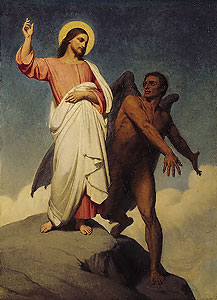
In a theological framework we talk about sin, but sin is simply the determination to do what we want instead of what God intends. It is the evasion of God’s rule over our lives and we are tempted to evade God on a regular basis.

We’re coming back to our study in the gospel of Matthew, reading chapter 4:1-11 this Sunday. In stepping into the human experience, Jesus faces temptation to evade God’s rule as well. In fact, the account of his temptation in the desert is a sweeping overview of the nature of our temptations. Do you ever feel bad for being tempted by things you feel you should be beyond in your Christian walk? Remember this: Jesus was tempted too. What does that tell us about how we should understand our own temptations? There’s an old saying that we’re not responsible for the birds that fly overhead, only the one’s we allow to nest in our hair.

The first temptation that is presented to Jesus is found in v1-4. It wasn’t wrong or evil for Jesus to be hungry. He certainly was given power to do miraculous things with bread – he’ll supernaturally provide enough bread to feed thousands of people out in the desert later on in this story. Why was this suggestion to make bread from stones a temptation to sin? How do you think this would this be evading God’s rule? What clue does v4 provide for us?

Next Jesus is tempted to jump from the highest point in the temple (v5-7). Again, this is similar to something Jesus will do later on – he won’t walk on air, but he’ll walk on water, defying the laws of physics. The devil quotes scripture to back up the suggestion. That’s something to ponder for a while. When people say “God said it, I believe it, that settles it” – why would that not apply in a situation like this? Why would it matter who is speaking God’s word? What is the temptation to sin in this suggestion of stepping out in faith that God will rescue him? What clue do we get from Jesus’ response in v7?

The final temptation recorded in this account is in v8-11. Once again we have the contrast of human kingdoms with God’s kingdom. Worship me, the devil says, and you will be King of kings. Interesting, since that is ultimately what Jesus is called – and the last book of the Bible says in Revelation 11:15 that the kingdoms of this world will become the kingdoms of our Lord. Why is this a sin if it’s the fulfillment of his destiny anyway? What happens before Jesus ascends to the right hand of the Father? What does Jesus have to go through in order to be exalted? Who’s will is he serving before he can be King of kings and Lord of lords?

In each of these temptations there is a forecast of something Jesus will ultimately do. The difference is by whom it is fulfilled. Where do we look for our fulfillment as human beings? A lot of things in this world promise fulfillment and wholeness – but Who holds the true source of wholeness? What has your experience been in looking for fulfillment in the things we can grasp for in this broken world? How can that instruct us?

Whelp – it will be an intense study, but comforting all in all. Hope to see you then!

Temptation: Settling for Less

Hey, hey!  I’m finally back to somewhat normal patterns, which leads me back to Wonderwhat!   I’ll do my best to keep updating with thoughts about our upcoming studies, but I will warn you that for the next month or so, I’ve got a lot on my plate.  For the last year, Ken Raney of Clash Creative has been negotiating with Voice of the Martyrs to do a series of graphic novel adaptations of some of the stories of triumph that have come from Christians who have endured persecution in closed nations.  I was asked to participate in this project, and a few weeks ago, they finally gave the go-ahead.  Needless to say, I have a lot of work ahead of me in laying out, penciling, inking and hopefully coloring said project.  Ben Avery wrote a compelling script…which has had me in tears multiple times as I’ve tried to convey this story through pictures.  Pray for me if you think of it…I need to learn how to draw and fast….I want, with all my heart, to do this story justice.

This Sunday we’ll be looking at Luke 4:1-13.

It’s a fascinating passage about the temptation of Christ in the wilderness.  It provides us food for thought concerning our own struggles with temptation…but it also gives us an amazing insight into just what kind of Messiah Jesus intended to be (and IS).  Jesus had to break with many of the expectations concerning the messiah in His day, and we see that the break from accepted patterns wasn’t just a public thing…it was initiated in the most private of times, alone and unobserved.

Here’s something interesting: if you get the chance, read Deuteronomy 8 and then read Luke 4:1-13 right after it.  What connections do you see?  Do you think there was a point being made in the nature of the temptations recounted in Jesus’ story?  Beyond that, what do we learn about the nature of temptation in general?  If we describe it as settling for less…less than what?  What do we learn about how to resist temptation from Jesus’ story?

This should be an interesting study…hope to see you this Sunday!