Trusting in Christ’s Authority

How difficult or easy is it for you to trust someone? For many people, trust is a hard commodity to come by. A lot of factors go into that – past experiences and a host of other reasons can make us reticent with our trust…and those are people we can SEE and examine and evaluate on a regular basis.  What about a God who we can’t see and who sometimes feels like he’s hiding himself?

Still, that’s the whole thing when it comes to Scripture. We are continually called on to trust God – and in the Good News of the Gospel, to trust in the authority of Jesus.

This Sunday we’ll be reading chapter 8:23 through chapter 9:8  as we journey through the gospel of Matthew. The chapter break really shouldn’t be there, because this whole section belongs in a single grouping. Three areas where Jesus demonstrates his authority to encourage our trust in him, even as we follow him into potential hardships. They link us back to the creation story in Genesis as well as the Exodus; God bringing order to the chaotic waters, subduing spiritual evil and reconciling us to God.

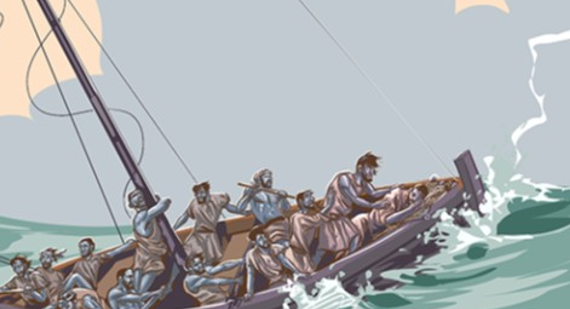
In chapter 8:23-27 we have the famous account of Jesus calming the storm. Have you ever felt like Jesus was sleeping while you were going through severe and stressful times? What does he ask his disciples? In our own storms of life, how can asking ourselves the question “why are you afraid?” help to orient our thinking and perspective?

In v28-34 Jesus heals two men who were demon possessed. How comfortable are you with the idea that there are demons on the loose in this world, taking possession of people sometimes? Our western culture mostly dismisses that notion as primitivism – but I think we need to be cautious about adopting the hubris of our rationalistic culture and leave room for mystery. Jesus demonstrates his authority over evil. How does that develop our understanding of his words in the Lord’s Prayer “deliver us from evil” – and in what way can that inspire our trust? What should our response to evil be, in light of his authority over it?

Chapter 9:1-8 tells the story of Jesus healing the paralyzed man. Before he heals him, he forgives his sin. Then he demonstrates his authority to forgive sins by healing the man’s physical body. What does his authority to forgive sins inspire you to trust Him with? What did the paralyzed man do to deserve that declaration of forgiveness?

Troubles from without, in the natural world and the spiritual one, and troubles from within in the form of our own failures – Jesus has authority over them all. What will you trust Him with?

Hope to see you this Sunday!

The Story of Faith

My formative Christian years were spent embracing what has popularly come to be known as “the health and wealth” gospel. I was told that if I had the right amount of faith, I could get God to do my bidding and provide me fabulous toys and inexhaustible wellness. Hebrews chapter 11 was a go-to source for the teaching of this persuasion. Over and over again I would be challenged with the anthem: “Faith is the substance of things hoped for, the evidence of things not seen! By FAITH they obtained the promises!”, which by application meant that through the exercising of faith I would obtain the (presumed) promise of a new model automobile. If I was still driving a rusty Pinto, it was my fault for not having enough faith to bring my desires into existence.

How did we draw that conclusion from Hebrews 11? Very simply. We NEVER read it in one sitting. We never put it all together to get the sweep of the story, nor did we ever place it in the larger context of the whole book. We dunked into it like we were bobbing for apples, coming up with a prized proof text in our teeth and demanding God’s unconditional surrender to what we “discovered”.

Needless to say, I don’t read Hebrews 11 that way anymore. I certainly won’t teach it that way this weekend. Nor will I break this lengthy chapter up to provide bite-sized sermons about Old Testament Heroes. *You’re sounding a little curmudgeonly Rob.*  – Sorry. I don’t mean to. It’s just that I’m pretty passionate about getting at the heart of what the writer is communicating in this chapter. It’s really very cool, but not what many people suppose. I really believe this is a chapter that needs to be read in one sitting to get the sense of emphasis I believe the writer intends.

You should read Hebrews 11. As you do, remind yourself of the overall point of this letter: encouraging Jewish believers not to give up their faith in Jesus as the Messiah because Jesus is greater than the Old Covenant system they had known. They were discouraged because they were facing persecution (as we learned in chapter 10) and Jesus hadn’t yet returned  – so Hebrews 11 presents a case for holding on by faith.

V6 of this chapter gives us the primitive core of a life of faith. How would you paraphrase what the writer is saying? Describe what that would look like in your life.

In this long list of characters, what is the consistent situation that must be faced by those who are holding on by faith? V13,19,22 and 39 can give you a hint. What direction does faith look? What impact did their faith have on how they viewed this present life?

How was Moses’ faith expressed according to v24-25? How does that influence our understanding of faith as it relates to the choices we make in this present, fallen world?

Man….I’m sorta’ stoked about this chapter. Hope you can make it this Sunday as we explore it together!

Also, here are the songs we’ll be singing:

Divine Romance

Glory to God Forever

Spirit of the Living God

Whom Shall I Fear

Hallelujah What a Savior

When Life Gets Stormy

2011-01-14-43I’m really excited about being back at Eastgate this Sunday! I had a great vacation, but I’m stoked about getting into the Gospel of John again! This Sunday we’ll be reading the account of Jesus walking on water, found in John 6:16-21.

Right after the miracle of Jesus multiplying bread so that more than 5,000 people could eat and have leftovers, we step out into troubled waters. Life seems to have that pattern to it, doesn’t it? We go from this idyllic scene where Jesus has everyone sitting on soft, green grass and is handing out snacks, to a scene where all hell breaks loose and Jesus seems nowhere to be found.

We’ve all experienced that sort of thing, haven’t we? It may not be literal boats and waves, but storms have a tendency to hit our lives. The Bible doesn’t ever seem to indicate that we won’t face times of trouble.  But this short account of this amazing event can clue us in on what significance our storms may have.

As you read this story – consider a few questions: Was Jesus really nowhere to be found in their crisis? Where did Jesus make himself known to them? What was the biggest issue facing the disciples, and how did they respond to it? How effective was the disciples’ rowing against the wind in getting them to their destination? What changed so that they finally reached the shore?

When you consider the storms you face(d) in life – what lessons can you glean from this account? In what way does this story encourage or challenge you as you deal with circumstances that oppose you in life?

When the waves are buffeting you and the wind is resisting you – take a moment to listen, you may just hear “It is I; do not be afraid”.

See you on Sunday!