Contrasts of the Cross

Image result for cross and shadowsHow many of us have had our lives go exactly as we planned them to go? I would venture to guess very few. I know that my dreams from just a young child were to be a cartoonist or comic book artist. God, of course, had other plans. It’s intriguing to me how often we struggle with the turns that life takes, wondering why God doesn’t change things. We can look at this broken world of wars and crimes and disease and wonder if God really has a plan at all. Then I look at the cross – and I’m reminded that God’s plans don’t always look the way I would assume they should. I remember how much beauty can actually emerge from the depth of suffering. How much hope can be found in the presence of sacrificial love.

This Sunday we’ll be reading Matthew 26:1-16 – entering the final stages of the gospel drama.

The story begins with Jesus giving one of his clearest predictions of his upcoming death so far. He even indicates when it will be taking place. What does that tell us about the nature of Christ’s death? Was it an accident? Was he pushed into a corner where he couldn’t escape? What does his foreknowledge reveal about his mission?

In contrast, look at the religious leaders conspiring to have him murdered. They considered themselves representatives of God; doing God’s work. Look at what morals, values and commands they were willing to throw aside in order to keep their place of political power. What contrast do you see between Jesus’ willingness to die and their schemes? How does our present day, Evangelical church measure up when compared to the cross?

The woman who brings the perfumed oil and pours it on Jesus (weird thing to do…but I’ll explain it a bit on Sunday) is commended by Him. He described it as anointing him for burial, tying this act to His upcoming sacrificial death. If we look at her example, what would we say the cross of Jesus can inspire in our lives? What do you think Jesus meant by indicating her actions would be remembered when the Good News is shared?

What question does Judas ask? How does that contrast with Jesus’ cross and the woman’s sacrificial devotion? If we’re not challenged by this, we’re not thinking it through. The cross exposes something here in Judas. What are our motives for following Jesus? If it cost us everything, would we still be faithful? How can the cross reshape our values and form us into better people?

Hope to see you Sunday! Surf-N-Grill is supposed to be happening – but the weather just doesn’t seem cooperative with our plans (with a nod to my opening paragraph). Let’s hope for some clearer skies!

Risky Mission

Image result for parable of the talentsWhelp – my latest Grandson is in town and he brought his parents, which got me delayed in posting about our teaching this Sunday.

This week we’ll be reading a very familiar parable – the parable of the Talents, in Matthew 25:14-30.

As you read this story, remember that parables aren’t meant to be exact representations of God’s kingdom in all the details. Jesus said it is “like” this sort of thing. The most important element of this story to discern is just what Jesus meant the talents to represent. A talent was a sum of money in Roman currency.  We get our English word “talent” from this parable, interestingly enough. Do you think Jesus is talking about money? Probably not, since money is the metaphor he’s employing. Do you think he’s talking about our skills though? What else do we know that God has entrusted to us, his subjects, to manage while our King isn’t presently seen?

The element of investing the talents is intriguing to me. It carries the implication of risk-taking. What would taking risks with what God has entrusted to us look like in our lives? What would it look like in our churches?

The third steward in this story seemed to speak respectfully to his master. But what do you think his actions actually revealed? Contrast the way the first two stewards interacted with the master and the third stewards assessment of what the master is like. What do you make of that contrast, if anything? Here’s a hint – how did the Pharisees understand God in contrast to Jesus’ revelation of God?

This should be an intriguing story to consider! Hope to see you tomorrow!

Prepared to Wait

Image result for crazy wedding themesDo you like weddings? What is the craziest wedding you’ve ever attended or seen? It seems like every culture has a different approach to weddings and the rituals associated with them. This Sunday, as we continue our study in Matthew, we’ll be reading about the unusual wedding rituals of ancient Palestine as we study chapter 25:1-13.

As you read the parable that Jesus tells, what do you believe the main point is?  How comfortable or uncomfortable are you with discussing the end times? If you knew for sure that Jesus was going to return within the next hour, what would you do differently?

It’s interesting to note that both sets of girls fell asleep while waiting for the bridegroom. The only time the differences began to show up between them was when the alarm was sounded. One group was prepared, one was not.

In what ways can we see to it that we are prepared for the reveal of Christ as King?

Looking forward to being back! See you on Sunday – and don’t forget Surf-N-Grill is on! Finally!


Living Like the World’s Ending (2)

Related image

This Sunday we’ll be continuing our trek through Matthew 24, reading v15-35. Much of what Jesus predicts in this section deals with the upcoming siege of Jerusalem, a prediction that was fulfilled in 70 AD.

As we did last week, we’ll focus on the instructions we receive from Jesus concerning how we respond and live in light of the temporal nature of this world’s systems. As  you read through the passage, pay attention to the places where Jesus gives specific instructions to his disciples and consider how those instructions would apply to our lives in this present world.

I think this week instead of writing a lot of stuff here, I want to share a link to a short  history lesson about the events of 70 AD. It is really important for any student of the gospels and the New Testament to have a working knowledge of those events – and this video are very well done with some excellent visuals.  Hope you find the time to watch it!

Living Like the World’s Ending

Image result for failed end of the world predictions

I’ve lived through a lot, and I mean a LOT of predictions that the world is going to end at a specific time. Growing up in an Evangelical home, I was weened on movies like “A Thief in the Night” and songs like “I Wish We’d All Been Ready”. As our culture was feeling the effects of a revolutionary upheaval in it’s values and beliefs during the 60’s, many sincere Christians were looking to the Bible for answers as to what it all meant. For many in the Evangelical church, the answer was clear – the end of the age is upon us. This, of course, was nothing new to church history. For 2,000 years as cultures and values changed, as wars and natural catastrophes struck the earth, the church has always (and rightly so, in my view) looked longingly towards heaven and wondered if this is the time that this broken world will finally be redeemed by the King.

 Apocalyptic speculation is sensational stuff. I know during my youth I was always intrigued with scenarios presented about possible timelines and what specific current events could be revealing about when the end would come. It filled me with a lot of emotional sensations – most notably, fear. I wasn’t alone in that. In talking with many of my peers, both then and now, the fear of missing the rapture and facing the Great Tribulation was a driving force behind much of our adolescent spirituality. On more than one occasion as a young boy I found myself alone in the house and assumed the rapture had happened and I’d missed it.  Much of that fear had to do with a works view of salvation which I wasn’t disabused of until many years later – but still, I can safely say that fear was not a sustainable motive for me.

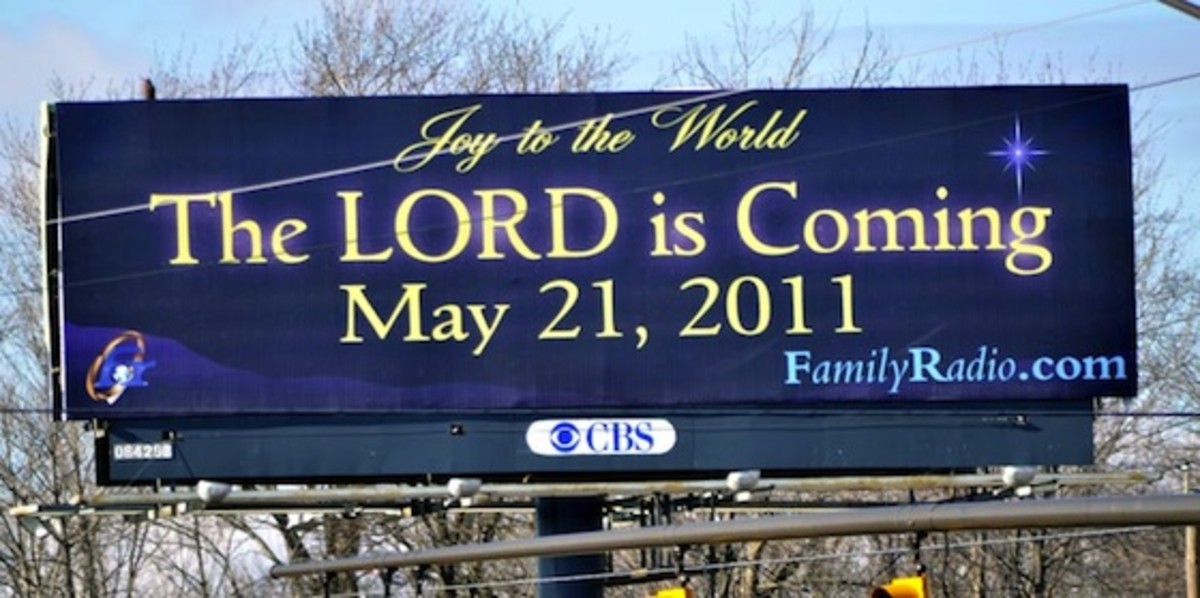
The danger in it all is an obsessive fascination with signs about the end. The problem with this sort of enthrallment with sensationalism is that it tends to spawn a lot of dubious revelations. Some people get very wealthy from that sort of thing. Harold Camping sold a lot of books in 1993, and again in 2010 and yet more in 2011 – and in each he was predicting the time of the rapture for the following year. It didn’t happen, just so you know. In all fairness though, book sales aside, I certainly can’t judge the sincerity of teachers who make claims about the end of the world. I would assume the motive is to stir up a fervor and passion for the appearing of our Lord – and I can’t see that as a bad thing. I can say, however, that it runs contrary to the way Jesus himself talked about these things.

We’ll be starting chapter 24 of Matthew’s gospel this Sunday reading the first 14 verses. Needless to say, this will not be a teaching which tells us when the world will end. What we’ll learn from Jesus is that there is a presupposition of the world’s ending. It’s how we live in the time we have that’s truly important.

v1-3 give us the overall heading of this section. Jesus predicts the end of something – what is it? The disciples ask him when this will happen, and what sign to look for to signal his coming. Do you find that odd? He’s right in front of them – why are they asking about his coming? They didn’t expect him to leave – what were they talking about? The word “coming” in the Greek is “parousia” – the arrival of a king. They are asking when he’ll be revealed as King and bring the present, broken world to it’s conclusion. They don’t realize it, but they are asking two different questions. What then, are the two subjects in view in this section?

Jesus describes things that sound like current events to us and could be alarming – except for what Jesus says in v6. What are these events, in his view?

Instead of giving his disciples a straight forward answer about when these things would happen – what does Jesus say to his disciples as instruction? (hint: v4, v6, v13)

Before things really end, what is happening according to v14? What is our mission then, in light of the end? How does knowing when the end may come have any bearing on what our mission is? Does it change? If not, what does that tell us? If so, how?

See you this Sunday!

Jesus Critiques the Leaders – or – Woe, Dude!

Image result for woah, dudeHey all – this Sunday we’ll be reading Mathew 23 – yes…the entire chapter. There are actually only a few themes in this chapter, it’s just that they are repeated a lot. It’s a challenging text to distill for modern, Western, sequentially oriented thinkers. We’ll give it our best go!

In this chapter, Jesus sort of goes all Gordon Ramsay on the Pharisees and Scribes! As you read the entire rebuke that Jesus gives to the religious leaders of his day – what is the overarching theme that you pick up on? What do you believe he reserves his scorn for?

It would be very easy to keep this text isolated to the temple leadership of Jesus’ day, but that would be a mistake. In what ways can you pick up on parallels between the religious culture of Jesus’ day, and our present day Evangelical culture? If you were able to communicate a warning to our church from this text, what would be the most important part of Jesus’ rebuke you’d apply?

Heavy stuff – but…Surf-N-Grill is this Sunday…so it evens out, I guess. See you then!

The God of Life and Love

The human condition is one that, all through our history, has desired to extend our existence behind this present life. In the ancient world, kings assumed that they could immortalize themselves by building great cities and monuments. The above sonnet by Percy Shelly illustrates the grand futility of such a pursuit. The sands of time have a way of grinding all our achievements down.

Try as we do, humanity can’t seem to pull off an extended existence. That reality has had a side-effect of cynicism that also traces its way through history – where the idea of any postmortem existence is dismissed. “This life is all there is, let’s eat drink and be merry, for tomorrow we die”.

We’ll be reading about a group of people, the Sadducees, who were themselves cynical of any notion of life after death. We’ll be reading Matthew 22:23-46.

The Sadducees pose a riddle to Jesus about a hypothetical conundrum which could occur in a resurrection of the dead in a case of levirate marriage. It’s a silly question – and Jesus seems to give a dismissive answer – but in reality, he uses the situation to express an important truth about God’s purpose with humanity. What is the emphasis of v32? What does that tell us about God’s intentions for those who will believe him?

After the Sadducees fail, the Pharisees send in a lawyer. Not that kind of lawyer – but one who was an expert in Jewish law. He asks a very common question debated by the rabbis throughout the history of Israel. What commandment is of supreme importance to God? In Jesus’ answer – what priority to we discover? How does his tethering of the WHOLE law to these two commandments reveal what God’s primary interest is for us as his followers?

In what ways do you find Jesus’ answer comforting? In what ways do you find it challenging? How can we more faithfully embrace and express the primacy of love?

Looking forward to exploring this together on Sunday! See you then!

The Kingdom Party

Image result for extravagant little mermaid birthday party

When my kids were all in grade school and younger, we lived across from a neighborhood that was way above our means. When our oldest daughter made friends in school, the inevitable birthday party invites went out. My wife and I were stunned at how elaborate and grand the parties were for kids from that neighborhood. Fully themed Little Mermaid extravaganzas were in vogue then, as I recall. The cost of one of those parties probably matched my yearly income.

What is the biggest, most elaborate party you’ve ever been invited to? Did you enjoy yourself or was it challenging to be there?

No matter how big the party was that you attended, I can guarantee it didn’t hold a candle to ancient royal feasts. They were known to last up the 10 days. Even into the medieval period, England and France threw a joint party that lasted for 17 days in a huge field, where everyone was given coats woven with silk and gold.

This Sunday we’ll read a story told by Jesus about a party thrown by a king who gets snubbed. It’s a curious story, not without it’s critics. We’ll be reading Matthew 22:1-14.

Who do you believe the king is in this story? Who is the son? Who do you believe the people snubbing the invitation represent? Who do you think the replacement invitees are? If you said, respectively, “God, Jesus, the Religious Leaders, the church”, you would be in the company of the majority of those who interpret this parable. I agree with them too. There are other views about who is representing whom, but they aren’t as convincing to me, given the context and theme that has been rolling along since chapter 21 began.

Jesus compares the kingdom of God to an elaborate party. How does that fit within your pictures of what God’s kingdom is like? How does it match up with images of people with wings sitting on clouds and playing harps? Which is more appealing to you?

The story is a metaphor – so what do you think the king’s reaction to the people who snub his invitation and kill his messengers represents?

What was the criteria for the second group of people being invited to the party? What made them candidates for entry?

How would you interpret the last part of the story – the guy who is under-dressed and gets tied up and thrown out? What do you suppose this metaphor is representing to us about our invitation to God’s party? How might Galatians 3:27 help you imagine what this part means?

Just some stuff to ponder – hope to see you on Sunday!


For Display Only

Image result for for display only

Ever start to pick up a perfectly beautiful piece of fruit to take a bite, only to realize that it’s made of plastic – a prop, for display only. I have a frustrating story to share on Sunday about things that are for display only when you’re trying to purchase something. That’s one kind of frustration. A religion that is for display purposes only is another kind of frustration. That’s going to be the theme of our study this week.

This Sunday we’ll be returning to our study in the book of Matthew, reading chapter 21:18-32.

In v18-22, we see Jesus do the only destructive miracle in the entirety of the gospels. Do you think this fruitless tree was just something that irritated Jesus and he lashed out…or do you think there was something else being communicated in this? If this were a living parable being acted out for his disciples – what do you think the message is?

The following account actually gives examples of what the message of the fig tree was. Jesus has yet another conflict with religious leaders – albeit, the chief priest is now involved. This is a first in an escalating opposition to Jesus. The question of authority is posed – “who do you think you are Jesus, emptying out the temple like that?”. There is no answer Jesus can give that won’t put him in immediate danger.  Jesus turns the tables on them by posing a question that is impossible for them to answer. What were the religious leaders afraid of when it came to answering the question? What does that tell us about the motive for their spirituality?

The parable of the two sons spells it out in a pretty straightforward way. If you were to sum up the lesson of the parable, how would you word it?

Looking forward to jumping back into our study this week! Hope to see you Sunday!

An Explanation of Holy Week

This week is called Holy Week in most church traditions. The first Thursday after Palm Sunday is observed as Maundy Thursday. People sometimes tilt their heads in perplexity when they hear the title Maundy Thursday, because they think one’s trying to say “MONDAY Thursday”…which makes no sense. But it’s not Monday, it’s Maundy (mawn’-dee). Of course, that makes no sense either. What is a “maundy”? You know what’s really fun? It goes so far back that we don’t know precisely where that term originated or its precise meaning. Many scholars believe that this word came down to us after passing through Old English and Old French transliterations of the Latin word “mandatum”, which is the first word in the sentence: “Mandatum novum do vobis ut diligatis invicem sicut dilexi vos

There. That clears it up.

Unless you don’t know Latin. The above phrase reads: “A new commandment I give unto you: That you love one another, as I have loved you, that you also love one another.” Jesus’ new commandment, or mandate – mandatum, given at the Passover Meal he ate with his disciples, and which he re-purposed for the New Covenant.

So, another way of naming this holy day could be Mandate Thursday – the day on which Jesus celebrated his final Passover and instituted the sacrament of communion and gave his great commandment – that we love one another.

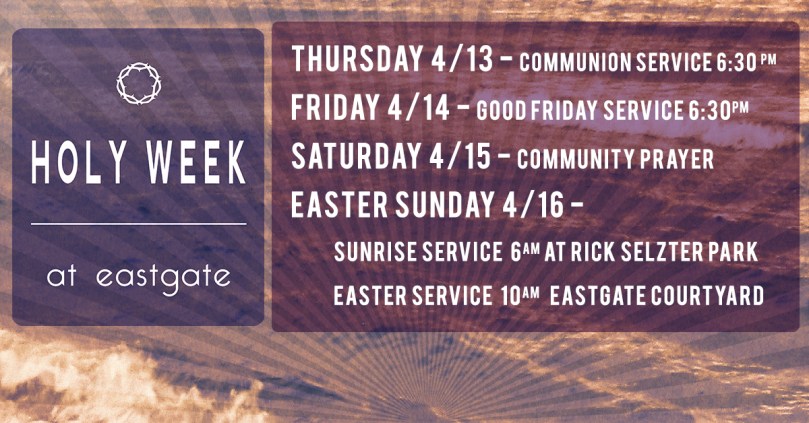
This Thursday at 6:30pm we’ll walk through the Passover with Jesus and his disciples – with our eyes, ears and taste buds. We want to be there in that upper room.

The Friday before Easter is called Good Friday – the day that commemorates Jesus’ arrest, trial and crucifixion. Some have questioned why we’d call it good Friday when so much bad happened. Remembering what was said last Sunday helps with this: “The disciples thought God was losing. They stood witnessing the greatest victory in history, and thought it was a loss. They saw the forgiveness of all humanity’s damning sins, and they wept and despaired because they had lost the plot, they confused a governmental victory for an eternal victory.” The historic events that took place that day were, indeed, horrifying. But the glory that resulted from his sacrifice makes this not just a GOOD Friday – but the greatest and the best Friday of all.

This Friday at 6:30pm we will have a Good Friday service of worship and a live art project with interactive elements which remind us of what Jesus has done for us in his death on the cross.

Saturday is traditionally a day of prayer and fasting in anticipation of Easter. We’re inviting everyone who’d like to, to join in to prayer and fasting (skipping a meal or two, or however God may direct you). I’ve written three prayers – morning, noon and evening – to help guide you in prayer if you need it. You can get them here: COMMUNITY PRAYERS 2017

Easter is the big day! N.T. Wright says in his book Surprised by Hope:

“[Easter] ought to be an eight-day festival, with champagne served after Morning Prayer or even before, with lots of alleluias and extra hymns and spectacular anthems. Is it any wonder people find it hard to believe in the resurrection of Jesus if we don’t throw our hats in the air? Is it any wonder we find it hard to live the resurrection if we don’t do it exuberantly in our liturgies? Is it any wonder the world doesn’t take much notice if Easter is celebrated as simple the one-day happy ending tacked onto forty days of fasting and gloom? It’s long overdue that we took a hard look at how we keep Easter in the Church, at home, in our personal lives, right through the system. And if it means rethinking some cherished habits, well, maybe it’s time to wake up. That always comes as a surprise.

…we should be taking steps to celebrate Easter in creative new ways: in art, literature, children’s games, poetry, music, dance, festivals, bells, special concerts, anything that comes to mind. This is our greatest festival. Take Christmas away, and in biblical terms you lose two chapters at the front of Matthew and Luke, nothing else. Take Easter away, and you don’t have a New Testament; you don’t have a Christianity; as Paul says, you are still in your sins. We shouldn’t allow the secular world, with its schedules and habits and para-religious events, its cute Easter bunnies, to blow us off course. This is our greatest day. We should put the flags out.”

At Eastgate, we “put the flags out”. We start with our sunrise service at 6am on the beach (at Seltzer Park). The Sunrise Service is the Protestant version of the Catholic and high church’s Easter Vigil. The Easter Vigil lasted all night until sunrise – but Protestants in the 1700’s seemed to prefer just waking up early to re-enact what happened on the day that Jesus rose from the dead. I kinda’ like that better too. To me, there’s nothing like gathering in the pre-dawn light, in that cool salt air, to joyfully announce, through prayers, songs and liturgies, that death ain’t what it used to be! Jesus is alive!

Then we bust loose at 10am in the courtyard in front of our Eastgate building. We just don’t want to be contained within four walls when we celebrate something of this magnitude! We want to to shout it out in the open, JESUS IS ALIVE, he’s making ALL THINGS NEW! We incorporate joyful music, kid’s performances, artwork, story telling, beach-balls, party poppers and bubbles into our celebratory worship! If you come, bring a lawn-chair or a blanket. Then we EAT! We have a potluck lunch – our meager imitation of that great wedding feast we anticipate, when our risen Savior brings heaven and earth together, forever.

I’m gettin’ pretty stoked just thinking about all this! Hope you are too!

He is RISEN!

He is RISEN INDEED!