Following Jesus

Bay County is made up of people who know just how much chaos a storm from the water can bring. Michael swept up on us suddenly and powerfully and left our world a wreck. That’s the nature of a storm like that – it is a bringer of chaos.

In our text this Sunday (Mark 4:35-41), Jesus and his disciples will face a sudden storm. While I believe this is an account of something that really happened, I also firmly believe that this event becomes a parable for us – a story that helps us see ourselves and Jesus more clearly. I believe this story helps us define what it means to follow Jesus.

In the story, Jesus tells the disciples to take him across the lake (of Galilee). That seems innocuous enough, except that in 1st Century Israel, that area was called the Decapolis, and was considered off-limits for pious Jews. According to Ray Vander Laan’s article on the Decapolis: “Apparently, the pagan practices of the people of the Decapolis and their anti-God values seemed to be continuations of the practices of the Canaanites, who used sexual perversions and even child sacrifice in their worship. It is probable that the people of Jesus’ day, who took their Scriptures seriously, viewed the Decapolis as very pagan.” 

What does Jesus’ intent on going across the lake indicate to us about how we will follow Jesus? Who are the people across the lake in your world?

When a storm comes up, it might have been easy for the disciples to assume that they were being punished by God for going to a place that was off-limits. Why would that be a wrong assumption? What does that tell us about the storms and chaos that effect us as we follow Jesus?

Why does Jesus rebuke the disciples? Do you believe they were wrong for being afraid? How can we understand what Jesus is looking for in our response to the trials of life?

It’s funny how the disciples go from fear to terror in this story. What is it that terrifies them? Why do you believe they are reacting this way? What, if any, experiences have you had with Jesus that have overwhelmed you because of his power?

We’ll be celebrating communion this Sunday as well – hope to see you there!

Do You or I or Anyone Know?

“Oats, Peas, Beans and Barley grow. Do you, or I, or anyone know, how oats, peas, beans and barley grows?”

This Sunday we’ll be having our Surf-N-Grill Sunday – which means we will have a shorter than normal service, and then head down to St Andrews State Park for a beach day. The weather looks pretty good for that!

If you haven’t been baptized and would like to, you can still sign up online: Baptism Sign Up

We’ll also be continuing our study in Mark, reading 4:26-34 which contains two parables about seeds. I drew a coloring page for the kids to work on during our teaching – and it may give you something to talk about afterwards.

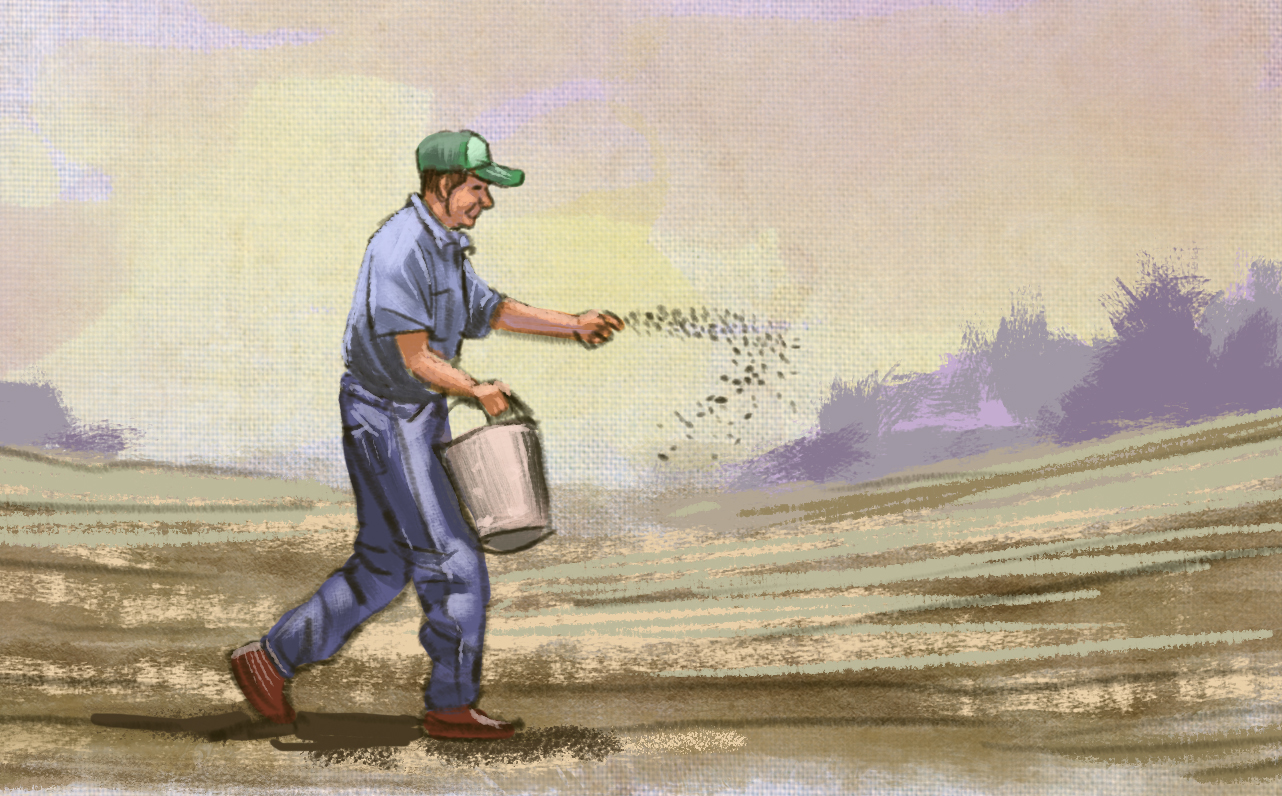
As you read the first parable in v 26-29, we should take our cues from the previous parable about what the seed stands for: the news of God’s kingdom advancing in this world. In this story, what does the emphasis seem to be on? What impact does human agency have in the growing of the crops? How would you correlate scattering seeds and gathering a harvest with our activity as the church? What lessons do you believe Jesus is intending to teach us with this imagery?

The second parable about the small mustard seed seems pretty straightforward. What would you say constitutes those seemingly insignificant ways in which God’s Kingdom grows in this world?

I’m looking forward to a family day at Eastgate! Hope to see you there!

Who Defines You?

One of my favorite types of humor is mistaken identity, like the Flight of the Conchords song above. The confusion and delightful misdirection as the mis-identified man tries to sort through the woman’s description of their relationship. I never get tired of that video. Mistaken identity like that can be fun – but usually when someone defines our identity improperly, it takes a heavy toll.

We’ll be reading about people mis-identifying Jesus in our text this week as we continue our study in Mark’s gospel. We’ll be reading 3:20-35, which will finish up the chapter.

In this section, Jesus’ family and the religious leaders from Jerusalem define Jesus as either crazy or demonic. The two groups of people who were most qualified to identify who Jesus is completely fail to do so.

This passage has a chiastic structure and is an example of Mark’s way of framing one episode with another…in other words, we will be enjoying a Markian sandwich this Sunday!

Here is how the text is structured:

verse 20  Crowd
verse 21  Family
verse 22  Scribes (accusation)
verses 23-27  The parable of plundering the satan’s possesions
verses 28-30  Scribes (warned about their accusation)
verse 31  Family
verse 32  Crowd

Why do you think Jesus’ family were so concerned about his behavior? Why do you suppose that they didn’t understand his mission? What do you think was motivating the religious leaders in their opposition to him? How significant do you think Jesus’ redefinition of family is in v35?

All of this will provide us with some insights about how we see ourselves and how it is that our own identity is defined.  Plus, we’ll have a talk about v28-30 and alleviate any unnecessary fears about the U.P.S. (un-pardonable sin). Hope to see you on Sunday!

The Risk of Love

Back in 1993 Meatloaf crooned a song that declared in it’s title “I’d do anything for love (but I won’t do that)”. Of course, people largely missed the point trying to speculate on what “that” was. The humor is the self-contradictory nature of the words – I’d do anything, but then a qualifier is added which nullifies the prior statement.

Um…is this a Bible study Rob?

Yes, it is. I’m getting to my topic. There is a risk that must be taken if we are really going to know and certainly if we are going to express love…real love…sacrificial love…God’s love. A risk that really doesn’t allow for prior qualifications or exceptions beforehand.

We’ll see that as a case in point in the section we’ll read in Mark’s gospel as we continue that study. We’ll be reading ch 3:7-19.

In this section Jesus has suddenly become very popular. It’s understandable, considering all that he is able to do and provide for people. In the narrative, Jesus and his disciples seem to be in danger of being crushed. There hardly seems to be any concern for Jesus, only what can be gained from Jesus. Yet Jesus continues serving the people as they come to him.

What risk can we see evident in the crowd’s treatment of Jesus? Did it seem to deter Jesus from a mission like this?

Why do you think Jesus ordered a getaway boat? What can we learn about love’s application from this?

Later on Jesus tags 12 guys to be his close disciples who will represent him to the world. I like how only three of them get nicknames. I wonder how the other guys felt when they were waiting for their nickname and it never got spoken. “My name’s Andrew but you can call me D-ROO!” “Shut up Andrew, it doesn’t count if you make it up yourself! We’re NOT calling you that!”

That’s some of the stuff I think about.

But, the one name that vividly jumps off the page is Judas. The name associated with treachery from that time forward. Why did Jesus choose him? Why did he allow him such close access? Those are great questions I hope to ask him someday. They go along with questions about why God even had a forbidden tree in the Garden. Maybe it has to do with the nature of real love.

What risk do we see that love takes when we look at this list of disciples? Jesus doesn’t seem to back away from the risks. What can that teach us about how we are called to express this Jesus kind of love? In what ways do we find ourselves challenged by these risks? How can we find the courage to take these risks for the Kingdom of God?

Hope to see you Sunday!


Easter Sunday

This Sunday we’ll be having very special gatherings where we celebrate the resurrection of Jesus! Our first meeting will be held on the beach at 6 am at the Pineapple Willie’s restaurant beach access. Pineapple Willie’s has been very gracious to Eastgate over the years and we are excited about partnering with them for this event! Bring a chair or blanket, and think about dressing in layers since the starting temperature will be in the lower 60’s.

We will be handing out papers which have the order of service, lyrics to the songs and prayers. However, we are also providing a PDF version of this which you can view on your phone. Download it before you come at this link: Easter Sunrise with Eastgate

Later on, at 10 am, we’ll gather in the courtyard in front of the Eastgate building and have a time of celebration with worship songs, a Kidsgate performance and more! Afterwards we’ll have a potluck lunch and hang out as God’s kids, enjoying the day! Bring a lawn chair and some sunscreen…and bring a dish to share!  We have a PDF to download for that service as well – courtyard service 2019

Easter is the centerpiece of our faith! Let’s get stoked, HE’S ALIVE!

The Heart of God vs the Hardened Heart

There’s a scene from the first Incredibles movie that reminds me of the text we’ll be reading this Sunday. Mr. Incredible is a superhero forced into retirement who had taken on a job as an insurance salesman. He keeps looking after his customers best interests, which gets him called into his boss’s office. Rather than describe the scene to you – let me just put it here for you to watch:

This Sunday we’ll be reading Mark 3:1-6 in our study of this gospel.
Do you see the parallels between a puny and petty boss trying to exert authority over a superhero?

As you read this passage, think about the contrasts. Who is Jesus looking at? Who are the religious leaders looking at? Following that, contemplate this question: what is the main concern of the religious leaders and what is the main concern of Jesus?

Answering those questions will unlock the lessons of this text.

What is it about the religious leaders that made Jesus both angry and sad? How does Jesus’ reaction to this help us to identify the priorities God intends for us to live by?

In a fast changing world we, as followers of Christ, often struggle to know how we interface our Christian values with this morally fluid society. Sometimes we’ve fallen into the same snare that the Pharisees did. In what ways has the church been blinded by a commitment to what might be considered necessary rules that we miss God’s overarching value of compassion? How can we keep that from happening while still holding to a conviction?

Those are the topics we’ll consider – it should be a thought provoking text to explore!

Priorities

There is a strange tension between the letter and the spirit of a law.

The “letter of the law” refers to how a law is spelled out in the penal code, vehicle code etc. The “spirit of the law” is the reasoning behind why the law was enacted; the original intent for its institution. It is possible to violate the “letter of the law” but not the “spirit of the law”. In such cases, law enforcement and prosecutors hopefully use discretion and don’t usually enforce violations of the “letter of the law” as long as the “spirit” wasn’t violated.

A sign may be posted in the park which says “no vehicles allowed”. That’s the letter of the law. The intent, however, is to prohibit large, motorized vehicles from entering. If a person in a wheelchair wants to enter the park, it may technically violate the letter of the law, but not the spirit.

Something along those lines is happening in our text for this Sunday as we continue our study in Mark. We’ll be finishing chapter 2, reading v 23-28.

Why do you think the Pharisees accused the disciples of “harvesting” on the Sabbath? Apply the letter versus the spirit of the law principle here. Do you think it was God’s original intent to keep people hungry on the day of rest?

The story Jesus references in his rebuke is found in 1 Sam 21. It’s an interesting story because it’s filled with all sorts of ethically disconcerting stuff, the least of which was the showbread (to me anyway). What do you believe Jesus’ point to the Pharisees is? What seems to be God’s priority when it comes to his intent behind any commandment?

How can we keep God’s priority in view as we attend to our own life of faith and the values that stem from that?

It will be a thought provoking study, hope to see you there!

The Joyful New

I’m back from vacation! I had a great trip to the Great Northwest – but I’m also glad to be back.

This Sunday we’ll be reading Mark 2:18-22. This text is in the midst of a grouping of religious controversies that confront Jesus in his early ministry. Jesus, from the get go, was upending religious expectations left and right.

Israel’s expectation for who the messiah would be judging and what the messiah would be doing were pretty straightforward. Messiah will come to dispense judgement to the Roman Empire, to condemn those who didn’t adhere to the law of Moses and command righteousness without reserve.

And then there was Jesus. What were they to make of this rabbi? He hangs out with the wrong crowd, he seems to only condemn religious people while giving the riff-raff a new start. He just didn’t meet people’s expectations.

That was true of our text on Sunday. The disciples of John the Baptist fasted regularly while awaiting the arrival of God’s kingdom. The Pharisees fasted regularly to show how sincerely they longed for the end of exile…and it didn’t hurt that it made them look really religiously pious.

When Jesus is asked why he and his disciples don’t fast (a question posed right after Jesus was at a dinner party with disreputable people), the people are merely expressing that he is not meeting their spiritual standards. Fasting was only required in the Old Testament for the Day of Atonement. This wan’t about Mosaic commands, this was about religious expectations.

  • Why do you think Jesus answered their question about fasting with the imagery of a wedding? How does v 20 help us understand that Jesus isn’t opposed to fasting? What religious standards have you felt pressured by? How have you found yourself pressuring others to meet a standard you have set?

The two further explanations by way of parable are the new cloth and new wine-skin pictures. New cloth, in shrinking, would tear away from old, pre-shrunken fabric. An old leather, brittle wine-skin would tear open during the expansion of fermentation.

Jesus’ point is straightforward – he didn’t come to reform something old but to establish something new.

  • What does this mean to our relationship with the Old Testament Law? How do we understand the purpose and value of the Old Testament?

Anyway – hope to see you on Sunday!

The Power of Forgiveness

“As high as heaven is over the earth,
    so strong is his love to those who fear him.
And as far as sunrise is from sunset,
   he has separated us from our sins. ” ~ Psalm 103

At the core of the Christian hope, there is the promise of forgiveness from God. Sometimes I wonder if we have become so acquainted with with that truth that it’s impact gets dulled. It can easily happen. That’s why I love revisiting the gospels, because the core truths that our faith is formed around are ready to be apprehended afresh with every reading.

This Sunday we’ll be reading Mark 2:1-12 which is the account of a paralyzed man being healed by Jesus, but is also a story that highlights the power of divine forgiveness.

The house is packed, not one more person can be squeezed in. Locals look up and down the street at the crowds who have descended on their tiny village to hear and see the young Rabbi.

Four men enter the fray, carrying a paralyzed man on a make-shift stretcher, asking people to make way to they can get through. A few people oblige, but the mass of humanity is too thick and progress comes to a complete stop. One of the four looks at the outside stairs of the house they are trying to enter.

  • What do are your thoughts about these four men? Why do you suppose they are so persistent? Where are they trying to take their friend?
  • If we imagine a symbolic meaning to their story, what lesson can we, the church, learn from these four men about our own priorities?
  • What can tearing up a roof in order to get someone close to Jesus teach us about our mission?

After they lower the man down to Jesus, the story takes a rather strange turn. Instead of immediately healing the man, Jesus by begins declaring his sins forgiven by God.

  • Why do you think Jesus declared forgiveness before healing the man?
  • What do you suppose get the religious leaders angry about this? What did they infer from this declaration?
  • The inward healing of forgiveness is something unseen and immeasurable – the outward healing of the man’s limbs was something everyone could observe. In what way does that help us to understand Jesus’ actions here?

I really love this story – Hope to see you Sunday!

Unexpected Authority

I don’t know. Why is it whenever I write the word “authority” I hear Cartman’s voice in my head commanding my respect? It’s the hazards of keeping up with popular culture I suppose.

Whenever we think of a king or government exercising authority, what usually comes to mind? Often, we think of violence or even battle. We’re going to see a battle of sorts in our text this Sunday as we read Mark 1:21-34 – albeit, it’s not much of a battle. The authority of God’s kingdom leaves very little room for resistance.

  • In the story, what is it that first gets the people amazed about Jesus?
  • What do you think the people mean by Jesus teaching with “authority”?
  • Why do you suppose they didn’t recognize that sort of authority in the teachers of the law?

The story gets really exciting when someone erupts with squawking and a demonic spirit begins speaking through a person to confront Jesus.

  • What are your thoughts about demons and the spiritual world?
  • Why do you think the demonic entity identified Jesus’ hometown?
  • Why do you think Jesus cut the demon short? What can we infer from that about our own focus in ministry?

For those who care, there’s a chiastic structure to v21-28

Jesus comes to the synagogue

Jesus teaches

People are amazed at his authority

Jesus confronts a demon

People are amazed at his authority

Jesus leaves the synagogue

After the public setting of the synagogue we move the private setting of Jesus’ home. Peter’s mother-in-law is sick with a fever and Jesus heals her. Word gets out and suddenly people are showing up in droves to be healed at Pete’s house. Not at the synagogue, isn’t that interesting?

  • How do you feel about the fact that Pete’s mother-in-law gets right to work, serving? Follow the link to the definition of that word. Look at the other passages where that word is used (the verse count is to the right of the definition).
  • How might we deduce something about the nature of being Christ’s follower from that?

Hope to see you Sunday!