Family Conflicts and Forgiveness

Image result for family conflict

One thing that I’ve learned about church over the last 20 years is that it’s full of humans. Now that I’ve impressed you with my observational skills, let me just point out that whenever you get a group of humans together, you will inevitably find conflict. The church is no different.  “Conflict in church? Meh, there you go, the church is full of hypocrites!”  “No…it’s not full, there’s room for one more, c’mon in!”

Here’s the thing. Jesus seemed to anticipate our propensity for conflict, which prompted him to give the instructions we’ll be reading this Sunday in our study through Matthew: Ch 18:15-35.

In v 15-19, Jesus lays out a pretty straightforward outline of how to manage a dispute within the church family. What would you consider the theme of this approach to be? How important do you think communication and listening is when it comes to conflict resolution? The last part of his instructions in v17 sound harsh, but how did Jesus treat gentiles and tax collectors? Read that verse in the Message version. How do you think this would look in a real life application? V 20 gives us hope that as a community we’ll have the right discernment concerning these issues. How can remembering that Jesus is present in our gathering together help us to better deal with our conflicts?

Peter asks a bold question in v21-22. What do you believe Jesus’ answer means – give a person 490 chances but at 491, lower the boom? If not that, what do you think he means? How does forgiveness tie in with the previous issue of conflict resolution?

The story Jesus tells us has a ring of comedic irony to it. It’s possible the listeners were chuckling…right up until v 35. How do you interpret this parable? What is the major theme and the source of the conflict? If this is addressing our motives and impetus, what is our motive for forgiving others?

There is some hefty stuff to dig into this Sunday! Hope to see you there!


Represent!

Image result for humility trophy

“When it comes to humility, I’m the BEST!”

“Really?”

“Yes, in fact, if it weren’t for my great humility I would go on.”

A conversation like that would ultimately reveal that the words don’t really represent the reality of the speaker’s attitude. Receiving an award for being most humble is sort of self-contradictory. Yet, how often do we find it difficult not to go out of our way to make sure the people around us have taken note of our gracious and humble attitudes? That’s the rub when it comes to human nature – we just want to be recognized in one way or another. We are a very lonely and insecure species.

We’re coming to a section in our study of Matthew where Jesus is going to give us some instruction as to how to handle ourselves in community. We’ll be reading Matthew 18:1-14.

The scene opens with Jesus’ disciples vying for the number one spot in terms of God’s kingdom and His fantasy team ranking. In response, Jesus puts a child in front of them and commands that we follow that example. In what ways do children embody the concept of humility on a societal level? If we think about ancient attitudes towards children, it expands that idea even further. Have you ever been upset when someone was treating you like a child? Why was that offensive?  How is Jesus’ call to intentional humility distinct from the way our normal societal patterns work? If we’re not getting our validation from our fellow humans, where will we get it from – to Whom do we look?

Jesus warns us not to put a scandalon – a stumbling block in front of someone who is a humble believer in Jesus. Given the context of not seeking to advance ourselves over each other, how do you think this translates to our community interaction? Based on what Jesus says, how important do you think this is to him?

The final section has a parable about a shepherd who leaves his ninety nine sheep to search for one lost lamb. He was pointing out how all the sheep are valuable to God. No one is unimportant, including you and I. Realizing that, what do you think Jesus’ point is concerning how we interact with each other in community? How can we better embody these traits as a church? If we could do that, what effect do you think it would have on the world around us?

Hope to see you Sunday!


The Kids are Free

Related imageHey – late post, but hopefully you’ll still have time to take a peek at our upcoming passage.

We’ll be reading Matthew 17:22-27 this Sunday. It’s a highly unusual story. One that’s unique to Matthew’s gospel, but understandable considering his tax-collector background.

The story opens in v22-23 where Jesus once again announces his upcoming arrest and execution, as well as his resurrection. Again, the disciples are puzzled. What reason can you imagine for this repeated message to his disciples?

When they get to home to Capernaum, they are confronted by “collectors of the two-drachma tax”. This was a tax instituted in Exodus 30 as a census tax that went to support the temple operations. The priests would go to outlying areas up in Galilee and collect it from the Jewish people. When the collectors corner Peter, they assume Jesus isn’t going to pay that tax. Why do you think they would assume that? Interestingly, a sect within Israel, who was contemporary to Jesus, the Essenes, openly opposed the temple tax. As cited in the dead seas scrolls, they believed the proper application of Exodus 30 was a once in a lifetime tax, not an annual one.

Peter answers in the affirmative, but when he sits down with Jesus, he gets a different perspective. He gives a parable about the kings of earth and how they operate a tax. Who do you think the “children” are in his story? What do you think his point is concerning the temple tax?

When Jesus capitulates, he does so not to offend. Who do you think might be offended? What can we learn about Jesus’ attitude and our calling here? What do you think is worth offending people over when it comes to our faith?

The fish story at the end…that’s something, huh? What’s the weirdest thing you’ve ever found? The text doesn’t tell us whether Peter went and did this or if it was meant as just a story for Peter – but either way, there is a plain point being made. Who is it that provides our ability to navigate through this world of ever present cultural expectations? Let’s trust him for the wisdom to live well.

See you Sunday!


Glory Revealed and Concealed

Image result for one step forward two steps backAre you familiar with the phrase “one step forward, two steps back”? Its an idiom meant to describe a difficulty in progressing. There are a variety of times in which that phrase can be employed in life, but one we don’t often like to think of is our own spiritual journey. Quite often, instead of a steady climb upward, from glory to glory, its more like slipping and sliding on a muddy hill.

This Sunday we’ll be reading Matthew 17:1-20 and we’ll get a glimpse of God’s glory revealed and then concealed as the disciples endeavor to follow Christ.

The first section, v1-8, provides the account of the “transfiguration” of Jesus. Jesus takes three of his disciples up on a mountain, and there, his appearance changes in front of them – he is glorious. Why do you think Moses and Elijah showed up? What is it that they represent?

When the voice instructs us to “listen to him“, Jesus, what do you think that means in light of who is on the mountaintop with him?

I find it intriguing that Matthew includes the detail that Jesus’ clothes started shining like white light. Why do you think that detail is there? Why would his ordinary clothes be affected like this? What can that mean for us?

When they head off the mountain in v 9-13 the disciples get a lesson about Elijah’s coming before the Messiah. Why do you think the people didn’t recognize John the Baptist as a fulfillment of the prophecy about Elijah’s appearance? What can we learn from that when it comes to our expectations about how God will manifest his glory?

After they return down from the mountaintop experience, they face a different tone in v14-20. What is the key element that Jesus says is missing, which prevented the disciples from helping the demonized boy? What do you think he means by that: they didn’t have faith that the boy would be healed or that they didn’t have faith that Jesus was working through them still, or something else? What leads you to your conclusion?

We’ll get really honest about our journey this Sunday – hope to see you there!

Christ in Confession and Action

Related image

Back in the 1970’s there was a Broadway musical that was quite controversial while it piqued the spiritual interests of the culture. It was the rock opera Jesus Christ, Superstar. I was enamored with that body of work as a young kid. I tried my adolescent best to pull off the same screams that Ian Gillian could emit. Never worked.

Anyway, the controversy centered around Tim Rice’s portrayal of Jesus through the lyrics of  the songs, as well as the omission of the resurrection from the story (albeit, I still insist the movie version has a subtle resurrection implication…but honestly, who cares?) The complaints weren’t really without some merit.

The title song, however, posed a question that got the nation talking. I think that’s a good thing.

Jesus Christ, Jesus Christ

who are you what have you sacrificed?

Jesus Christ, Superstar

Do you think you are what they say you are?

That’s such an important question to pose to Jesus. Who are you? That’s going to be the main subject we’ll be covering in portion of the narrative we’ll be reading this Sunday, Matthew 16:13-28.

Who do people of our day and age say that Jesus is? What differences can you detect between churches and who they see Jesus as being?

More importantly, who do you understand Jesus to be? Peter gives his great confession and Jesus validates both him and his words. In fact, I believe it’s this very confession that Jesus says he’ll build his church on. How does that inform you about what the church is?

As the narrative goes on, Jesus outlines his mission as Messiah. How do you think this fit with what the disciples expected Messiah to come and do? When Peter resists, Jesus begins a rebuke that mirrors his blessing from the previous verses, but goes the opposite way. How does that help us understand the distinction between the ways we pursue victory in this broken world over against the way God’s kingdom operates?

Worse yet, Jesus tells his disciples (that would be us, too) that our calling is to follow in his steps and take up our cross. The challenge is huge, but the stakes are high. To give up the advancement of our own will and ego in order to be conformed to Christ’s self-sacrificial love. What aspects of self-will are the most difficult for you to imagine releasing? On the other hand, what would be more important than finding wholeness in life God’s way?

I really love Eugene Peterson’s version of this section – I’ll leave you with that:

“Anyone who intends to come with me has to let me lead. You’re not in the driver’s seat; I am. Don’t run from suffering; embrace it. Follow me and I’ll show you how. Self-help is no help at all. Self-sacrifice is the way, my way, to finding yourself, your true self. What kind of deal is it to get everything you want but lose yourself? What could you ever trade your soul for? “Don’t be in such a hurry to go into business for yourself. Before you know it the Son of Man will arrive with all the splendor of his Father, accompanied by an army of angels. You’ll get everything you have coming to you, a personal gift.”

Signs and Religious Control

Can you believe it’s been 14 years since that movie came out? Stunning. I always remember that part of the movie. It still stands out as a great illustration of our own intentions getting in the way of our ability to hear from God.

Something akin to that sort of irony will be involved in the passages we’ll be looking at this Sunday as we read Matthew 15:29-16:12. It’s a big section, but I think you’ll see how it all goes together pretty well.

As you read through this section you’ll notice that, even connected with last weeks teaching, there is an ongoing bread theme. The Canaanite woman asked for bread crumbs. Jesus provides bread in the wilderness and then warns about the wrong kind of spiritual bread. There could be a whole teaching in that thematic vein alone…but that’s not where I went for this study.

In the section that closes out chapter 15, Jesus is doing all sorts of miracles, finishing off with a miraculous feast on a desert mountaintop. A quick glance at Isaiah 35 and Isaiah 25 provides a backdrop and reveals what’s going on here. When Jesus is performing all these miracles, what does it mean? How should it be read?

When we come to chapter 16, much like Jim Carry, the Pharisees and Sadducees ask for a sign – ignoring what has been happening right under their noses. They are intent on trying to control God’s plan. In what ways are we sometimes guilty of trying to dictate to God our own purposes? How can we keep from trying to steal the director’s chair in life?

in v 5-12, Jesus’ disciples are cast in a pretty dim light. They forgot bread and assume Jesus’ warning about the leaven of the Pharisees was about a lack of bagels. Leaven is used as a metaphor for an element introduced that changes it’s host into something else. Leaven changes bread dough, causing it to rise and inflate. In what way do you think the teaching of the Pharisees had done this as it touched Israel’s calling? What is Jesus warning his disciples, and us as well, about? What are the philosophies, politics and religious agendas in our world that could veer us off the path that God originally set the church on? What is lacking, according to v8, that can keep us from falling prey to these aberrant directions?

Once again, this will be a challenging and thought provoking passage to dig into. Hope to see you on Sunday!

Not an Easy Faith

Image result for dog stealing thanksgiving turkeyA few years back my oldest daughter was getting married out in Jacksonville the weekend after Thanksgiving. We had made preparations to have out Thanksgiving meal out there. My wife, youngest daughter and soon to be in-laws were all gathering for our meal, which we had procured at Publix (weddings leave little time for holiday cooking). My youngest daughter (who shall remain nameless even though her name is Janelle) brought her dog, Zooey, on the trip.
At one point, while we were all setting up the table, my new son-in-law’s dad came out from the kitchen and announced, in a rather matter of fact way, that the dog was eating the turkey. I almost pushed him down to get past him and into the kitchen where I discovered, true to the description, Zooey with a large portion of the turkey on the floor. She had already consumed an entire drumstick…bone and all. No trace of it was left. Shooing the dog away, I hastily tried to straighten out the remaining turkey on the platter, looked at my brand new in-law and said with a smile, “Welcome to the family”.

Dogs wanna’ eat too. I tell that story because of what we’re going to be reading this Sunday as we return to our study in Matthew’s gospel. We’ll be picking up where we left off, reading Matt 15:21-28.

I am clearly the poster child for bad planning, because this is not the sort of passage one wants to resume a study with. And yet…here we are.

This is a distressing section of Scripture. We are confronted with a Jesus who seems strange to us; uncharacteristically distant and even apparently rude. He and his disciples have left Israel and are 50 miles north in the coastal region of Tyre and Sidon, which is modern day Lebanon. What do you suppose they went to the coast for? Even Jesus knows there are times when you just need to escape to the beach.

While there, a local woman calls out for Jesus’ help on behalf of her demonized daughter. Jesus doesn’t answer her, but remains silent.

Jesus’ response and statements about and to this woman are perplexing – they have been since he spoke them, I guess. We’ll look at that a bit more closely in our study – but for now, consider this woman. Have you ever had anyone give you the silent treatment? How did it make you feel? Have you ever felt like heaven was silent when you were calling out for help? What did you do in those times? What does this woman do?

When Jesus finally does interact with her, he uses an illustration that puts her in the same role as a dog. He doesn’t call her a dog, but that’s of little comfort when we consider the implications. Have you ever prayed and extended your faith for God’s help, only to find the situation get’s more difficult? How did this woman handle Jesus’ statement?

What lessons can we learn about faith – faith that’s not easy, exercised in a world that is not easy on us either. In what ways can she inspire us when we feel frustrated by God’s silence or by circumstances that seem to be against us?

This is a challenging section, and not a good one if we’re looking for easy answers. However, I think we’ll benefit from this story if we are willing to allow God to fine-tune our expectations and illuminate different avenues of grace. Hope to see you Sunday!

Traditional Troubles

Image result for christmas in japan

Apparently, Christmas isn’t a national holiday in Japan, but they still celebrate it. How they celebrate, however, is somewhat unusual. It seems that back in the 1970’s, the company behind KFC decided to do some intense marketing to the Japanese people, so they pushed KFC as the perfect way to celebrate Christmas. The idea caught on, and Japanese KFC’s report their biggest sales of the year on Christmas Eve. Because nothing says “Christ is born” like the Christmas Eve Party Bucket – it comes with fried chicken and wine.

Do you have any odd traditions for Christmas that your family has passed down through the years? I think the most unusual for our family is the annual watching of Die Hard. “Ho, Ho, Ho…now I have a machine gun.” C’mon? What’s more Christmasy than that?

Traditions are great. They can keep us in touch with our history and even connect us with what is unique about our family or community. Traditions, however, can become troublesome if we allow them to take precedence over the more important issues of life. That’s what we’ll be considering this Sunday as we read Matthew 15:1-20 in our study of Matthew.

The passage starts out with a controversy over hand washing. This wasn’t about hygiene – it was about this:

V6, 8, 17-20 sum up Jesus’ response to the Pharisees. How would you word what it is that Jesus is trying to communicate about religious traditions and rules?

What does Jesus point to as being the most important issue when it comes to our relationship with God and how we live our lives in this world (v19)?

It’s not addressed in this passage per se, but how do we go about seeing a change take place in our hearts if righteousness doesn’t come from the outside in?

I hope this proves to be an encouraging foray into the Gospel of grace. See you on Sunday!

God’s Rule in an Unruly World

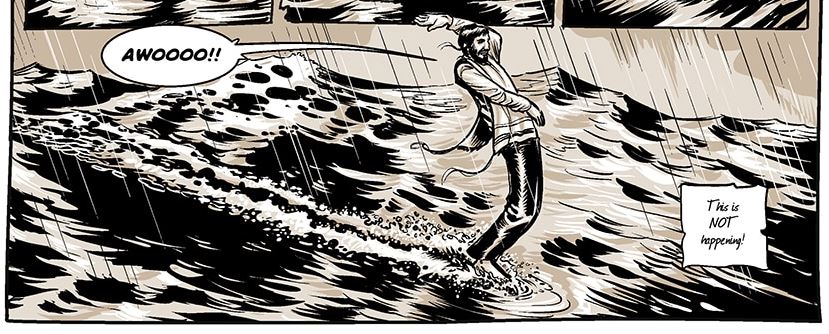
rabbisurfMost of you know, I’m a cartoonist who is serving as a pastor until the Lord fixes that. I’ve drawn a graphic novel for the web called “Rabbi Encounters”. You might enjoy reading chapter five, “Surf” (click the title to go there). It’s my rendition of the events that we’ll be reading this Sunday as we continue our study of Matthew – 14:22-36.

I believe this is an account of something that really happened. I also believe this actual event can read as a parable – a metaphor for a life of following Jesus.

The disciples follow Jesus’ instructions to get in the boat and go. Obeying Jesus, they find themselves caught in a storm and being (literally) tormented by the waves. What metaphor can you see in that? How does this correspond with your own life of faith? What can be learned?

When Jesus shows up the disciples are terrified. Why? To your knowledge, has anything like this happened before in the Bible, where someone has walked on water? Do you think any of the disciples expected to see Jesus out there? In what ways can you see a parallel of this in your own expectations about God and what He’s up to?

What do you think, was Peter right or wrong to ask Jesus to command him to walk on the water? Scholars seem to be divided about it. Do you think his lack of faith began when he had to have proof that it was really Jesus, or was it a bold move of faith to claim participation in the miracle?

When Peter is focused on the rising surf, he begins to sink. The lessons there are obvious. Something else to think about is: what was Jesus’ first response (not words necessarily) to Peter’s predicament? How does his response encourage you when you remember times where you’ve had “little faith”?

Those are just some things to consider before Sunday. What I’d really like you to do is read this whole section and read it as metaphor – use your imagination. What is the boat, the water, the storm, the destination? What can those be portraying to us about life and faith and most importantly, Jesus?

Hope to see you this Sunday!

Contrast of Empires

Image result for herod antipas john the baptist

I think the idea of the “kingdom of God” is one of the more difficult concepts for Christians to grasp. In my conversations with people, it often seems to be a primarily future construct. “One day, Jesus will return and set up his kingdom”. That’s true and I agree with that, but is that all there is to it? Jesus came on the scene announcing that the Kingdom of God was at hand, closing in, so to speak. The whole theology of the New Testament indicates that the kingdom of God is presently active and at work in this world, through the church. God’s kingdom can be described as God’s good rule – over our lives and over all creation – but the New Testament even indicates that it is God’s rule over the nations as well. But how does that work? How could they say that while Caesar still sat on the throne?

One way to understand it is to see that God’s rule is at work subversively, working right along side of the fallen world and human empires, showing a different way that ultimately leads us to the aforementioned conclusion of Christ’s return and restoration of all things.

That’s something we sort of see in our text we’ll be reading this Sunday as we continue our study in Matthew, reading chapter 14:1-21.

We’ll be reading this passage in two sections, v1-12 and then v13-21. In these two accounts we have what appears to be an intentional contrast. We have two different leaders – both of whom are called “King of the Jews”. Both stories contain an account of a feast of sorts. But the circumstances and outcomes of both stories are radically different. Here’s what I want you to do: Read through each section, back to back. Then go through and look for whatever connection you can see between them. Ask questions like: How did Herod seek to protect his kingdom compared to how Jesus went about advancing his? What practical differences were there between the two feasts ? What is Herod’s feast all about? What was the result of each feast and how did it differ?

Ask your own questions about the contrast. Then ask yourself the most important question of all: Which feast would I rather be attending? Does my answer correspond with the way I presently live my life?

It’s going to be a challenging, yet encouraging study (I hope) – see you Sunday!