The Triumphant Decline

Have you ever worked really hard on some idea only to have someone else come along and take credit for it, even indirectly? What emotions did you feel?

The human need to be significant and important, at very least for recognition is universal. Ego is a tough wrestling opponent. Yet, as we’ll read in this week’s text, John the Baptist was able to find joy and peace by putting his own ego last and Jesus first.

This Sunday we’ll be reading John 3:22-36 as we continue our exploration of the fourth gospel.

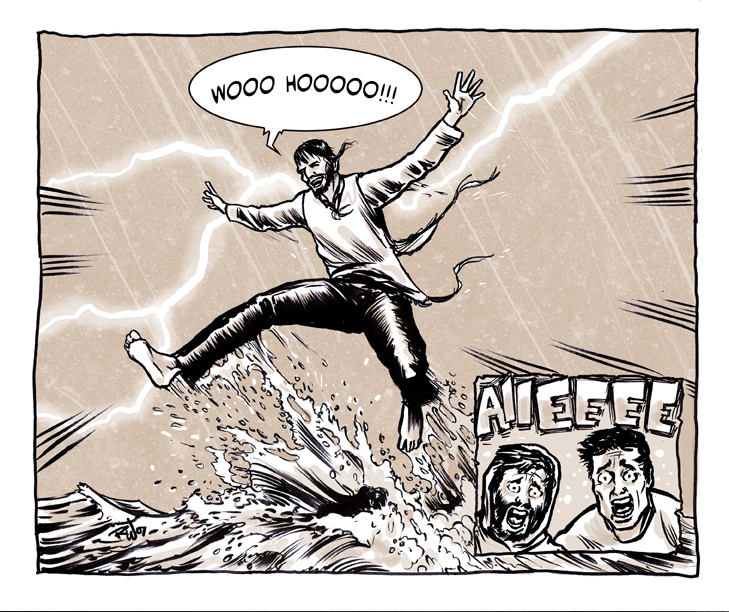
John’s gospel is the only account that indicates that Jesus and John had a time when their ministries overlapped. Jesus began with John the Baptist’s endorsement, and now, we find that he is present when the first hint of controversy arises. His disciples are jealous at the rising popularity of Jesus and his message. John was very popular, probably more popular than Jesus at this beginning stage…he had all the trappings of what passes for successful ministry. Yet it was his joy to step aside for the elevation of Christ.

What reason does he give for that in v27?

Does that help you in any struggles you may have in embracing an intentional humility?

v30 is a powerful statement. It sets the tone for the entire church movement. We haven’t always been very successful in remembering who it is that everything orbits around. How do you think it can bring you joy, like it did for John the Baptist, to allow the reality of Jesus to increase in your life? What would be decreasing in your life as this takes place?

In yet another way, the kingdom of God moves counter to the world’s assumptions, we we find ourselves flourishing through this triumphant decline.

Hope to see you on Sunday!

Nick at Night

It’s one of the most famous stories from the Gospels – the story of a religious leader who has a nighttime meeting with Jesus – where Jesus cryptically conveys the scope and power of his plan – where those famous words were uttered: “For God so loved the world…”.

We’ll be reading John 3:1-21 this Sunday.

I actually did a version of this in my webcomic Rabbi Encounters – you can read it HERE.

While v16 of this section is probably very familiar – much of what surrounds that text is pretty mysterious stuff. Nick wasn’t the only one who got confused – scholars have had multiple interpretations about some of the things Jesus says here for more than a thousand years.

It says the Nick is a ruler of the Judeans – which means he’s on the Sanhedrin. That being the case, he must have been well older than Jesus, a respected man in the community as well as the temple, and he must have been a person from a wealthy family. What do you think was going through his mind as he met with this young, homeless Rabbi from the sticks?

Based on what he says, does he seem friendly or hostile to you? By the end of the gospel, in ch7 and ch19, he clearly becomes a disciple.

Jesus’ answers certainly don’t fit the paradigm that Nick tries to set up. Jesus talks spiritual rebirth and Nick talks obstetrics…it’s sort of a mess.

In trying to make sense of Jesus’ statements about being born of water and spirit, read Ezekial 36:25-26 – what insight, if any, does this give you about what Jesus may be referring to?

What condition does Jesus put on receiving eternal life? What does this condition mean to you?

Read v17. Read it again. If God’s purpose is not to condemn the world, how do you understand v18-21? (read it in the Message…it really helps to make sense of what is being said).

God’s purpose is not to condemn – how well do you think the church has presented that truth? How can we better embody what the gospel message is?

I’m really looking forward to Sunday – see you there!

Jesus Throws a Temple Tantrum

It’s hard to fully grasp the events that took place that morning that Jesus walked into the temple grounds in Jerusalem and started throwing people out. But that’s what we’ll be tackling this Sunday as we explore John 2:13-25.

It’s easy for us to immediately assign the guilt in this scene to the people who are crassly selling the accouterments of worship at the temple. How dare they sell sacrificial animals like a commercial enterprise…and yet…there was a legitimate purpose that these vendors served. Imagine living a long ways from Jerusalem and hauling the required sacrifice with you. Imagine that a dog nips at it’s heel along the way, or worse, a wolf takes a bite out of it’s ear. The sacrifice won’t be accepted and the expenditure of time and food for the trip would be for naught. It actually makes sense to provide a place right at the temple to buy a pre-approved animal to sacrifice.

There was actually something else going on that morning. A disruption and a replacement was being made.

If Jesus was replacing the temple – what are the implications of that as you read it? What can it mean to us today, as his followers in 21st century America?

This should prove to be a compelling study – hope you can make it!

The Sign in the Wine


Our passage for this Sunday is John 2:1-12 as we continue our study in the Gospel of John.

It’s a very famous story – Jesus doing the remarkable thing of transforming ordinary water into extraordinary wine. It is the opening story in a section of stories that have the theme of the old being replaced by the new.

According to v11, why does John include this story in his gospel?

The function of a sign is to reveal where something is – this sign that Jesus does reveals, according to John, the glory of Jesus. His glory is the reality that he is the Son of God bringing God’s reign of grace and truth to this world (1:14).

So – of all things, Jesus chooses THIS setting and THIS miracle as his first sign to reveal what the kingdom of God is coming to do. I find that really interesting. What does this sign reveal to you about the nature of God’s inbreaking kingdom? How does it compare with the way the church represents the kingdom of God – is there a difference?

Think about the nature of water and the nature of wine – what can we discern about God’s presence in the world that is revealed in that contrast? Think about the amount of wine that Jesus creates – what does that tell us about the life God has in mind for us?

The water jars were used for ritual purification. Jesus looks at those reminders of human uncleanness and re-purposes them completely. What lesson does this sign teach us about the nature of what God is up to in our lives?

Have there been times in your life when the wine ran out? How about now? What does this sign encourage you to do about it?

Hope to see you on Sunday!

Following Jesus

What does it mean to follow someone? It really depends on the context. If you follow someone on Twitter it simply means you have an interest in keeping up with what that person writes in 140 characters or less. If you follow a football team, it basically means you’re a fan – you cheer for them and wear their team logo on your person.

To be a follower of Jesus implies much, much more. Jesus’ first disciples will be the topic of our study in the gospel of John this Sunday.  We’ll be reading John 1:35-51.

To really understand the dynamic of what is transpiring in this text, we need to become familiarized with the 1st century practice of rabbis and their disciples. Here is an EXCELLENT article about that subject. Please, please do yourself a favor and take the time to read it.

As you read this account of Rabbi Jesus gathering his first Talmidim (disciples, followers) – what do you observe about following Jesus; what did it meant to them? Did they have questions, and what were they? What was their first order of business after they met Jesus? What significant thing happens with Simon (whose name means sinking sand) – and what might it imply for him?

As the disciples tell their friends about Jesus – what is the invitation they give?

What would you invite others to “come and see” about Jesus?

Here are the songs for this Sunday from the Eastgate Hymnal – its a good practice to meditate on what we’ll sing together and heighten our sense of worship.

“Love Song”
“Bless Your Name”
“There is No One”
“No Other Name”
“From the Inside Out”

Embracing a Life in God

This Sunday as we continue our study in the gospel of John, we’ll be reading John 1:19-34. 

This is the start of the narrative proper. Without any sort of deeper introduction, we get thrown into the middle of a scene that is already underway – there is conflict and tension, and we have to be familiar with the other gospel accounts to even understand who we’re reading about and what’s going on.

Here is an excellent source of information about John the Baptist, not only from Scripture, but also quotes from the ancient Jewish historian Josephus. I highly recommend you taking the time to read it.  It is very possible that John the Baptist was influenced by, or even in direct contact with the Essene community. It’s likely that his practice of baptism evolved from their practice of ritual cleansing.  Here’s a cool breakdown of the religious movements that dominated the cultural landscape of Jesus’ day.

John is sent to sound an alarm that Messiah is not just at hand, but here. His purpose is to encourage the right response from the covenant people of Israel. As we read this section of the narrative – what do you learn about John the Baptist’s view of himself, and how does that instruct us about how we should view ourselves in light of Christ?

What do we learn about Jesus and the Messiah’s ministry from John the Baptist? How does that effect us – what does it mean to our lives as 21st Century Christians?

Hope to see you Sunday!

Identities Defined in the Light

If I were to obtain a retinal scan, a copy of your driver’s licence, your fingerprints, a sample of your DNA and your Social Security number…I would probably be able to positively identify you as a person. Those things are routinely used for security and courtrooms to identify people – but they are wholly impotent in defining a person’s identity – defining who they really are.

Personal identity is such a murky subject – philosophers and doctors of psychology have spent vast amounts of time studying this idea and have yet to come to a fully agreed upon means of drawing out one’s personal identity. So many different factors play into this as well – ethnicity, gender, culture, the nation we live in – but all of these are subservient to the core of who we really are.

It’s odd that answering that question is challenging – why are we so in the dark about something so intimate?

We’re going to consider this theme as we continue our study in the Gospel of John, reading John 1:6-13 this Sunday.

John the Baptist is introduced, but he is plainly described as NOT being the Light that shines in the darkness. There is a lot to consider there, especially as it touches church culture and leadership – but if we think about finding identity, what does that tell us about where our search should begin?

V12 in the Message version is so wonderful to me. I believe Peterson hits the target. V12 reveals who we really are…or at least, who we are meant to be.  This reveals who God is – and how is God revealed in this verse?  This reveals who we are. Does this make any difference in your life, or especially your self-awareness? Does knowing who you are in God’s pattern for life change anything about how you understand your life? If so…how?

I’m really stoked about this section – and I’m looking forward to digging into it!

If you haven’t been there, you should check out The Eastgate Hymnal – a 21st century hymnal. The songs we’ll be singing this Sunday are: Forever ; Holy is the Lord; Beautiful Lord; As Children; and You Are My King  – check out the lyrics and read the meditation to be prepared to enter into our corporate worship time.

See you Sunday!

Introduction to John – The Pattern Revealed

Well…if we make it through these floods, this Sunday we’ll be introducing a new study which will take up our Sundays for many weeks to come. We’ll be embarking on an exploration of the Gospel of John.

I struggled a lot with how to introduce this study. We can’t read John like the other three, synoptic gospels. I thought about just posting a poem…but that seemed a little too ambiguous and maybe even pretentious. However, it is vital that we not approach the Gospel of John like a textbook or a documentary. John’s gospel isn’t intended to educate us as it is to introduce us to….well, to God.

John is basically saying through his account – “If you want to know who God is, or what He is like, take a long look at Jesus.”

That’s what we will set out to do. Through John’s selected vignettes, we will get a different view of Jesus than we find in Matthew, Mark or Luke. John wrote his gospel much later than the other three (which had been circulated for years by the time John’s writing), and it’s clear that he had had a lot of time to think over and draw some conclusions about the things he witnessed and experienced.

This Sunday we’ll be reading John 1:1-5, the prologue.

What other famous passage of Scripture starts with “In the beginning…”? What does that tell us about John’s account of Jesus?

John begins by talking about the Word – eternal, creator, light and life. He will later identify the Word as Jesus. The Greek word for…well, word, is Logos. If you feel like it, you might want to read an interesting Wikipedia entry on the very complex ideas that word carried in the 1st Century Greco-Roman world, as well as in Israel.

What significance to you find in  John using a word that was this meaningful in the ancient world to describe Jesus?

If you were to describe the opening of this gospel, would you say it was a) a curtain rising on an epic drama;  b) walking in on a movie that’s already started;  c) hearing a familiar song sung in a foreign language?

That’s enough stuff to think over for now. Hope to see you Sunday.

Final Words

Final words are easy to miss.  When we sense that a speaker is finishing up, we can wander – close our notebook, put away the pen, think about what’s for lunch.  But many times, final words can provide clarity for what has been said before.  

This Sunday we will be finishing the study in 2 Peter. We’ll be reading 3:14-18.  Peter covers several ideas which we’ll look at.  But his final words I believe provide a clarity to help us properly interpret the call to holiness and godliness; and a stability that can enable us to endue difficulties.

Lets look forward to exploring this passage together.

See you Sunday

Living Now for Then

When I was a kid, my Mom used to buy my brother and I this soap called Fuzzy Wuzzy. It was this bizarre marketing gimmick of an animal shaped soap that would grow “fur” in between uses. Then, when you used it enough times for the outer layers to be washed away, a toy dinosaur was hidden inside. I loved that soap. I kept using that soap faithfully, always with my eye on the prize I was waiting to be revealed.

We’re going to be reading 2 Peter 3:1-13 this Sunday and Peter talks about something similar.

Actually…it’s not similar at all…not even close. But he uses imagery of the elemental patterns of this world melting away and revealing something new underneath. As I read it, I imagine a refiner’s fire burning away all the corruption on the surface of a metal. The idea, poetic or literal, is that at this very moment something is hidden beneath the world as we see and understand it right now. One day Christ will return and with him a new heavens and new earth is revealed. An earth made right again.

That is the very core of our Christian hope. But Peter addresses the hurdles of skepticism that we have to overcome in maintaining that hope.

As you read this section, what does it reveal about God’s seeming delay in concluding his plan? How does that inform you about any area of life where it seems God is delaying his answers?

Peter employs a now/then model for his instruction. We live a certain way right now in anticipation of something in the future.  When the question arises “what does it matter how I live if Christ already paid the price for all my sins?” – how would you answer that question based on what Peter says in v10-13?

Something about a world “all landscaped with righteousness” (as the Message puts it) ignites hope in my heart. I hope it does yours.

See you Sunday!