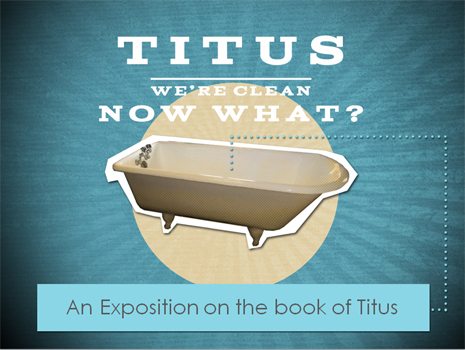
Finding Who We Are in God’s Plan

Well Kats and Kitties, we’re on to our next study! This Sunday we’ll be starting a seven week (just shy of two and a half years) study in the book of Titus.  Titus was a really funny TV show back in the 90’s…but that’s a different thing.

The Titus we’ll be looking at is the one in the New Testament. It’s a short little book written by Paul to a young protege he left in Crete to get things in order with the churches. It was probably written sometime between Paul’s house arrest and his final arrest in Rome, so it’s just near the end of his ministry.

The larger theme of this book will be about how we put the stuff we claim to believe (the gospel, the hope of the coming kingdom of God) into practice.  In this short letter Paul makes the strongest correlation between what we believe and how we live.

We’ll cover the first four verses of chapter one this Sunday.  It is Paul’s introduction and greeting – though even by ancient standards, it’s pretty long.  It’s one serious run-on sentence. We get the distinct impression that Paul is less concerned about grammatical structuring than he is trying to get a point across even in his “hello”.  As you read it, consider how Paul describes himself.  What is the first thing he identifies as a characteristic of his life (v1)?  The word he uses in the Greek is “doulos” – and here’s the lexicon entry for that word. Is there any hint of self-importance in that title?

The question that lingers is…who are WE in God’s plan? Paul saw his place, is ours any different? What does this look like when lived out in real life?

Paul new more than just his status though.  If you read the passage in the Message (it reads much more clearly there), what did Paul’s overall purpose in life seem to be?  If you were asked to sum it up in one word, what word would you choose?

Just a warning: If we’re people who want to build our own kingdom, prioritize comfort and feel we deserve to always be happy….Titus will wreck us. If, however, we are weary of empty and shallow pursuits in church and life in general…Titus will drink like cold, clear water on a hot summer day.  It all depends on our end-goal I suppose.

Hopefully we’ll see you Sunday!

EASTER!!!!

Don’t forget the sunrise service! Try to be there early because we want to start on time, just as the sun is breaking the horizon’s line.  Then join us for our Easter service at our normal meeting times of 9 and 11 am.  This Sunday we’ll be reading 1 Cor 15:1-4.  What is the gospel, the good news?  Paul lays it out, and reveals in a few short sentences the monumental implications of such news.  What does he say the good news is?  What does this news tell us about God, His agenda and ultimate goal? Do you consider that good news?

Resurrection is about redemption.  Jesus rising from the dead shows us what God’s got in mind…and man, is it GOOD!  So get up, get stoked…HE’S ALIVE!!!

See yer’ Sunday!

Peace, Purpose and Passion

If you’ve been hanging out with Eastgate for the last 2.5 years, this Sunday you need to pat yourself on the back because you have journeyed through the entire gospel of Luke, chapter by chapter, verse by verse.  This Sunday we’ll be reading our final installation, ch 24:36-53 , and examining it to see how it relates to our lives.

We have read through Jesus’ birth and ministry in Galilee, right up to his betrayal, arrest and crucifixion.  It was a compelling, challenging story. We have read how three days after his death, Jesus’ body was missing and a couple of glowy guys said he had risen from the dead.  We read how Jesus himself ambushed a couple of travelers on the road to Emmaus and  gradually revealed himself to them. It’s been an amazing ride…and yet, with all of those stories surrounding us, we could STILL be left wondering what it all has to do with us, right here and now in 21st Century America.

That’s where the final section of Luke’s story becomes crucial.  In this wrap-up, we actually see a transition take place for Jesus’ followers.  Jesus shows up and they’re startled, yet he comes announcing something that is entirely opposite of their reaction.  That’s typical.

But then something changes.  What happens?  All before the events of Acts 2 the disciples take on a different demeanor. What do you think changes for them?

Jesus is with them, but differently than he was before.  Then Jesus is gone from them again – yet this doesn’t discourage the disciples, just the opposite.  Christ’s presence, activity and absence all seem to have a profound effect on them.  Do you think those same aspects of the resurrected Christ have the same impact on us?  How would you describe this at work in our own lives?

Hope to see you on Sunday!

On the Road to Hope

All kinds of things disappoint us in life, don’t they?  In fact, its hard to remember a week where something didn’t disappoint me in some way…not sure if that makes me a whiner or not, but I’m just being real.  Whether its the deeper disappointments that come from wars or economies or failed relationships; or the shallow disappointments of sports teams shuffling ’round quarterbacks – we all face things that let us down and cause us sorrow.  That’s just sort of the nature of the road we travel in life.

Our study this Sunday will be in Luke 24:13-35 and we’ll meet some fellow travelers on a disappointing road.

As you read the passage, what do you notice about seeing and not seeing, visible and invisible?  When Jesus started walking with the travelers, what characterized their attitudes?  What does that tell us about where Jesus meets us in our life?

V 21 reveals what hope had been dashed for these travelers.  How did their expectations play a role in their present disappointment?

The obvious lesson that emerges in this section is Jesus’ skillful presentation of the Word that provides the travelers with a fresh vision.  How does that apply to our own lives right now?

What does v35 say caused the travelers to know the stranger was Jesus?  When they see it’s him, they suddenly can’t see him anymore, but they are filled with new hope and activity.  Why do you think that is?

This is one of my favorite stories in the gospels.  This, like no other account, is directly relating to our every day experience as followers of Christ 2,000 years after his death and resurrection.  Try on the character of the travelers and see how the story relates to you.  You may find yourself being ambushed by grace!

Hope to see you Sunday!

The Message of the Empty Tomb

Have you ever encountered anything that you just can’t explain.  Something that just shocks you not only because it’s so unexpected but because it leaves you so confused?  Sometimes it can be ordinary things but because they seem so out of place, it just takes a minute to try and process what’s going on.  I remember a few Christmases back, when my daughter Janelle and her husband were just engaged. He lived in Jacksonville and she was living at home with us in PCB.  He had decided to surprise her by visiting without letting her know she was coming.  She was on the phone with him, each of them pining away for each other.  Suddenly, the doorbell rang, and Janelle went to answer it, still on the phone.  When the door opened, there stood her finance.  She was so confused and shocked, she almost closed the door on him – his appearance was completely unexpected and difficult to process.

Imagine that shock a billion times over, and we can start to get a picture of what the followers of Christ were going through when they found an empty tomb one Sunday morning.

We’re going to be reading Luke 24:1-12 this Sunday (only three more teachings in Luke to go!).

This is Luke’s lead up to the actual appearances of Jesus in the resurrection. Luke gives us more perspectives and details than any of the gospels, as a good documentary maker would do. Here, several women go to finish up the job of perfuming Jesus’ corpse only to find the tomb empty and the corpse missing.  This was not at all expected.  Nor were the angelic glow-dudes who start talking about Jesus not being dead anymore…and things move from unexpected to downright insane.  Nevertheless, they put together what Jesus said before and suddenly, what used to be familiar territory starts shifting and changing around them.  They go to tell the other disciples who understandably dismiss this all as nonsense.

The whole story is delightful to me! I really love how the various gospel accounts don’t match up very well either.  To me, that authenticates this whole scene…full of confusion and conflicting details. Everyone’s in shock trying to figure out what is happening.  The only consistent thing in all of the accounts is the subject at the center of this disarray.  The tomb is empty and Jesus is gone.

There’s a message in that empty tomb.  The fact that Jesus wasn’t able to be confined to that man-made hole tells us something…but what?

The empty tomb was all they had to go on at first. No one SAW Jesus rise from the dead, just a couple florescent fellows  said he did.  What does that tell us about what it will take to accept this message?

Of all the disciples, Peter (and John according to John’s gospel) went to check this story out for themselves. Even though the claim the women made was completely absurd and flew in the face of every certainty life experience could provide.  A willingness to check it out for himself tells us something about Peter…what does that tell us about the impetus for this journey of faith? What do you think is more important, clinical facts, or  possibilities?

This is great stuff to explore – looking forward to examining it with you this Sunday!

All in For the Outlaw

Sometimes its hard to stand up for what you believe when everyone else see’s things differently.  That is never more true when it comes to our faith in Christ.  Following Jesus means we will have to count the cost of being associated with him in an environment that isn’t always favorable for that.  Joseph of Arimathea had to experience that before any of us…in fact, he was the first one through that gate.

We’re going to read about him in the passage we’ll be exploring this Sunday, Luke 23:5-56.

As you think about who Joseph was in the society and culture of that time, what do you think this act of taking Jesus’ body to bury it would cost him?

Have you ever had to go against the flow of the culture around you to be identified as a follower of Christ?  How did you feel? What became your motivation for paying the cost to be associated with Him? We might think it’s smarter just to keep our faith a secret…but how does that compare to the message of the Gospel?
This is a thought provoking subject for us in a Post-Christian America.  I’ll be interested to hear your thoughts.


Also – here is the last small group leader’s guide for this quarter: leaders guide 23-50-56

The Great Convergence

We will be reading the events that surround Christ’s crucifixion this Sunday.  There is no way to cover that much text and subject matter and do a thorough job of exegesis…so suffice it to say that we will be looking at the major themes of what the cross means to us as followers of Christ.

As I read it, all of the sacrifices, prophecies and narratives of the Old Testament lead in a line, converging at the cross of Christ.  All of the effects and consequences of mankind’s great rebellion against God and His plan converge there as well.  In the crucifixion of Jesus, we have pictured not only the judgment and pain of sin, but also the grace and forgiveness of God.  It is a literal cross-hair on which the meaning of life is focused.

As you read this account, you’ll see a wide variety of characters in Luke’s narrative.  From mourners to soldiers to religious leaders to crooks.  If you try any of these characters on for size, which ones can you relate to your own life and response to God?  Which character’s interaction with Jesus upsets you?  Which one comforts you, and why?

What comes across so clearly to me is the sheer magnitude of God’s grace revealed in the cross.  I’ve been contemplating the sacrifice of Jesus a lot this week.  I once questioned a friend’s destructive and self-destructive choices in light of their Christian confession, and the person reprimanded me saying “Remember what you teach Rob, it’s not about being legalistic, it’s about grace!”

As I think about what Jesus suffered in paying the price for my sins…I’ve been contemplating a right response to his love.  His love is never in question…and I will never move from the torn curtain of God’s grace.  But what should OUR response be to that love?  Does our response reveal anything about what we believe and what we consider real?  If I’m a rebel forgiven by great love, is further rebellion a reasonable reaction?  I guess my question is, where’s the love?  Guess I’m just thinking out loud.

Hope to see you Sunday.   Leader’s guide for small groups can be found here: leaders guide 23-26-49

What to do With the King

Here is the opening to what I’m sharing this Sunday:

Imagine if you will for a moment a scene in Afghanistan, where you are the U.S. Commander of an outpost and you’re confronted with a mob of Afghan people who are dragging a prisoner to the gates of the U.S. Military base….and spokesman for the mob is shouting in broken English that the man they have captured is an insurgent, guilty of plotting against the presence of American troops in their country.

You recognize the person who is making the accusations against the prisoner…he’s the imam of the local mosque, a well respected man in the town.

The mob is calling for the immediate execution of the prisoner – they are asking you to do this in deference to the presence of our troops…they don’t want to be mistaken as insurrectionists themselves.

You call for a translator and try to get to the bottom of what’s happening here. Why should this prisoner be executed? The answer comes back that he has blasphemed Mohammad and declared himself as the rightful leader of the region who will bring a new jihad against your military base.

You try to ask the prisoner what he’s done, but he just stays silent.

As the commander of the base, you’re on thin ice. You’ve been reprimanded by a brigadier general and a major general for the way you’ve mishandled diplomacy with the locals…one more write up and you’ll probably be transferred and busted down a rank….or worse, face a court martial.

You don’t know if the prisoner is guilty or not. You know virtually nothing about him except that he’s at the center of a growing crisis.

The imam is getting hysterical, demanding the prisoner’s death. You don’t know why they consider him worthy of death.

You don’t understand his religion, the culture is alien to you, the mob is growing in size and volume teetering on the verge of a riot….and you’re job, you’re FUTURE is on the line.

What will you do? Sacrifice this one insurgent whether he’s guilty or not…. or defy the mob and risk a riot and the loss of many lives? (Not to mention your career)

Execute one potentially innocent man in order to save a lot more lives who are potentially guilty?

We will be reading about the trial of Jesus in Luke 23:1-25.  Pilate is under the extreme pressure of the world and religion as he decides what to do about Jesus’ claim to be king.  As you read his story, think about the pressures life has put on you at times – and think about Christ’s claim as king over  your life. What did Pilate try to do, and what did he  ultimately do, and what can we learn from observing his actions?

Small Group leaders, your leader’s guide can be found here: leaders guide 23-1-25 – note that the title of the message has been changed.

See you Sunday!

Author Ronnie McBrayer

This Sunday Author and speaker Ronnie McBrayer is going to be sharing with us.  Ronnie is a friend of mine, whose writing always challenges me to consider what I really know about Christ and how to live out this faith I have in Him.  Trust me, you will want to hear Ronnie.  Among those I’ve met who are wandering in search of authentic faith, Ronnie is one I feel a deep, kindred appreciation for.  Check out this video he made, and check out his website to get to know him a little better!

Home Group leaders…you’re on your own this week.  My suggestion would be to have a discussion by asking people to share their own thoughts about what Ronnie shares with us. If not that…have a hang out night just for fun.  We will be returning to the regular schedule from your leader’s guides next week.

Hope to see everyone Sunday!

God in the Hands of Angry Sinners

Have you ever dealt with a really obstinate person – a person whose mind is made up and no amount of reasoning or arguing will ever change it? How do you feel when faced with that kind of exchange…what do you do?

In our study of the Gospel of Luke this week we’ll be reading chapter 22:63-71. It’s the account of Jesus’ trial before the Sanhedrin, the highest Jewish authority of the time.

Much is revealed about the nature of who Jesus is in this account, yet surprisingly Jesus says very few words.  He’s beaten by soldiers and interrogated by religious leaders – both groups doing their best to provoke a desired reaction from him, both failing.  What IS revealed is that there are actually two courtroom scenes in this section, one seen and one invisible to the naked eye. In a masterful literary setup, Luke presents the irony of one group assuming a position of power over One who is actually judge of all.  Jesus makes the statement in v69 that identifies him as one holding equal power and right to rule with God, and that seals his fate in their minds.  Its a strange scene where God is in the hands of angry sinners (with apologies to Jonathan Edwards).

Hebrews 12:3 says ” Consider him who endured from sinners such hostility against himself, so that you may not grow weary or fainthearted.”  – in other words, look at Jesus’ example of how he behaved when faced with closed minded, intolerant people, and learn how you can handle people like that.  As you look at Jesus’ behavior during this unjust trial, what do you observe about him and how he did or didn’t react?  Who’s opinion of him does he point to as having ultimate importance? – that is, who’s opinion of him matters most?  What can we learn from that when people don’t like us or misunderstand us or have a low view of our worth?

It should prove an interesting discussion for the home groups this week. A leader’s guide for this week can be found here: leaders guide 22-63-71

Stuff to think about.  Hope to see you Sunday!