Won’t You Be My Neighbor?

What a great discussion we had here last week.  I really appreciate the time and consideration so many of you gave in posting your thoughts.   Having said that, I’m not trying to put anyone under pressure to make comments now…I’m just sayin’ it was cool last week.

This Sunday we’ll be reading Luke 10:25-37, the story of the Good Samaritan.

Why do you think the Scribe (Lawyer) was testing Jesus on this point?  Think about where they are and what has happened in the first part of the chapter.  The Scribe is concerned with how one achieves eternal life.  That is, how does a person get in on the Kingdom of God when it gets revealed (keeping in mind what the 1st century Jewish view of the Kingdom of God).   He’s basically asking “what is the core of our faith, what is our highest priority?”.  It all boils down to two things…what two things are of highest importance?

Notice that Jesus never answers the Scribe’s questions directly, but answers with a question, or tells a story followed by a question.  Who then provides all the definitions in this story?

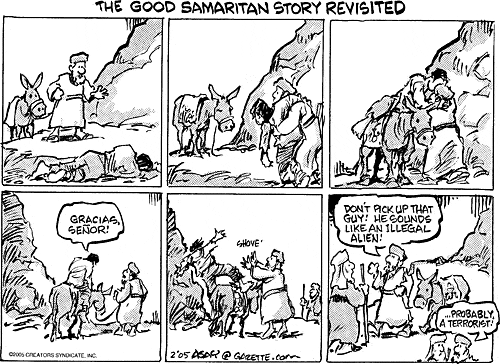
Samaritans were hated by the Jewish people.  They were the traditional bad guys.  If you were to put this story on a contemporary stage, who would the Samaritan be to you?  Why do you suppose Jesus turned the tables like this, what was his point?

Applying this parable to real life, how does it challenge you?

Looking forward to exploring this on Sunday!  See you then.

We Got a Reason to be Stoked

Do you ever find yourself just going through the motions of what you perceive is expected of you as a Christian?  Ever find yourself in a joyless funk where you feel like you’re just going through the motions of faith?  Every once in a while, its really good to get back to the heart of what this life of following Christ really has going for it…to sort of shake us out of our malaise and reignite our passion and excitement for the kingdom project Jesus started whilst on earth.

Our passage in Luke will be chapter 10:17-24 this Sunday.

As the 72 (or 70, your choice) return from their mission, they are pretty stoked.  They give a reason for that joy, and Jesus affirms it, and that is…Jesus WINS.  If Jesus wins, who loses?  Why is that a reason to be joyful?

We do have Jesus qualifying their stokedness…reminding them that they don’t want to look at what they’ve done, nor even what they may do as being the SOURCE of their joy…what IS the source?  Why is that a reason to be joyful?

In so many ways, this journey Jesus takes from Galilee to Jerusalem is a picture of the church age, and even the end of the story.  It’s a good ending, an ending prophets and kings were longing to see fulfilled in their day.  If the story has a good ending, then all adversity that happens in the meantime is simply part of the adventure.  To me, that seems like a good source of joy. What about you?

We Are Meant to Make a Difference

Hey everyone, I’m back from my brief sabbatical!  I had a really good time getting away and praying (the picture here is the view from the place where I was staying in Kentucky)…also went down to Merrit Island to a Calvary Chapel Pastor’s day…which was cool to meet up with other guys in the CC network.  I’m rested up and refreshed, and ready to hit it!  I really appreciate the guys who filled in to teach while I was gone…I got to hear them, and they all did a great job!

This Sunday we’ll be returning to our study in Luke, and we’ll be reading chapter 10:1-16.

Once again Jesus sends out an advance team to prepare the way for His coming.  He did this with the 12 apostles back at the beginning of chapter 9, but here He sends 72 (or 70, depending on which translation you read…it doesn’t really matter that much which number is right…it was obviously more than 12).  The other big difference between the sending of the 12 in ch 9 and this sending is the fact that He is sending the 72 to villages in Samaria, since that’s where He’s traveling in this part of the narrative.  It sort of gives us a picture of the future mission of the church, when Jesus sends us into “all nations”…meaning the gospel message isn’t confined to Israel alone.

As you read through Jesus’ instructions, what message do you get concerning our mission as the church.  What is our purpose as a community?  What do you suppose Jesus is meaning by asking us to “pray to the Lord of the harvest to send out laborers into his harvest”?

When Jesus starts in on the “woe” section, He starts naming names when it comes to the places who are going to be judged more severely for rejecting Jesus.  What villages does He name…and do you find anything interesting about the places He mentions considering where He is when He says this?  As you read what Hes says, do you think there’s a difference between “never hearing” Jesus and “rejecting” Jesus?

The Right Kind of Sell-Out

Robert Kearns is the guy who invented the intermittent wiper blade.  He got shafted by the auto industry who basically stole his design, and had to go to court to sue for recompense and damages.  He won after many, many years of litigation.  They made a movie about it called “Flash of Genius”.  I saw that movie a while back.  What struck me most was how completely sold out Kearns was to getting justice for his injury.  So much so, he lost everything in the process of winning his law-suit.  His wife, his kids…all who were close to him.  But he was committed to winning his case, so everything else was expendable by default.

I don’t know if I admire him or pity him…I really don’t.  The thing is, you can’t help but notice commitment like that.  It’s radical.  Troubling as it may be, Jesus calls us to that same kind of radical commitment when it comes to following Him.

We’re looking at Luke 9:57-62 this Sunday.  Jesus will be approached by three different would-be disciples.  They each represent three qualifications for commitment to Christ and His Kingdom.  This is no-holds-barred, sharped edged stuff here.  No one can read this brief account and not feel some sort of cut.  As you read it, what challenges do you encounter?  If we compare our own lifestyles (as 21st Century American Christians) with the claims Jesus seems to lay on our lives…how deep does our own commitment run?  What does counting the cost of following Christ mean to you?  I’d love to hear your thoughts…even though this is a tough subject.

Religious Pride Gets a Smack-Down

One of the most profound revelations we get about ourselves in Scripture is just how valuable we are to God.  All through 66 books of the Bible, the message cuts through the static: “I love you, come back to Me.”.  It’s in this context that our souls are awakened and we find new meaning in the spiritual significance of life as opposed to wrapping our identities in the mean and mundane trappings of materialism.  We become followers of Christ, Children of God…Christians.  And then for some reason, we seem to lose our minds.

We begin to assume a certain transcendence of position and knowledge because of the truth we embrace…and a whole new world of false identity begins to snug around us…we fall prey to religious pride.  It’s easy to have happen…it sneaks up on us without us even noticing it.  It happened to the disciples pretty early on, and Jesus had to deal out a serious smack-down to the prideful attitude that was beginning to bubble up among his crew.

We’ll be reading Luke 9:46-56 this Sunday.  (By the way, I appreciate the comments and even the emails I received concerning last weeks meeting/message.  I’m in awe at how God is moving in new ways in our community)

In the section we’ll be looking at, we will see the disciples falling prey to a form of religious pride in regard to three different areas of relating to people.  Among themselves (v46-48), among other believers who weren’t part of THEIR group (v49-50), and toward those who are actively opposing the message of Christ (v51-56).  In each case, self was at the center of the dispute.  In each case, Jesus corrects their attitude and behavior with a counter response (ie: instead of doing this, do that).

Which of these vignettes hits closest to home for you?  Do you identify with the disciples at any of these junctures?  What counter response seems the most difficult to you to embrace?

If there’s one thing that’s clear…Jesus makes no room for prideful attitudes among His ranks.  This is the work He does in shaping us into the people we were meant to be.

See you Sunday!

From Majesty to Messy

I don’t believe it properly represents Christ to burn books as a protest, or as a means of “venting”, as Dr. Terry Jones explained his reasons for desiring to burn copies of the Q’uran on the 9/11 anniversary. I honestly believe it is not only a poor example of Christianity, it is pretty much the antithesis of what Christ represents.  Anti-Christ, you could say.  I’m not saying that to stir up more anger and controversy about the proposed book burning…I’m saying it because Dr. Jones reminds me that we as the church don’t always do a very good job of representing who Jesus is, or what He’s all about.  A quick glance at church history tells us that.  It’s pretty much been that way from the beginning.

We’re looking at Luke 9:37-45 this Sunday.

The disciples of Jesus didn’t do a very good job representing His power to the people back then either.  It’s sort of endemic to our faith.  Jesus prays, we go to sleep.  Jesus reveals the glory of heaven, we want to build tents.  Jesus gives us power and authority to advance His kingdom, and we just can’t seem to get it to work like He does.  It’s been 2,000 years of this same show.

Yet…what is the result of this story.  What happens, and what do we learn about Jesus and ourselves?  What is His final statement to them in this section…and why does he bring THAT up again?  Those are some interesting thoughts to ponder as we prepare to explore this together.  Let me hear your thoughts!

Glimpse of the Finish Line

This was from an article over at CNN: “James Cameron’s completely immersive spectacle “Avatar” may have been a little too real for some fans who say they have experienced depression and suicidal thoughts after seeing the film because they long to enjoy the beauty of the alien world Pandora.” Putting aside that the movie was a bit of tripe, I was reminded of that article as I read the passage we’ll be looking at this Sunday at Eastgate.

Luke 9:28-36

I think about people sitting in a theater for the 3 hours Avatar took to play out.  Totally immersed in the lights and colors spread out before them in 3-D.   I imagine them sitting all the way through the credits, loath to take off those glasses and confront the reality of familiar things.  Gone are the translucent, glowing forests.  Spilled popcorn and wads of chewing gum now decorate their path.  The glory fades away, and the hard edges of real life return to focus.

I bet Pete,  Jimmy and Jack felt that way too, after their mountaintop experience with Jesus.  Right in the middle of it all, Pete had blurted out instructions for how to secure the moment and enshrine it.  It wasn’t meant for enshrinement though.  It was just a glimpse, after all, of what the end game will be like.  A glimpse of the finish line.  Back in v 27, Jesus predicted that there were those standing there with him who would “not taste death until they see the kingdom of God”.  All three synoptic gospels place the story of the transfiguration on the heels of that prediction…so it must be what he was talking about.  Jesus showed the disciples why taking up a cross and following him was worth it…he pulled back the curtain just a bit to show just how glorious it will be.

As you think about the details of this story, what jumps out at you?  What happened, who were the characters involved, what was said?  As you ponder that, share what thoughts you have about how it forecasts what the kingdom of God will be like when it’s fully revealed.

There have been great comments on these posts, keep them coming!

The Cost of Commitment

Last Wednesday we taught on Proverbs 5.  Several people expressed that it was helpful…and I just thought that if you weren’t able to be there…you might find it beneficial too.   You can listen to it here: Proverbs 5

This Sunday we’ll be reading Luke 9:7-9, 18-27.

The overall theme we find here is underscored by the question, “who is Jesus?”  The answer to that question propels Jesus’ conversation with his disciples toward the reality check about what this will cost them to follow him.  Ultimately, that is the theme.  The cost of commitment to follow Christ.

How do you feel about Jesus’ command to “take up a cross” and follow him?  Imagine what that must’ve meant to those who grew up watching the Roman’s brutally execute people they’d known all their lives…how insensitive that must have sounded. What does his command mean to you?  How would you apply it to your own life circumstances?

Losing and finding are repeated themes in this section.  Losing our life to find life…what a strange line of reasoning.  How does that reasoning flow with the values of our present culture?  What do you believe Jesus meant by saying that?

This will be a challenging passage of Scripture to wrestle with.  So bring your wrestling shoes this Sunday and we’ll grapple with this thing together!

Our Inadequacy is Christ’s Abundance

This Sunday we’ll be exploring the events described in Luke 9:10-17.  The astute reader may worry that I’ve skipped verses 7-9 in our studies…but we’re just putting those aside, and we’ll be dealing with them next time.  Our focus this week will be on the miracle of the loaves and fish.

This appears to be an important miracle, because all four gospels recount the story of it.  Early Church art often used the imagery of loaves and fish as symbolic of God’s provision, and even the gospel itself.  We have been exposed to the telling of this miracle so much that it tends to get lost in the shuffle of telling the story of Christ, but it has a very important message contained it.

There are several parallels to the Old Testament that are most likely intentional.  Jesus in the wilderness, providing food for His followers, like Moses in the wilderness providing Wonder Bread (manna) for the children of Israel; or the multiplication of resources yielded to God like the story of Elijah and the widow of Zarephath.

As you read this story, what distinctions do you see between the way Jesus responded to the people and the need and the way the disciples responded?  Consider the overall setting and circumstances, that the disciples had just come back from their own ministry tour and were probably worn out…does this possible detail impact the story in any way?  If you apply this story to your own life as a servant of Christ…what lesson can you glean about meeting the needs of the world around you?

Should be interesting…hope to see you Sunday!

We’re on a Mission From God

That iconic phrase that propelled Jake and Elwood on their hilarious adventures could also be applied to the earliest disciples who were sent out by Jesus to advance His cause in the passage we’ll be reading this Sunday.  Luke 9:1-6 will be the text for our study.

This was essentially the very first missions trip.  it was a precursor to the Great Commission issued by Jesus at the close of His earthly ministry.  As we read these few verses, we can sort of grasp at the nature of our own mission as the church today.  What can you observe about the mission Jesus has called His followers to in these instructions given to the disciples?  Where does power and authority come from, what is it power to do, what are the specific instructions about how to live among those we are sent to?

His commands seem strange and rather culturally specific, it may be hard to relate this passage to our present experiences.  Do this: consider what it meant to the disciples who had to live it out…what would it have looked like in THEIR experience, then make the closest possible connection with our present culture.  For instance, Jesus told them “Take nothing for your journey, no staff, nor bag, nor bread, nor money; and do not have two tunics…” .  Now, these are not what we would call travel essentials in our day, but for the traveler in ancient Palestine, it was important equipment for the road.  Why would Jesus limit what they carried…what was his point, do you think?  Once the possible reason is established, then imagine what that principle would look like in our present world as we carry OUR mission out.

Share your thoughts!  See you on Sunday.  Oh yeah, if you tweet, don’t forget to follow @eastgatepcb .