Who is the King?

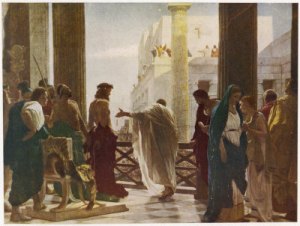
Pilate offers Jesus to the crowd

We’re going to continue in Mark this Sunday…we’ll be looking at Mark 15:1-20.

The Jewish leaders have concluded their judgement of Jesus, and believe Him deserving of death.  They, however, don’t have the authority to put someone to death because they are under Roman rule.  Their difficulty is now to convince the Roman governor, Pilate,  who has jurisdiction over Jerusalem to condemn Jesus to the death sentence.

They have condemned Jesus as deserving of death because of blasphemy, but they know that will never wash with a Roman ruler.  So, they focus on the one thing sure to get Pilate’s attention, and that is the claim to be the King of the Jewish people.  Why would that get Pilate’s attention?

When Pilate asks Jesus about this claim, Jesus, in the original language, says essentially: “That’s what you say.”  Why does Jesus seem so non-committal in His answer?  Maybe John’s version of this encounter sheds some light on it: John 18:36-37.

Things get exposed in glaring detail the nearer we get to the cross.  Pilate sees why the religious leaders want Jesus killed (v10).  What were their motives?  Why THOSE motives?  What does this tell us about their thought of Jesus as king?

What does Pilate marvel at (v5)?  Why do you think this causes him to wonder in admiration?  What was he looking for in a king?

Why did the crowd choose the way they did?  What made the difference between Jesus’ entry into Jerusalem and this moment?  What were they looking for in a king?

Why do the soldiers treat Jesus the way they do?  What has them so riled up?  What possible motive can they have for this level of cruelty?  What do they reveal about their view of Jesus as king?

What is the center of this trial?  What is the crucial question asked?  Have we asked that question when it comes to our lives? 

See you Sunday!

Identities Revealed Through Crisis- Mark 14:43-65

Our text this week will be Mark 14:43-65, and you can read it here.

As the tension of the situation mounted last week in the scene of Jesus’ prayer in the garden, it now explodes into crisis, as Judas leads a group of armed men to come and apprehend Jesus to take Him back into the city for trial.

This “multitude” as Mark puts it, would have been a a detachment of the Temple Guard, men who were authorized by the Roman government to carry arms and act as local police, so that Roman soldiers weren’t always responsible for day to day operations of the city.  Think of them as the Iraqi police our military is training to keep order in Baghdad.

Several characters and groups come into sharp focus as this crisis mounts…and their true nature gets revealed in the process.

Our first exposed character is Judas (v 43-46).  He greets Jesus, it says, with a kiss.  The word implies tenderness and affection.  It looks so good on the surface…but something else is revealed.  What are Judas’ motives for showing affection to Jesus?  Who benefits from his action?  Do our actions ever flow along these same currents when it comes to our walk with Christ?  What do we learn from Judas?  What should we watch out for in our own expressions of loyalty and love for Jesus?

The next character exposed is unnamed in Mark, but we’re told in John 18:10 that it’s Peter(v 47)…the guy lopping off ears with a sword.  Peter was pretty adamant about his loyalty to Jesus in the last section we read.  What gets exposed about Peter in his actions here?  The parrelel account of this in Luke tells us that Jesus has to clean up this mess for him.  What, again, is Pete relying on in this crisis?  How does it seem to work for him?  Have you left any ears on the ground in your response to a crisis?  What do we learn about where our battles should be fought?

The rest of the disciples get exposed (v 48-52) during this arrest.  For all of their lofty talk a few hours before, when the whip comes down, they scatter.  When we are faced with crisis, how are we tempted to move farther away from Jesus?  Using v 52 as an example, what is often the result of distancing ourselves from Christ when things seem to be falling apart?

The trial before the religious leaders takes up the rest of the section (v 53- 65)  Here, the religious leaders are exposed for who they really are.  As I read this, I have no reason to think that they believe they are doing God’s will, and defending God’s ways.  Yet in the process of doing what they think is right, they do an awful lot of stuff that’s wrong.  In fact, you might find this article interesting, concerning the illegal procedures the Sanhedrin employed in Jesus’ trial.  What does this tell us about the religious leaders?  They believe they are doing the right thing, and are willing to go to any lengths to achieve it?  Is it still right, if we employ wrong tactics to get what we want?  What implication does this have on how they esteem their own interpretations of the Word?  Are there places in our lives where we are unteachable?  Have you ever  been pressed to give an answer, and been tempted to “make something up” in order to prove you are right?  What do we learn about “being right” in this portion of the text?

The final revelation comes concerning who Jesus is (v61-62). When they ask Jesus point blank “are you the Messiah, the Son of God (Blessed)?”…Jesus answers first with two words.  Read Exodus 3:13-14.  What does this tell us about Jesus’ response?  Who is Jesus revealing Himself to be?  It amazes me when people say “Jesus never said He was God, His followers said that after He was gone.”  Not true, as the passage above reveals.  That’s what causes such a dramatic reaction from the High Priest.  In light of who Jesus is revealed to be in this crisis…what do we learn about where our loyalties, trust, and direction is to be toward?  How do we do that in real life?

Stuff to think about.  See you Sundee’.  Have a great 4th of July!

Just When We Think We’ve Got it all Together – Mark 14:27-42

Hey everybody.  First off, I want to mention that Sabet Kuj called me yesterday to thank our church for praying for Suzy and he.  In case you don’t know, they are missionaries to the Sudan that we have been supporting as a church, and who stayed in our area and hung out with our church for a year.  She had filed for citizenship in the U.S. (Suzy is from the U.K.), and last week she received it.  The whole family will be united in Sudan by September.  God is good.

Our text this week is going to be Mark 14:27-42 – read it here.

Verse 26 provided the larger context of the events recorded in this part of chapter 14.  Even though we have the account of Jesus praying in the garden, that event is surrounded by accounts of self confidence and failure.

Have you ever made a commitment to something verbally, but failed to follow through because it was more difficult than you thought?  How did it make you feel?  What did you learn from something like that?

In all the gospel accounts, Peter is always quick with his tongue…and his own account (if that’s what Mark is) is no different.  He makes bold claims and promises, but later on in the chapter, we’ll find out just how he keeps those promises.

As Jesus goes off to pray, what do the disciples do?  In His humanity, as best we can tell, Jesus had the same struggles with surrendering His will to survive.  This is, in part, what is making Him “exceedingly sorrowful to death…”  It is in the context of laying aside His own will that Jesus utters the rally cry the church has echoed for 2,000 years – “not what I will, but what YOU will.”.

When He gets back to His disciples, he awakens them.  What do you make of that?  How would you apply that to your life as a disciple now?  His warning is about the weakness of our flesh when it comes to fulfiling our spiritual desires and goals.  Obviously, this has application to prayer, because that’s the immediate context, but what do we learn from His warning as we try to apply it to other areas of our spiritual journey.

In v 40, we’re given a reason why the disciples were sleeping.  In your own times of struggle or heart pain, when you just don’t know what to do, what has been your response?  Escaping is a natural human tendency.  What things do we try to escape to, instead of resolving to entrust our situations to God?

This whole scene gets repeated three times.  As you read it, how do you imagine Jesus’ facial expressions?  How do you imagine His tone of voice?  Does Jesus give up on them?  What is His final word to them in V 42?  What does that mean to your life? 

Well…I hope that sparks some good conversation.  Thanks for reading this, and being willing to dig a little during the week.  This is time WELL SPENT.  See yer’ Sundee!


Come to the Table – Mark 14:12-26

Wow, we had a great discussion going last week!  Thank you to all who participated.  I might need to mention that I may be lifting some of this conversation and using it in our teaching time, I hope that’s OK.  I think this is a great way to expand the exploration and make it interactive to some degree.  This is putting the technology we have to good use, IMO.

OK…so our passage this week will be Mark 14:12-26.

As we read this passage, we can see the unifying theme to these verses.  What is it?  What is happening all through this section?

If you were to take this section, and break it into chunks, you would have v12-16, v17-21 and v 22-26.  It’s interesting that each of these vignettes tell a different sub-story, yet all together, they describe the whole event.

In v12-16, Jesus sends His disciples to get a room prepared for them all to celebrate the Passover.  Mark spends a lot of time on this detail.  One thing that interests me is that they waited so long to get this room.  Jerusalem is swollen with pilgrims from all over the country…it’s like spring break on the beach.  I wonder how easy it is to come down to the beach the night before spring break starts and just get a room?  As we read this…what is this sub-story telling us?  How do we apply what we learn from this story to our own lives?

In v17-21 Jesus breaks the news that not all of the disciples are who they seem to be.  There is a traitor in their midst.  It’s a dire warning, and certainly not what the disciples were expecting for diner conversation.  What is their reaction to this news?  How do they feel, what do they say?  How do we apply this to our own lives?

Finally, in v 22-26 Jesus takes the Passover meal in a whole new direction.  Jesus took portions of the meal and applied them symbolically to Himself, and the events that were about to unfold.  In v24-25, there is a word that gets repeated.  What word is it?  What does it tell us about the effect of Jesus’ death on us?  What is the lesson we learn from the Lord’s Table?

Stuff to think about.  Have a great week, see yer’ Sundee!


She Has Done a Good Work for Me – Mark 14:1-11

 Our study this Sunday will start chapter 14 in Mark.  We’ll be reading the first 11 verses.  We are now just a few days out from Jesus’ arrest and crucifixion.  The religious leadership want Jesus out of the way, but in their reasoning, they’ll have to wait until Passover is finished, because they don’t want to cause an uproar.  Interesting that despite their planning…Jesus is still crucified over the Passover weekend.  What does that tell us about who’s really in charge here?

The text tells us that Jesus is staying at the house of a guy named Simon the Leper.  Talk about sorry nick-names.  Many believe this was a man who had been healed from leprosy by Jesus, and was now a follower of Him.  I think that’s reasonable, but we do want to keep in mind that some scholars question the translation, and there is a possibility that it should read Simon the “potter”.  I’m not a language scholar, so I’ll stay out of that debate.

John’s parallel accountof this event tells us that the woman who comes to Jesus is Mary, the sister of Lazarus, whom Jesus raised from the dead just before He came into Jerusalem.  She lived in Bethany too.  Both accounts say that Mary broke open an alabaster flask, or jar of very expensive perfume, and poured it on his head and feet.

John’s account has Judas doing some quick calculations about the cost, which equates to about a year’s wages in that time.  Judas did this quick economics lesson to accuse her, but I’m glad he did it because it gives us a good point of reference to understand what this gesture meant.

When she was accused, she was accused (by Judas, according to John 12) of being wasteful.  Yet Jesus says she “did a good work for ME”….what do you suppose Jesus means by that?  The description of what she does isn’t always what comes to mind when I think of work.   Jesus also says “She has done what she could.”  Jesus is very pleased with her actions.  He defends her, and promises that what she has done will be immortalized, taught synonymously with the gospel.  Wow. 

Obviously, we live in a different culture, so some things are hard to understand in this.  Pouring oil on a guy’s head wouldn’t go over quite so well in our culture (at least since the 1950’s).  In that day and place, taking baths wasn’t something a person had the opportunity to do as often as we do.  People would quickly develop a certain odoriferousness (funk) about them.  So, this sort of thing was a welcome way to put a sheen on the hair and diffuse the funk.

But, Jesus associated it with his burial.  All along Jesus has been warning His disciples that He’s going to be betrayed, handed over to the gentiles, and murdered.  Do you think Mary is the only one who really heard HIm?  Is it possible she is anticipating His death, or is Jesus steering this somewhere?  What would Jesus be doing, if He were tying her activity here to His approaching death?

What other observations do you draw from this passage?  What do we learn from her “work” about our daily lives that we live here and now?

What contrasts do we draw from Judas’ behavior immediately following this event? 

See yer’ Sundee.

Dark Clouds over Mordor; Mark 13:14-37

Forgive the Tolkien reference in the title…sometimes I just can’t help but let my inner geek run amok.  This Sunday we’ll be looking at Mark 13:14-37, and we’ll finish up the chapter.

Remember our introductory remarks about the first thirteen verses…while end time events and prophecy is cool and all, to over emphasize it can be almost as dangerous as ignoring it.  So, while keeping our heads cool and level, we’ll be looking at some of the characteristics that Jesus describes will surround (what I believe to be ) the end of the age.

Jesus begins this section pointing to a prophecy from Daniel 11which references “the abomination of desolation”.  It might be interesting reading to look at this entry from the Jewish Encyclopedia (it’s about a Syrian King named Antiochus).  From the Jewish perspective today, and back in Jesus’ time, this was a historic event, not something yet to be fulfilled.  What does that tell us about Jesus’ statement here? 

In v19, what will the world be like in the time period he’s describing?  What does that tell us about the direction the world is taking…and how does it effect our expectations about the state of the world?

As you read this section over, who or what seems to have the upper hand through it all?  Yet what is the final outcome that Jesus predicts?  It might be helpful to read Daniel 7…or at least v13-14 in that chapter.

Verses 28-31, of Mark 13, tell us that we can expect an intensifying of troubles, leading up to the grand finale…just like we see buds and leaves sprouting and leading into summer and harvest.  In v31, Jesus makes a prediction about his predictions…what is it that he says?  What does that tell us about his predictions?

The final section, v 32-37 sort of put the final qualifier on the issue.  What does He say about these events?  What do we need to factor in because of this qualifier?

That should give us plenty to mull over and chew on this week!  See ya’ Sundee’!

Mark 13:1-13, Our Text this Week

Remember to visit the Prayer Wall…lets continue to keep each other in prayer.  Also, don’t forget to visit the links provided in the post below if you desire to help in some way during the crisis in Myanmar and China.

I was so woefully behind last week, I’m sorry for that.  Sometimes other aspects of life and the commitments I have may impede my ability to do this…so don’t be offended or give up if I get behind or miss one of these.  Ok?

This week we’ll be reading Mark 13:1-13.  It’s actually just the first part of a sermon Jesus teaches through the whole chapter (all 37 verses).  It’s the longest teaching that Mark’s gospel records…so it must be pretty important.

This sermon is traditionally called the Sermon on the Mount of Olives.  The whole thrust of this chapter is apocalyptic in nature.  Jesus is talking about things that will take place later.  The big question is, HOW much later?  Some view this whole sermon as a forecast of the events of 70ad, where the forces of Rome destroyed Jerusalem and the temple, and it changed the face of Judaism from that day forward.   The only problem with that view is that some of what Jesus describes later on in this sermon (v24-27) didn’t get fulfilled at that time…at least, they didn’t get fulfilled as literally as the first part of the prediction was fulfilled.

That’s been puzzling for a long time.  Some hold a view that everything Jesus is saying here is talking about future events that will surround the Great Tribulation.  My problem with that is that it demands we rip this sermon completely out of the surrounding context, which we’ve pointed out is all about the end of the temple system of worship.

Others believe this is talking about BOTH the events of 70ad and the future events of the end of the age.  I’m closer to being convinced by that stance.  It’s also possible that this is a prophecy that has multiple levels of fulfillment…sort of like the events spoken of are almost cyclical, and there is a first and secondary fulfillment possible.  I could agree with that too.

In all of it, I’m not willing to get so dogmatic about my views that I would stake anything important on it.

My thing is, while contemplating future events is really interesting and sensational…it can also be a distraction from what the Bible stresses more frequently, and that is, how we live out our faith day by day.

As you look over the first 13 verses, we realize that Jesus describes events that may feel like the end, but are only the circumstances that will be present in the age betweenJesus’ assencion, and His return.  That means, this time we live in right now…in our day by day lives, we are facing these types of things in the world around us.  So my question is, what things do we learn about living in this time from these first 13 verses?  What does Jesus tell us and warn us about?  What can we take from these verses as encouragments about daily life in the 21st century?

I’ll be interested to read your thoughts on this. 

Relief Information for Myanmar

The death toll from the Myanmar cyclone continues to climb. Official numbers are at 78,000, but many on the ground believe the number to be much higher and could grow significantly in the next few weeks if adequate water and supplies do not reach those in need. Clean water is a rare commodity in the delta region where the Cyclone caused the most long-lasting damage, and efforts to provide water and other essentials to those in need are being thwarted at every turn. The Burmese government is doing all it can to prevent the international community from being able to do the work it needs to do, but some restrictions are being lifted.


The following is a list of 6 organizations that are doing the best they can to help the people of Burma. Each one has its strengths and weaknesses. GRI, Partners Relief and Development and The Free Burma Rangers are smaller organizations that don’t necessarily have the clout or funding power of Samaritan’s Purse, but they have been on the ground in Burma and will continue to be on the ground long after the public has grown tired of hearing about the tragedy. GFA also has an ongoing presence in Burma with a Bible school in the capital city.


Please prayerfully consider how you can support any of these groups or the people they seek to reach:


· Samaritan’s Purse

             http://www.samaritanspurse.org/MP_Article.asp?ArticleID=158  – Samaritan’s Purse is primarily a relief organization, and as such they seem to be getting around some of the barriers that other groups are facing. They have a plane in Burma with 20 tons of supplies. It is the first of three scheduled to arrive.


From the website:


” As heavy rains resumed in the Irrawaddy River delta, a plane carrying 20 tons of Samaritan’s Purse emergency relief supplies landed in Myanmar during the early morning hours on Thursday. The shipment is the first of at least three planned deliveries of critically needed aid to survivors of the cyclone that ravaged the country nearly two weeks ago.

Prayers continue to be answered as Samaritan’s Purse was among the first humanitarian agencies to receive clearance to land in Yangon, the capital of Myanmar (also known as Burma).

A delegation of military personnel and church leaders welcomed Samaritan’s Purse when the Antonov AN-12 cargo plane arrived in Yangon around 4 a.m. local time. We are working with area churches to coordinate distribution of the relief supplies to devastated communities.

The first shipment of emergency aid included 974 cartons of water purification kits, 2,000 plastic buckets for use with the kits, 135 rolls of plastic for temporary shelters, 10,000 mosquito nets, 3,000 blankets, and 6,000 pieces of clothing for men, women, and children.”


· Gospel for Asia:

 http://www.gfa.org/cyclone  – GFA has an established presence in Burma. They have a Bible college in Yangon (Rangoon, the capital city), from which it has sent out five teams to survey the damage and assess needs.


From the website:


One of the teams is being led by the school’s dean of students. The GFA country leader is directing the relief efforts at the college, which includes providing desperately needed food and water to survivors staying on and near the campus.

‘For us, the issue is not as much visas as it is getting supplies into the affected areas,’ K.P. explained. ‘Our people are already on the ground. Our national leader is organizing the relief efforts. And he is trying to arrange for our materials to get in. But they need much more—and they need much prayer.

‘We are working to get some of our workers into Burma from India,’ he noted, ‘but right now we are relying on our Burmese workers and church members who are helping every way they can to alleviate the suffering.

‘Most importantly, they are bringing the hope of Jesus Christ into the situation. One of the things we learned in the wake of the Asian tsunami was that even when we bring physical aid, the emotional and spiritual needs are even greater.’

‘I still remember when one of our missionaries read Scripture to a woman who was about to walk into the ocean and drown herself because she had lost everything in the tsunami,’ he recounted. ‘She had received food and clothing and shelter—but she had lost her entire family and didn’t want to live anymore. It was only the Good News of the Gospel that saved her.

‘Even as we minister in the wake of this cyclone, we must never forget what man’s deepest needs are.’”


· World Vision

http://www.worldvision.org/news.nsf/news/myanmar-cyclone-20080505?open&lid=20225&lpos=fea_txt_MyanmarERDMVid_LearnMore  – World Vision’s main focus is to help children. In their relief efforts in Myanmar they are paying special attention to the needs of children.


From the website:

May 15 update:


Our teams are rolling out 37 Child-Friendly Spaces in and around Yangon to help children cope with devastating consequences of the disaster; many children have been left orphaned, injured, or vulnerable to disease. World Vision’s priority is to ensure all children are safe and to support their recovery. At these places, children will be able to play games, gain informal education, and talk about their experiences in a caring and supportive environment facilitated by trained World Vision volunteers.

May 14: World Vision has been supplying clean water to survivors in the Irrawaddy area. Our teams also have started chlorinating wells, providing water tanks, and disinfecting camp sites with bleaching powder. Meanwhile, in Yangon, more than 78,000 people have received clean water, rice, and other emergency aid, such as clothing, blankets, and tarpaulins. Diesel fuel is being distributed to operate water pumps.


· Global Refuge International

http://www.globalrefuge.org/pages/index_content.html – GRI has had ongoing ministry in Burma preceding the cyclone.


From the website:


“As of May 16:


-Assessment team currently in Burma organizing relief supplies and distribution.


-An aid airlift containing one million dollars of antibiotics, other medications, mosquito nets, tarps, water purification equipment, and plastic sheeting sits in Europe, awaiting Burmese approval to land and distribute.


-GRI is raising funds to provide direct relief to victims in delta region through existing in-country channels.”


· Free Burma Rangers:

 http://www.freeburmarangers.org/Reports/2008/20080513.html – The Free Burma Rangers are on the ground in Burma providing photos and information on the needs in Burma. They have been active in Burma for years, providing information on how the government is oppressing its people. See: http://www.freeburmarangers.org/Reports/2008/20080509b.html 


From the website:


Dear Friends,

Thanks for all of your support for IDPs under attack and the cyclone victims. With your assistance we are able to continue to support relief teams helping people displaced by ongoing attacks of the Burma Army.

In the cyclone-affected area, we are now working with Partners Relief and Development and assisting in three major activities:

1) The support of a local relief network operating in the affected Irrawaddy Delta area, including Rangoon. This network is now providing emergency food, water, medicine and shelter to as many victims as they can.

2) The support and expansion of a communication and information network in order to disseminate information, images and analysis of the situation.

3) Prayer for those in need and encouragement of the local relief network.

Thank you and God bless you,

Free Burma Rangers “


· Partners Relief and Development

             http://www.partnersworld.org/cyclone.html – One of Partners specific goals is to help the 1.5 million people who have been displaced by the Burmese army, so they too have an ongoing presence in Burma.


From the website:


“Already a truck loaded with supplies including 7 tons of rice and grain along with 100 rolls of plastic to serve as temporary shelter have made the overland trip to Rangoon for distribution. Further supplies are being purchased from within Burma for direct distribution to the people who need it, while we are also arranging the delivery of water purification systems, medical aid, and people to be on the ground as ministers of love and healing.”


LINKS/STORIES

AP Update on Death Toll as of May 16-http://www.npr.org/templates/story/story.php?storyId=90347274

NPR interview with Doctors Without Borders-http://www.npr.org/templates/story/story.php?storyId=90394712 

UN update May 14 – http://www.un.org/News/briefings/docs/2008/080514_Holmes.doc.htm

AAAAGH!

CRUD!

You know what I failed to do this week?  I forgot to publish the text for this weeks teaching.  Sometimes life gets the better of me…sorry about that for those who read this.

Well…better late than never.  This week we’ll be looking at the last verses of Mark 12….verses 35-44. Read it here.

Jesus is still in the temple, and it’s still during this final week before the cross.  In v34, Jesus told a Scribe that because he was in agreement with Jesus about the summation of the commands of God (Love God and love people), he was “not far from the Kingdom of God”.  V 35 seems to flow right out of that conversation…even stating that Jesus is “answering” something.  What would He be answering?

In his discussion about the improper understanding the Scribes had about what the Messiah would be, Jesus points something out that had been overlooked…what do we understand about the Messiah from the passage in Psalm 110 that He quotes?  What does it have to do with the Kingdom of God?

Jesus is harsh in his condemnation of the religious leaders.  Do any of His observations sound familiar?  Instead of picking on the obvious caricatures of church leadership, how would we apply his warnings to our own lives and spirituality?

What is Jesus watching at the offering box?  What does this tell us about our spiritual journey from God’s perspective?  What is most important to God, based on these verses?

Anyway…hope you had a good week!  See you Sunday, Lord willing.

Sunday, May 11th; Mark 12:13-34

First off…please remember to check the Prayer Wall and keep the requests there before God.  Golda reminds us to pray for the people of Myanmar in Asia.

Secondly, thank you so much for all the support that was shown after my little state of the community fund talk last Sunday.  I mean support as in resources, but also so many who said such encouraging things to me personally.  It must have been obvious that I was less than comfortable doing that.

Ok…so on to our study.  We’ll be covering a lot of ground, vs 13-34 in chapter 12.  Read it here.

We don’t know if this is the next day, or exactly when this fits into the time-line…but after Jesus has had his initial confrontation with the leaders of the temple, we then have this section where the religious elite try to corner Jesus three more times, seeking to trap him with questions.  We’re going to look at all three of those traps…and we’re going to think about how Jesus evades them…and we’re going to consider ourselves, how WE can avoid the snares of religion on our spiritual journey.

The first section deals with their question about paying taxes, and if God fearing Jewish people are betraying God by paying taxes to a heathen authority.  Jesus’ answer is brilliant, and it makes a very important point about loyalty and commitment.  What does his answer say to you?  What is the most important thing, from Jesus’ perspective (based on his answer)?

In the second section, the religious “scholars” pose an elaborate “theological” question, trying to get him to side with one camp or another, hoping to stir up division based on his answer.  What is the first thing Jesus points out to these guys?  What is it that the so called scholars of his day were mistaken about in their question?  What can we learn from this about avoiding the traps of “religion”?

Thirdly, a less hostile question is asked by someone who really seems to want to hear Jesus’ answer.  But all are watching, probably hoping for ammunition to use against him.  This is a famous passage, where Jesus employs some real reductionism in his response.  Does anything jump out about what Jesus provides as an answer to this possibly complex question?  What do you take away from his response?

I came away with three distinct principles that I think are helpful in keeping our focus on the right things, and not allowing religious behavior and the expectations of church subculture from veering our course.  I hope it all is beneficial as we unpack it.