A View From the Cross

We will be studying Mark 15:21-(possibly)47 in our exploration of the gospel of Mark this Sunday.

Jesus has been tried, condemned and brought before the powers of Rome, who have determined to crucify Him for political reasons.  All of this was predicted by Jesus before hand.

Mark’s gospel is unique in all the accounts because Mark provides so few details about Jesus during this time.  There is no description of Jesus’ other words spoken just before and during His time on the cross, other than what he says in v34.  It has been suggested that Mark’s viewpoint then, is not at the foot of the cross looking up…but rather a view from the cross looking around. 

From this vantage point we see Simone the Cyrenian press-ganged into carrying Jesus’ cross.  He and his sons are mentioned in such a way that we would think they are well known to the readers who originally recieved this gospel.  Tradition says that they became leaders in the early church.

We see from Mark’s view the solders who try to offer Jesus pain killers, and then once their grizzly task is completed, begin dividing up Jesus’ clothing as the spoils of their job.

Looking to the right and left, we see two other men on crosses.  Robbers, it says in the text, though that could have been a generic term used to describe people who stirring trouble and breaking laws.  They may have been the very men Barabbas was chained up with when Jesus took his place.

From the cross, we see the passers by…the ones who probably have heard about this teacher from up north who thinks He’s the Messiah.  Now they see Him on a cross, and begin jeering and taunting Him, because in their minds, this proves Jesus isn’t the Messiah they’ve been waiting for.

The religious leaders are there too.  When the mocking begins, they don’t urge people to mercy.  There is no kindness demonstrated in spite of their disagreement with Him.    They don’t say “listen, this guy’s suffering already, lets not add to it, lets pray for Him.”  No.  They join in the mockery.

Darkness descends, the atmosphere becomes strangely ominous.  Jesus gives one final cry, and dies.  One final character stands at the foot of that cross, and we see him looking up at Jesus.  He says “Truly, this man was the Son of God.”

What are your thoughts on the cross, at least from Mark’s description of it?  Mark’s gospel was the earliest one written, and if all we had was Mark’s account of this….what would we make of it?  What do you think Mark’s view from the cross tells us?  I’d love to hear your thoughts.

Peace
Who is the King?

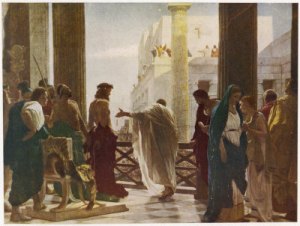
Pilate offers Jesus to the crowd

We’re going to continue in Mark this Sunday…we’ll be looking at Mark 15:1-20.

The Jewish leaders have concluded their judgement of Jesus, and believe Him deserving of death.  They, however, don’t have the authority to put someone to death because they are under Roman rule.  Their difficulty is now to convince the Roman governor, Pilate,  who has jurisdiction over Jerusalem to condemn Jesus to the death sentence.

They have condemned Jesus as deserving of death because of blasphemy, but they know that will never wash with a Roman ruler.  So, they focus on the one thing sure to get Pilate’s attention, and that is the claim to be the King of the Jewish people.  Why would that get Pilate’s attention?

When Pilate asks Jesus about this claim, Jesus, in the original language, says essentially: “That’s what you say.”  Why does Jesus seem so non-committal in His answer?  Maybe John’s version of this encounter sheds some light on it: John 18:36-37.

Things get exposed in glaring detail the nearer we get to the cross.  Pilate sees why the religious leaders want Jesus killed (v10).  What were their motives?  Why THOSE motives?  What does this tell us about their thought of Jesus as king?

What does Pilate marvel at (v5)?  Why do you think this causes him to wonder in admiration?  What was he looking for in a king?

Why did the crowd choose the way they did?  What made the difference between Jesus’ entry into Jerusalem and this moment?  What were they looking for in a king?

Why do the soldiers treat Jesus the way they do?  What has them so riled up?  What possible motive can they have for this level of cruelty?  What do they reveal about their view of Jesus as king?

What is the center of this trial?  What is the crucial question asked?  Have we asked that question when it comes to our lives? 

See you Sunday!

Just When We Think We’ve Got it all Together – Mark 14:27-42

Hey everybody.  First off, I want to mention that Sabet Kuj called me yesterday to thank our church for praying for Suzy and he.  In case you don’t know, they are missionaries to the Sudan that we have been supporting as a church, and who stayed in our area and hung out with our church for a year.  She had filed for citizenship in the U.S. (Suzy is from the U.K.), and last week she received it.  The whole family will be united in Sudan by September.  God is good.

Our text this week is going to be Mark 14:27-42 – read it here.

Verse 26 provided the larger context of the events recorded in this part of chapter 14.  Even though we have the account of Jesus praying in the garden, that event is surrounded by accounts of self confidence and failure.

Have you ever made a commitment to something verbally, but failed to follow through because it was more difficult than you thought?  How did it make you feel?  What did you learn from something like that?

In all the gospel accounts, Peter is always quick with his tongue…and his own account (if that’s what Mark is) is no different.  He makes bold claims and promises, but later on in the chapter, we’ll find out just how he keeps those promises.

As Jesus goes off to pray, what do the disciples do?  In His humanity, as best we can tell, Jesus had the same struggles with surrendering His will to survive.  This is, in part, what is making Him “exceedingly sorrowful to death…”  It is in the context of laying aside His own will that Jesus utters the rally cry the church has echoed for 2,000 years – “not what I will, but what YOU will.”.

When He gets back to His disciples, he awakens them.  What do you make of that?  How would you apply that to your life as a disciple now?  His warning is about the weakness of our flesh when it comes to fulfiling our spiritual desires and goals.  Obviously, this has application to prayer, because that’s the immediate context, but what do we learn from His warning as we try to apply it to other areas of our spiritual journey.

In v 40, we’re given a reason why the disciples were sleeping.  In your own times of struggle or heart pain, when you just don’t know what to do, what has been your response?  Escaping is a natural human tendency.  What things do we try to escape to, instead of resolving to entrust our situations to God?

This whole scene gets repeated three times.  As you read it, how do you imagine Jesus’ facial expressions?  How do you imagine His tone of voice?  Does Jesus give up on them?  What is His final word to them in V 42?  What does that mean to your life? 

Well…I hope that sparks some good conversation.  Thanks for reading this, and being willing to dig a little during the week.  This is time WELL SPENT.  See yer’ Sundee!


She Has Done a Good Work for Me – Mark 14:1-11

 Our study this Sunday will start chapter 14 in Mark.  We’ll be reading the first 11 verses.  We are now just a few days out from Jesus’ arrest and crucifixion.  The religious leadership want Jesus out of the way, but in their reasoning, they’ll have to wait until Passover is finished, because they don’t want to cause an uproar.  Interesting that despite their planning…Jesus is still crucified over the Passover weekend.  What does that tell us about who’s really in charge here?

The text tells us that Jesus is staying at the house of a guy named Simon the Leper.  Talk about sorry nick-names.  Many believe this was a man who had been healed from leprosy by Jesus, and was now a follower of Him.  I think that’s reasonable, but we do want to keep in mind that some scholars question the translation, and there is a possibility that it should read Simon the “potter”.  I’m not a language scholar, so I’ll stay out of that debate.

John’s parallel accountof this event tells us that the woman who comes to Jesus is Mary, the sister of Lazarus, whom Jesus raised from the dead just before He came into Jerusalem.  She lived in Bethany too.  Both accounts say that Mary broke open an alabaster flask, or jar of very expensive perfume, and poured it on his head and feet.

John’s account has Judas doing some quick calculations about the cost, which equates to about a year’s wages in that time.  Judas did this quick economics lesson to accuse her, but I’m glad he did it because it gives us a good point of reference to understand what this gesture meant.

When she was accused, she was accused (by Judas, according to John 12) of being wasteful.  Yet Jesus says she “did a good work for ME”….what do you suppose Jesus means by that?  The description of what she does isn’t always what comes to mind when I think of work.   Jesus also says “She has done what she could.”  Jesus is very pleased with her actions.  He defends her, and promises that what she has done will be immortalized, taught synonymously with the gospel.  Wow. 

Obviously, we live in a different culture, so some things are hard to understand in this.  Pouring oil on a guy’s head wouldn’t go over quite so well in our culture (at least since the 1950’s).  In that day and place, taking baths wasn’t something a person had the opportunity to do as often as we do.  People would quickly develop a certain odoriferousness (funk) about them.  So, this sort of thing was a welcome way to put a sheen on the hair and diffuse the funk.

But, Jesus associated it with his burial.  All along Jesus has been warning His disciples that He’s going to be betrayed, handed over to the gentiles, and murdered.  Do you think Mary is the only one who really heard HIm?  Is it possible she is anticipating His death, or is Jesus steering this somewhere?  What would Jesus be doing, if He were tying her activity here to His approaching death?

What other observations do you draw from this passage?  What do we learn from her “work” about our daily lives that we live here and now?

What contrasts do we draw from Judas’ behavior immediately following this event? 

See yer’ Sundee.

Dark Clouds over Mordor; Mark 13:14-37

Forgive the Tolkien reference in the title…sometimes I just can’t help but let my inner geek run amok.  This Sunday we’ll be looking at Mark 13:14-37, and we’ll finish up the chapter.

Remember our introductory remarks about the first thirteen verses…while end time events and prophecy is cool and all, to over emphasize it can be almost as dangerous as ignoring it.  So, while keeping our heads cool and level, we’ll be looking at some of the characteristics that Jesus describes will surround (what I believe to be ) the end of the age.

Jesus begins this section pointing to a prophecy from Daniel 11which references “the abomination of desolation”.  It might be interesting reading to look at this entry from the Jewish Encyclopedia (it’s about a Syrian King named Antiochus).  From the Jewish perspective today, and back in Jesus’ time, this was a historic event, not something yet to be fulfilled.  What does that tell us about Jesus’ statement here? 

In v19, what will the world be like in the time period he’s describing?  What does that tell us about the direction the world is taking…and how does it effect our expectations about the state of the world?

As you read this section over, who or what seems to have the upper hand through it all?  Yet what is the final outcome that Jesus predicts?  It might be helpful to read Daniel 7…or at least v13-14 in that chapter.

Verses 28-31, of Mark 13, tell us that we can expect an intensifying of troubles, leading up to the grand finale…just like we see buds and leaves sprouting and leading into summer and harvest.  In v31, Jesus makes a prediction about his predictions…what is it that he says?  What does that tell us about his predictions?

The final section, v 32-37 sort of put the final qualifier on the issue.  What does He say about these events?  What do we need to factor in because of this qualifier?

That should give us plenty to mull over and chew on this week!  See ya’ Sundee’!