Identities Defined in the Light

If I were to obtain a retinal scan, a copy of your driver’s licence, your fingerprints, a sample of your DNA and your Social Security number…I would probably be able to positively identify you as a person. Those things are routinely used for security and courtrooms to identify people – but they are wholly impotent in defining a person’s identity – defining who they really are.

Personal identity is such a murky subject – philosophers and doctors of psychology have spent vast amounts of time studying this idea and have yet to come to a fully agreed upon means of drawing out one’s personal identity. So many different factors play into this as well – ethnicity, gender, culture, the nation we live in – but all of these are subservient to the core of who we really are.

It’s odd that answering that question is challenging – why are we so in the dark about something so intimate?

We’re going to consider this theme as we continue our study in the Gospel of John, reading John 1:6-13 this Sunday.

John the Baptist is introduced, but he is plainly described as NOT being the Light that shines in the darkness. There is a lot to consider there, especially as it touches church culture and leadership – but if we think about finding identity, what does that tell us about where our search should begin?

V12 in the Message version is so wonderful to me. I believe Peterson hits the target. V12 reveals who we really are…or at least, who we are meant to be.  This reveals who God is – and how is God revealed in this verse?  This reveals who we are. Does this make any difference in your life, or especially your self-awareness? Does knowing who you are in God’s pattern for life change anything about how you understand your life? If so…how?

I’m really stoked about this section – and I’m looking forward to digging into it!

If you haven’t been there, you should check out The Eastgate Hymnal – a 21st century hymnal. The songs we’ll be singing this Sunday are: Forever ; Holy is the Lord; Beautiful Lord; As Children; and You Are My King  – check out the lyrics and read the meditation to be prepared to enter into our corporate worship time.

See you Sunday!

Introduction to John – The Pattern Revealed

Well…if we make it through these floods, this Sunday we’ll be introducing a new study which will take up our Sundays for many weeks to come. We’ll be embarking on an exploration of the Gospel of John.

I struggled a lot with how to introduce this study. We can’t read John like the other three, synoptic gospels. I thought about just posting a poem…but that seemed a little too ambiguous and maybe even pretentious. However, it is vital that we not approach the Gospel of John like a textbook or a documentary. John’s gospel isn’t intended to educate us as it is to introduce us to….well, to God.

John is basically saying through his account – “If you want to know who God is, or what He is like, take a long look at Jesus.”

That’s what we will set out to do. Through John’s selected vignettes, we will get a different view of Jesus than we find in Matthew, Mark or Luke. John wrote his gospel much later than the other three (which had been circulated for years by the time John’s writing), and it’s clear that he had had a lot of time to think over and draw some conclusions about the things he witnessed and experienced.

This Sunday we’ll be reading John 1:1-5, the prologue.

What other famous passage of Scripture starts with “In the beginning…”? What does that tell us about John’s account of Jesus?

John begins by talking about the Word – eternal, creator, light and life. He will later identify the Word as Jesus. The Greek word for…well, word, is Logos. If you feel like it, you might want to read an interesting Wikipedia entry on the very complex ideas that word carried in the 1st Century Greco-Roman world, as well as in Israel.

What significance to you find in  John using a word that was this meaningful in the ancient world to describe Jesus?

If you were to describe the opening of this gospel, would you say it was a) a curtain rising on an epic drama;  b) walking in on a movie that’s already started;  c) hearing a familiar song sung in a foreign language?

That’s enough stuff to think over for now. Hope to see you Sunday.

Living Now for Then

When I was a kid, my Mom used to buy my brother and I this soap called Fuzzy Wuzzy. It was this bizarre marketing gimmick of an animal shaped soap that would grow “fur” in between uses. Then, when you used it enough times for the outer layers to be washed away, a toy dinosaur was hidden inside. I loved that soap. I kept using that soap faithfully, always with my eye on the prize I was waiting to be revealed.

We’re going to be reading 2 Peter 3:1-13 this Sunday and Peter talks about something similar.

Actually…it’s not similar at all…not even close. But he uses imagery of the elemental patterns of this world melting away and revealing something new underneath. As I read it, I imagine a refiner’s fire burning away all the corruption on the surface of a metal. The idea, poetic or literal, is that at this very moment something is hidden beneath the world as we see and understand it right now. One day Christ will return and with him a new heavens and new earth is revealed. An earth made right again.

That is the very core of our Christian hope. But Peter addresses the hurdles of skepticism that we have to overcome in maintaining that hope.

As you read this section, what does it reveal about God’s seeming delay in concluding his plan? How does that inform you about any area of life where it seems God is delaying his answers?

Peter employs a now/then model for his instruction. We live a certain way right now in anticipation of something in the future.  When the question arises “what does it matter how I live if Christ already paid the price for all my sins?” – how would you answer that question based on what Peter says in v10-13?

Something about a world “all landscaped with righteousness” (as the Message puts it) ignites hope in my heart. I hope it does yours.

See you Sunday!


Avoiding the Dark Side

I didn’t get the impression that Anikan Skywalker intentionally set out to become a bad guy…he just sort of veered that way by not paying attention.

I doubt that many church leaders who become abusive set out with the thought “I hope I can destroy a lot of lives”…I sort of think those patterns develop over time.

Peter is going to blast false leaders with both barrels in our study this Sunday – 2 Peter 2:12-22

Again, this is a tough passage to teach from. Matt made a comment a few weeks back about chapter two (you can read the comment here, at the bottom of my post) that really got me thinking about a different way to approach this text.

If we want to AVOID being an abusive church or abusive leaders – it would make sense that we would go the opposite direction from what Peter describes these false leaders to be like.

So…as you read this section about how these dudes are falsely representing the kingdom of God, apply the opposite pattern. I rightly represent the kingdom of God when I __________________.

I’d be interested in what you come up with.

Reckoning and Rescue

Sometimes we may feel like justice doesn’t get carried out. I can think of many criminal court cases in my lifetime where defendants that had copious amounts of evidence tying them to a crime were set free by a not-guilty verdict. I certainly don’t know if someone is guilty or innocent in those cases – but I know my gut feeling of frustration when I don’t think justice is served.

We seem to be wired to want things to be just – for wrongs to be righted or at very least paid for.

Peter taps into that part of human nature in the section that we’re reading this Sunday – 2 Peter 2:4-11.

This is a pretty difficult passage to teach from. It’s not my favorite subject, and the construction of it is a little unwieldy. Peter uses three examples of divine judgement to reinforce the fact that false, abusive church leaders will one day face a reckoning for how they are treating God’s people. How do you think these three examples help to drive that idea home?

What reason would Peter have for reminding people that God is the one who dispenses justice? Does that idea provide any sort of encouragement to you in a present context?

“the Lord knows how to rescue the godly from trials…” – From the examples of Noah and Lot, what does Peter seem to be saying about the way God rescues us? My natural inclination is to try and fix things – life, people, circumstances – so that I can remain where I am (especially if I’m comfortable). My attempts at self-rescue haven’t ever yet succeeded in accomplishing what I intend. God’s means of rescue are different – and usually require that we move on from where we are.

How difficult or easy is it for you to trust in God’s rescue plan instead of your own? What have your experiences been with that so far?

If nothing else, it should prove to be a challenging section. See you on Sunday!

Weeds in the Lawn

I’ve met a lot of people who have been abused by a church at some point in their lives. I feel like I’ve met more than I should have. I suppose I shouldn’t be surprised though, because the New Testament devotes a surprisingly large amount of space warning us about the dangers of church. Specifically the dangers of bad leadership in the church. Sometimes we bemoan the state of the church today, and we forget that bad leaders have always been around.

The writers of the New Testament were rightly concerned about the vulnerable position people put themselves in when joining to a church community. So they warned, over and over again, that it’s up to us to be discerning and careful when it comes to the leaders we choose to follow.

That will be the subject of our text this week as we read 2 Peter 2:1-3.

As you read Peter’s warning here, what seems to be his main concern about these false teachers? The word heresy in the Greek means dividing into a sect. What would a destructive heresy look like then?

When he says they deny the master who bought them, would you find it hard to follow a person’s teaching who denies Christ outrightly? Are there other ways we can deny Jesus, and what would they look like?

Verse three has the harshest indictments in it. What does Peter say these false teachers are doing to God’s people? Do you see a connection between that and the harsh words?

Given this warning, what is our responsibility as God’s people?

That’s some stuff to chew on between now and Sunday. Hope to see you then!

Can I Get a Witness?

This Sunday we’ll be returning to our study in 2 Peter – reading ch 1:16-21.
There are some events that I’ve witnessed in my life that are indelibly etched into my memory. I still remember with distinct clarity watching the TV in horror as the first WTC tower went down. If someone were to come along a few years from now and claim that it never happened…I’d just smile and say, “You’re wrong, I saw it happen”.

But someone could respond “You saw an image on TV, and those can be manipulated”. I’d have to concede that possibility, but then I’d point to all the people in New York that lived through that fateful day – the multitudes of eyewitnesses – their testimony would carry a lot of weight.

By the time Peter is writing this second letter, you get the idea that people are already starting to reevaluate the timetable of Jesus’ kingdom project. This was taking a lot longer than anyone expected it to. Peter is now faced with a fresh crop of teachers, people farther removed from the original events of Jesus’ ministry who are starting to twist and question the veracity of the gospel story.

Peter’s answer to them is “You’re wrong, I saw and heard it all, I was there”.

As we read what Peter says in this text, how would you apply this to your present life? Jesus’ ministry was 2K years ago – so what personal testimony could you give in support of your faith?

Peter talks about the prophetic word, which would probably be talking about the messages we now hold to as the Old and New Testament. If someone asked you if the Bible is true – how would you answer, and what support would you provide for your answer?

These are challenging thoughts – stuff we really NEED to take the time to wrestle with. Hope you can be with us on Sunday….and bring your wrestling shoes as we grapple with some heavyweight thoughts.

Important Reminders

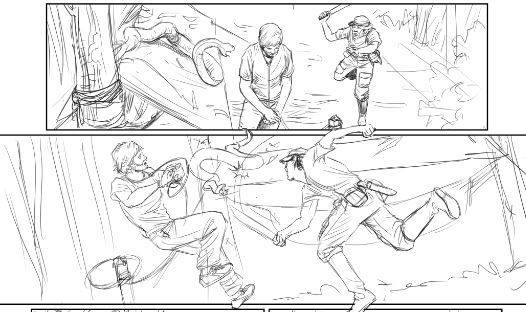
Hey everybody…I thought I’d put a few panels up from the graphic novella I’m working on for Voice of the Martyrs:

panels RTC-1. panels RTC-2.

I’ve penciled 22 of the 28 pages, but I still have to ink and color them…so I’m only a third of the way through.

Anyway…this Sunday we’ll be reading 2 Peter 1:12-15 as we continue our study of that book.

Having spent the first 11 verses sort of laying out the basics of the gospel, Peter then explains why he is repeating stuff that his readers are already familiar with. Why does he say he does this?

Have you ever known someone (or maybe you ARE someone) who repeats a story over and over again, even though everyone’s already heard it multiple times? My mom was famous for that – she would tell some stories from her childhood over and over, and each time she told it like it was breaking news. As a kid it used to irritate me…but now that she’s been gone for nearly 20 years, I’m really glad she repeated them.

There’s more to human communication than just the transferring of information. If we read a poem to gather information, we are missing the point of poetry. Yet poetry does communicate – but on an elemental level. Poetry and stories invite us in to an experience or a feeling – we participate when we listen to or read them. That’s why we go over them again and again, to relive that experience gained through that communication.

How does this apply to what Peter says about repeating the basic truths of the gospel to people already acquainted with those truths?  What benefit do you believe can be derived from the repetition of these basic truths – or do you think there are any?

Come hang out with us Sunday as we carry on Peter’s legacy by repeating some well-worn words of wisdom.

2 Peter – What’s Needed for the Good Life

2 peter webNow that we’ve finished 1 Peter, the only logical thing is to head straight into 2 Peter. They are two very different letters. As far back as the 2nd Century people questioned Peter’s authorship of this letter – and of course we can never prove anything beyond all doubt – but there are lots of pretty good arguments to consider it a genuine work of his.

The overall theme of this letter is an encouragement for followers of Christ to keep on growing and avoid the pitfalls of erroneous teaching that could derail their progress. The tone will be a bit more urgent than his previous letter (written, as best we can tell, about 4 years prior to this).

This Sunday we’ll be reading the first four verses.

Peter starts with the basic greeting, extending a hope that his readers will experience grace and peace from Christ. Those are the two New Testament ideals for the good life, a life as God intended it to be. Filled with favor from God and wholeness in our self-understanding.

As he goes on, he indicates in v4 that we are drawn into this good life through a knowledge of Christ. What ways do we grow in our knowledge of Christ?

Peter says we have these promises that we “partake of the divine nature”. That’s a staggering statement, to me. In union with creator God. What difference does this make, if any, on how you view your meaning and purpose in this world?

Take some time before Sunday to pray and ask God to lead you into a greater knowledge of Christ – and ask him to reveal what it is to partake of the divine nature.

See you Sunday!


Steady As We Go

We’re coming to our final study in 1 Peter – we’ll be reading 1 Pt 5:6-14.

I’ve really learned a lot from Peter’s letter. Navigating through times of suffering is such a timely theme – suffering seems to be a constant companion on this journey of life. It was 2,000 years ago, it is today. But if we can learn to gain a higher perspective on suffering, it can enable us to respond to it in healthy ways.

As Peter closes his letter, he offers a few strategies for handling trouble in this life. V 6-7 are pretty famous verses. Why do you suppose Peter encourages us to be humble before God as a response to anxious circumstances? What connection between our anxieties and humility do you see?

V8-9 are likewise popular verses. Normally the devil is described as a serpent or a dragon. Why do you think Peter uses the metaphor of a lion here, when talking to Christians who faced persecution under Nero’s reign? Are there any other significances you can imply from the lion imagery, in terms of how they hunt or who they target? How would you connect that metaphor to Peter’s warning for the community of church?

What is his final resolve in v10-11? How does he sum this up? How would you sum up what he sums up (say THAT 10 times real fast!)?

I hope this study is encouraging and challenging – see you Sunday!