I Can See Clearly Now

This Sunday, we’re going to read the account of Jesus healing 10 lepers, and the one who came back to thank him.  It’s found in Luke 17:11-19.

The word “saw” occurs twice in this story.  To me, it emerges as a subtle theme concerning perspective.  There are also some strong contrasts that emerge in the text, encouraged by Jesus himself.  He asks the question “where are the other nine?”.  The similarities and differences between the 9 and the 1 are intriguing to me. What similarities in plight, positioning,  plea and cure do you see in the 10 as a whole…but what differences occur with the ONE who “…saw that he was healed”?  What contrast do you see from his original plight, positioning, plea and even pronounced cure?

Crud…this is too heady, isn’t it?  How about this…. All ten lepers stood at a distance pleading for mercy in the opening of the story.  Where does the one Samaritan end up positionally at the end of this story?  Jesus tells the 10 to GO to the priests….what does he tell the one to do at the end of the story?  We’re told that the 10 were cleansed (original word), but he told the one who returned that he was made well (original word)…what distinction, if any, do you see in this?  A cure that leads to healing…that sounds strange, doesn’t it?  If we think about our own lives and encounters with Christ, do we see similarities between our own experiences and that of the 10 and then the 1?  What does this tell us about goals for our spiritual journey?

Well…those are some interesting questions about a passage that always seemed so straight forward to me before.  This will be fun to explore together this Sunday!

No Privatized Faith

Did you grow up in a family with siblings?  Did you ever disagree on anything with your brothers or sisters?  Ever get into an all-out brawl over anything?  If you were part of a family with siblings, and you answered no on any of the other questions, you are A) in total denial and unable to process reality correctly; or B) an alien for whom Scully and Mulder have been searching in vain for these two score years.

Point is…families fight. They just do.  The Christian church is oft described as the family of God…and we shouldn’t be surprised that as God’s family, we fight too!  Jesus is going to give us some instruction concerning this, in a series of sayings that require us to engage in some serious self-inspection.

We’ll be reading Luke 17:1-10 this Sunday (Father’s Day…happy happy! – then it’s off to the beach for Surf N Grill!!!!)

It’s my consideration that v1-2 are a transition, where Jesus is still talking about the bad behavior and attitudes of the Pharisees.  We aren’t told to judge them back…but that’s not to say that judgement is non-existent.  With eternity in view…what should we feel for those who try to put a stumbling block in our path of faith?

V3-4 change the focus to US.  How are WE supposed to deal with offenses within our community of faith?  Sluff things off, tell white lies that “nothing’s wrong”….or what does Jesus instruct?

If someone wrongs us, we’re commanded to forgive.  Not just once…but open-endedly.  How does that work for you?

By v5-10, the disciples are in a panic because this seems like impossible stuff to live out. They need more faith…they really want superpowers to accomplish this change in reaction.  But Jesus doesn’t seem to indicate that more faith is the answer.  What DOES Jesus indicate as the key to living out this forgiving love in real life?

Should be an interesting read this Sunday…hope to see you there!

The Great Reversal

Well, about two or three months ago a book was released entitled “Love Wins” by Rob Bell.  It immediately caused a firestorm from all the people burning Bell in effigy on Twitter.  The smoke is still in the air.  The big deal was and is, Bell questions the doctrine of eternal judgement and damnation in hell as Dante  or Spawn described it.  I haven’t read the book, only in snippets (But Cole has, and he gave me a book report).  I really don’t care about reading it, as awful as that sounds. Even if Rob Bell is a universalist, (which I don’t KNOW that he IS, that’s just what’s been asserted by others) it really isn’t that important to me.  I can still love him and respect him and learn from him even if I happen to disagree on that issue.  I just don’t remember Paul saying anything about holding to the doctrine of hell as a prerequisite for salvation…but maybe someone can enlighten me.

My point in bringing this up is…the passage we’re going to read this Sunday is one of the primary weapons of those who represent an understanding of the  judgement of hell in detail.  We’re going to be reading Luke 16:19-31. This is the parable of the Rich Man and Lazarus. There are not a few people who are adamant that this is not a parable, but a warning about what awaits us in the afterlife.  I’m someone, as I hope you know, who believes without reservation that there is something more, beyond this life we now live.  I believe in the eternal state, and in divine judgement for sin.  I really do.  I just am not at all certain on the details…and I have strong reservations about reading Luke 16 as a provider of those details.

If you’ve kept up with this at all, I’d like you to remember the overall context in which we find this story that Jesus tells.  The context was established back in chapter 15 and it hasn’t changed yet.  If we use chapter 15 as our context for this story…does it effect the way we read it?   If this story is a literal description of heaven and hell, are there any concerns you have about what is described?  Who goes to heaven, and who goes to hell, and why?  What is heaven described as?  Are you comfortable with reading all those details literally?

Lets think about it another way.  Lets just consider that maybe Jesus didn’t suddenly change subjects from how we handle the resources we’ve been given and how the Pharisees looked good to everyone else, but God knew their hearts… and lets imagine that He told this story as a way to reinforce the point He had been making.  What would that point be, do you suppose?

I’d be interested to hear your take on this section of Luke.  how do you read it? It’s certainly a fascinating passage, and one I think we’ll find really interesting to explore!  Hope to see you Sunday!

The Responsibility of Life

Money is deadly.  I was perusing the headlines of MSNBC just today, and saw so many stories of trouble that had as their basis the issue of money.  A senator indicted, a stalled economy…as we drill down we read of killings during robberies and the heartbreak of those who’ve lost great sums of money.  We use money every day of our lives…do we ever stop to think about what a powerful force in this world it is?  It’s pretty important that we consider it now and anon.

We’re going to read Luke 16:10-18 this Sunday, and Jesus will go from telling a parable which uses commerce as a vehicle for truth, to actually talking about money and it’s place in our lives.

V10-12 transition from the story about how to live with eternity in mind, to v13, a warning about loyalties.  The over-arching idea is that of stewardship…of properly managing what God has entrusted to us…our time, talents, resources and money.  When we think of someone SERVING money, what do we normally think of?  Do we ever consider OURSELVES as people who serve money?  If we use serving God as a template, how would we define serving money, and what ways could we recognize this behavior in our own lives?

By v14, the Pharisees are upset (again….those guys were seriously no fun to be around).  Their reason for offense?  Their true religion was being challenged.  Jesus then launches into an expose of their fraudulent religious practices, culminating with v18.  PLEASE, don’t let v18 throw you…Jesus is making a point about heart-faithfulness, NOT a commentary on intricacies of human relationships.  I did a teaching in Mark 10 about Jesus’ sayings concerning the issue of divorce, I’d implore you to hear my whole argument before you make up your mind about v18.

Ok…well…we’ll see you Sunday, hopefully!

Relational Stewardship

This is Memorial Day Weekend.  While we’ll have our fun doing what we do best as Americans (BBQ), lets enjoy ourselves for all its worth, but not forget the price that gets paid to ensure our freedom to do so. Lets pray for peace and an end to madness…that’s the best gift we can give to any solider far from home.

Ok…well, this Sunday we’ll be reading Luke 16:1-9  …it is a serious WTF passage. (WTF=”where’s this fit?”…..why, what did you THINK I meant?)

Scholars have had headaches for hundreds of years trying to puzzle through what this story is trying to say…and how we apply it to life as the church.  I scoured through a lot of writings by experts from  N.T. Wright and Eugene Peterson to John Piper and John MacArthur (different ends of the doctrinal spectrum, FYI),   and taking their thoughts in overview provided  the footing I needed to try and exegete this passage.  I’m no scholar…so you may disagree with me, and that’s totally cool…but I think we CAN learn some valuable principles from this passage that are at very least in harmony with the rest of Scripture.

I won’t throw out a lot of questions in this post….just one main one:  What do you think Jesus’ point is in telling this parable?  Can you decipher a context that could help this make sense?

I’d be interested in your thoughts….but it’s an odd passage, so I’m not pressuring you to weigh in.  You’d be surprised how many scholars just say “We can never understand it”, and move on to the next verses.  Not US though…we’re taking this passage to the mattress!   Hope you can be there to join the exploration!

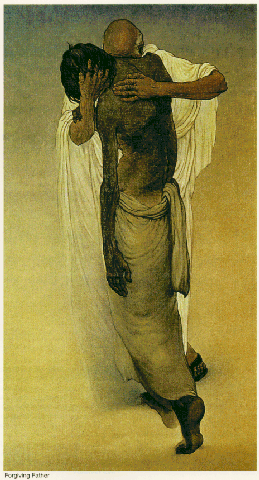
Parable of the Father’s Love

What was the biggest shock you encountered when you finally left the home of your parents and got out on your own? I know I had all these dreams about how things were going to go and how I would finally do things MY WAY…but in the end, I still found myself leaning into and receiving my parent’s love and support.

In Luke 15:11-32, Jesus tells the famous story of the Prodigal Son(s).  It’s probably very familiar to most of us…if not, then you’re in for a treat.  It’s one of my favorite stories of the Bible, and it is the picture of God I cling to most of all.

As you read the story, you may realize that we’ve sort of misrepresented it by calling it “The Prodigal Son”…because the main character is not the son(s).  The main character of this story is the Father.  Jesus is trying to tell us something about God…and he’s telling it in response to v1-2.

Read the story with your main focus being on the Father. What do you learn about God in the face of man’s rebellion of sin?  What do we learn about life away from God? What do we learn about God’s willingness to accept us into his family?

The second part of the story has to do with the Father’s other son…the one who was lost while still at home.  What was his biggest complaint?  How would you understand his complaint in light of v1-2?  The oldest son had LOST the plot…his values had gotten misconstrued. What can WE learn from this…from what the Father instructs his oldest son?

Anyway…those are just some things to think over before Sunday.  Also, please remember that we’re collecting RELIEF ITEMS for the tornado victims in Alabama…bring them this Sunday if you can!  You’re the BEST!!!

The Finder of the Lost

Ever lose anything…like something pretty important?  What was it?  How did you feel, what did you do?  If you found it again, what emotions did you experience?

I lost my dog Shadow once…but I’ll tell that story on Sunday.

Jesus goes toe to toe with Pharisee lame-ness in our passage this Sunday, Luke 15:1-10.

The story opens with Pharisees grumbling because Jesus is hanging out with the wrong crowd, yet again. They specifically are upset because Jesus is eating with decidedly non-spiritually minded people.  What’s the big deal with that, do you suppose?

To answer, Jesus responds the best way he does, with four different parables (not three, as Eugene Peterson points out in his book “Tell it Slant”) about lost-ness. He talks about a lost sheep, lost coin and two lost sons.  We’ll only look at the first two this Sunday.

I love these stories.  What are your thoughts on what Jesus is conveying about the nature of the Kingdom of God advancing in this world?  What does this reveal about God’s heart toward humanity…and what does this reveal about humanity…about YOU?  Read v5 and close your eyes and imagine the scene…what does it evoke in you emotionally?

Man…I love this section.  Hope you can make it this Sunday.  Surf n Grill is this Sunday too!!! Come hang out at St. Andrew’s St Park and we’ll eat and enjoy the beach and baptize a few folks who are “found”…and let’s get stoked!  We still need people to hang late and help clean up…so pray about serving Christ this way!  See you then!

What it Means to Follow Christ

I had a friend who owned a 9’6″ longboard which had it’s origins somewhere in the early 70’s. The thing was a beast. Dark green and heavy, it caught waves really well but was a feat of strength to turn. It had no leash plug, not even an old fashioned hole in the fin to tie one on – consequently he would surf it without a leash. He was pretty good, so it usually wasn’t a problem.
What was awesome about that board was it’s intimidation factor. If you dropped in on that board, you would not win. It would plow you under. On days when the swell was particularly good and the numbers of boards in the water were increasing by the hour, my friend would smile and pat that huge green beast of a board and say “I’m not worried about how many are out here. I have a CROWD CONTROL board.”

Crowd control. That’s sorta’ what Jesus is about in the section we’ll be reading in Luke this week. (Luke 14:25-35)

Jesus is experiencing what it seems most contemporary pastors in the U.S. are obsessed with achieving – large crowds.   Jesus never seems to be able to appreciate big crowds, because when he has them, he always seems to make “crowd control” statements which thins the herd. John 6 is a great example of that too.  In this instance, Jesus begins spelling out in stark, even harsh, detail what following him really means, what it will really cost.  Why do you suppose he said this in this context?

He talks about hating family members and hating self in order to follow him.  Wow. As modern pastors, we scramble around as quickly as possible to explain it doesn’t really mean that (and it doesn’t in terms of the straight English reading of it)….BUT, Jesus never qualifies what he says.  He just pulls the pin on the grenade and smiles.  I find that both fascinating, admirable – and scary.  How do you read this? What do you think he’s saying?

He also talks about counting the cost of following him, illustrating it with a story of an incomplete construction project and a king considering going to war with insufficient forces. The thrust of both those stories is RE-EVALUATION.  What is Jesus telling us we will need to reevaluate when we count the cost of following him?

If we follow Jesus we are not defined by our families (v25-26), we are not defined by our own self will (v27), and v 33 tells us what ELSE we are not defined by.  What does he say, and how badly does it cut us as good American consumers?

Jesus pulls no punches in this section. This is a crowd control speech if ever there was one. His words are a dividing line between spectators and the team. These aren’t words to apply to everyone else, these words are missiles aimed at our own heart. These are words to wrestle with – they are designed to produce crisis. Crisis which leads to conversion and correction and ultimately, the best life possible on this broken planet. Salt, after all, is GOOD.

Ok…well, this is stuff to ruminate on until Sunday. Hope to see you there!

Easter is Here!

They had seen him die.  They had watched in horror as his tortured body gasped and gurgled it’s last breath. They saw his skin change color, his jaw go slack and his eyes set.  Still, lifeless, they knew that the person they had followed and loved was a stranger to them now. No sparkle in the eye, no grin or laughter, no knowing look.  Just a shell; a grizzly mannequin hanging like an effigy of all their hopes and dreams.

When all hope is gone, when dreams and loves have run through your fingers like sand, when you slump to the wall and whisper “it’s broken, it will never be right again”, God has one final word for you.

RESURRECTION!

Look in wonder at wide open horizons of hope that resurrection reveals. God reveals that he’s the God of NEW BEGINNINGS, and no matter what we say is plausible or rational or scientifically viable, God winks and reminds us those are not the adjectives that describe a deeper magic.  Resurrection reminds us that God is God and the possibilities are endless as life passes through his hands.

No one expected this. During those three days not one disciple suggested that maybe Jesus would be back. Why would they? This is unheard of, unthinkable, impossible. Yet there he was. He had passed through the grave and come out the other side in a whole new condition of existence.  Sometimes our hopes and dreams have to have the mark of the cross on them. Sometimes we have weep and bury them, only to discover they were really the seeds of a whole new answer and purpose we hadn’t anticipated. Flowers that are different from the picture on the package, but are far more wonderful than we could have conceived of.

This is the wonder of Easter.

I hope you can come out and celebrate with us at some point this weekend…or for everything we’re doing!  Here’s what we have going on:

FRIDAY @6:30 pm, APRIL 22nd: We’re having a special GOOD FRIDAY BURNING HOUSE service.  We’re going to have elements of the Seder (the Passover meal) for you to sample, and we’re going to talk about the correlation between the Seder and Jesus’ instructions to us concerning the communion.  There’ll be music and praying for each other and hanging out and laughing and maybe crying…all the stuff connected with human beings reaching for the Divine.

EASTER SUNDAY @6 AM: The Dawn Patrol Sunrise Service!  GET UP! GET STOKED! HE’S ALIVE!! Easter morning we are going to meet on the beach for a time of worship, reflection and prayer as we begin the day where we remember that Jesus rose from the dead and changed everything forever.  If that’s not a reason to get up early, I can’t imagine what is. Bring a lawn chair or a blanket. We’ll be meeting at the corner of Oriole and Gulf drive on Panama City Beach (off of Thomas Dr).  Here’s a map

EASTER SUNDAY, 9-11 AM: Come celebrate Easter as we read and explore John 20:10-20, 24-31.  It’s the story of a guy named Tom…someone I consider a soulmate.  We’re going to look at his journey from honest doubt to real faith.  Have you ever struggled with doubts and questions concerning the claims the Bible makes?  We don’t need to be afraid of doubt, and especially don’t feel shame.  Tom is our guide through those times we ALL have.  What do you see in this story?  What does it inspire in you?

Ok…well….long update, but worth it! Hope to see you at some point this weekend!
Guess Who’s Coming to Dinner?

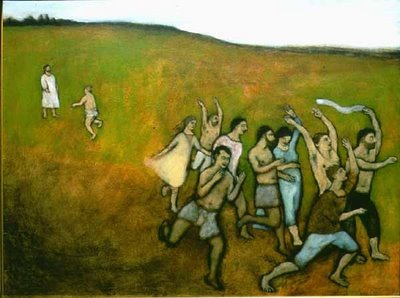
If you were invited to a special dinner thrown to honor a great person, lets say, a war hero or a philanthropist…the ceremony was free and was going to be lavish.  Would you go?  If you didn’t go, what sort of excuse would you consider valid?

Jesus is going to pose this sort of scenario in the portion of Luke we’ll be reading this Sunday. Luke 14:15-24

As you read the story and consider what it is that Jesus is responding to, what do you believe his main point is in this parable? As we think about the broader implications of Jesus’ story, we start to make some observations about the kingdom of God as Jesus presents it. If we understand the kingdom of God in eternity to be the marriage of heaven and earth and the restoration of all things…what does the imagery of a banquet mean to you? Does this conjure up images of dry ice fog, clouds and harps….or something else?

Who are the people who enjoy this party? Who are the people left out…and why?  What place do you see yourself in this story, and what response does it inspire in you (if any)?

We’ll unpack this as best we can on Sunday — see you then!