This Sunday we’ll begin a new study in the book of Romans. I taught through this book 17 years ago, but I’m not sure I agree with that guy, so I’m re-imagining our approach to this magnum opus from Paul. The letter to the Roman church is considered one of the most important books of the New Testament. It certainly has the most robust and dense theological arguments of any of Paul’s writings.

It’s impossible to overstate the impact that this single letter has had on the history and ongoing formation of the Christian church. Augustine, Luther, Calvin, Wesley, Barth and a host of other important thinkers of the Christian faith all point to this letter as having the greatest impact on their spiritual worldview. The writing of Romans is an amazing example of an intellectual mind from the ancient world.

There is little dispute that Apostle Paul was the author of the letter – written sometime between 55-57 AD. We’ll discuss the reasons he may have written this letter on Sunday, as well as looking at how the letter unfolds and the best way of approaching it for study. Traditionally, this book has been seen as a series of systematic theological arguments on a variety of subjects. I have been persuaded (HT: N.T. Wright, Katherine Grieb) that Romans has a narrative substructure which lays out the story of God’s righteousness, revealed for us in Jesus.

So…we’re going to be keeping story in view as we journey through this epic letter. The Story, that is.

We’ll be starting with an introduction, but then we’ll read Paul’s greeting: chapter 1:1-7. We’ll be using the NLT for presenting the text.

From what we understand, Paul hadn’t yet been to the church in Rome, so he is introducing himself. The letter begins like most ancient letters do – the author identifying himself and stating his position in life, then identifying his intended recipient. Paul elaborates on this formula quite a bit though. V2-6 expand the greeting into a summary of the gospel. Here’s what’s interesting: V2-6 are all modifiers of the original subject, Paul. Paul is still in the process of introducing and describing himself in V2-6.

What does that tell us about Paul and his connection to the gospel? On personal reflection, what stories do you feel have shaped your life so far? If you were to introduce yourself to people who didn’t know you, what stories would you tell that would best indicate who you are as a person?

Based on what Paul writes in his greeting, what sort of person do you understand him to be? As you consider what characterizes Paul, what aspects of him do you admire. What parts, if any, of his person put you off?

I cannot properly express how stoked I am to begin this study! What’s yer story, morning glory?


Easter Weekend at Eastgate

Tonight is Good Friday and we will be observing it with a service which reflects on Jesus’ sacrificial death on the cross. It will be a time of singing and contemplation. We will also be doing a live painting, as well as an interactive, visceral worship experience. The cross has been a central part of the Christian faith for 2000 years. Tonight, we’ll take our place alongside the church through the ages and remember that pivotal day…the day the revolution began! We hope you can join us tonight, 6:30 pm in the Big Room at Eastgate.

On Saturday: we are inviting people to join in a voluntary day of fasting and prayer in anticipation of Easter. You can skip a meal, or two or skip the whole day (if your health allows for it). This allows us to step into an experience of loss and discomfort, like the first disciples experienced that terrible Saturday after seeing their Rabbi die along with their hopes and dreams of God’s kingdom. We have prepared written prayers that you can use to guide you in contemplating and communicating with God. This is a time to give thanks and to deeply consider the depths of God’s love for us.

You can find the prayers here: COMMUNITY PRAYERS_

On Sunday: Join us at sunrise at Rick Seltzer Park on Thomas Dr as we welcome the day and begin celebrating the wonder of resurrection! If you haven’t joined in on one of these services, I encourage you to do so, you won’t regret it!

Later, at 10 am in the courtyard of the Eastgate building, we’ll have a day of celebration, where we kick up our heels and shout for joy because Jesus is loose in the world making all things new! Join us for the celebration, then stay for a potluck lunch where we can fellowship and reap the benefits of God’s renewal by hanging out with the family of God! It’s always a good time! Bring a dish to share…and I hope to see you there! (see how I did that? It rhymes!)

See you tonight!

Elemental Eastgate

So we finally made it through the extremely challenging task of studying the book of Revelation. This Sunday, before we begin our study in a new book, we’re going to take a moment to reflect on our goals as a community. We will be looking at our purpose, our values, as well as our vision.

Some of the Scriptures we will be looking at will be: Matthew 22:36-40; 2 Corinthians 5:18-20; Galatians 5:1-3 as well as others.

If you’ve been a part of Eastgate for anytime, how would you describe our fellowship? If you were to take an objective look at our fellowship, what do you think our values are? Are there specific things that you appreciate about Eastgate? Are there things you think we could improve on? I’d be interested to know your thoughts on this in the comment section.

I think this will be a good refresher on why were here and what we’re doing. It’s good for us to find unity in purpose and harmony in Christ! I hope you can make it, I believe it’s important for everyone who feels that they are a member of this fellowship. Hope to see you Sunday!

In necessariis unitas, in dubiis libertas, in omnibus caritas

Further Up & Further In

“I have come home at last! This is my real country! I belong here. This is the land I have been looking for all my life, though I never knew it till now…Come further up, come further in!” 
― C.S. Lewis, The Last Battle

Well, we are coming to our final study in the book of Revelation. We’ll be reading Revelation 22.

To really get a grasp of and appreciate the imagery of v1-5, you have to be somewhat familiar with Ezekiel 47:1-12. To contextualize that for you, Ezekiel was a prophet of God during Israel’s exile in Babylon. Many of his prophecies were about Israel’s return and justice dealt out for her enemies. Near the end of the book, Ezekiel sees the temple rebuilt, and a river flowing from it which gets deeper and deeper and has the remarkable properties of turning the salt water of the sea into fresh water. It also has the tree and fruit imagery as well.  Ezekiel was seeing more than just Israel’s return from exile, he was seeing the whole world restored.  John’s vision takes from this picture and completes it for us.

There is also imagery from Genesis 1-3 sprinkled in. What do you think the point would be, to have these parallels with return from exile and original creation? What does the end state appear to be, as you read this?

V6-21 are comprised of the final messages and warnings and encouragements about the whole of the vision.

I find it really curious to the point of humorous that John repeats his folly from chapter 19 again in v8. The repeated warning given by the angel in v9 seems emphatic enough to get our attention. Why do you think this warning is repeated? Why do you think John makes this mistake twice? What does that tell us about human nature and what we need to be alert about in our mission here?

I love the final words of Revelation, which then become the final words of the whole bible.

“May the grace of the Lord Jesus be with God’s holy people”.

It all resolves with grace.

Amen.

Here’s something: if you have any questions about this book, or want to discuss various interpretations or ideas about it, or if you need one of my points of view clarified, let’s use the comment section of this post to discuss it. There are no wrong questions, and I can’t promise anything resembling an intelligent response, but I’d be happy to talk about this more if anyone wants to. If not, it’s cool. I really enjoyed teaching through Revelation, even though the research and artwork fairly well swallowed up most of my days. Still, I have to say that I’ve gained a new appreciation for a mindset that eagerly awaits Christ’s return – even as we reflect that future good in our lives and actions today. I hope you were able to get something out of it too!

Hope to see you Sunday!

Out With the Old, In With the New

I can’t think of a more fitting time to look forward to a new day, one where all things are made right. Once again, our nation is rocked with the agony of senseless violence and more families have to cope with unthinkable loss. God help us.

It. Is. A. Broken. World.

We all grope around looking for answers – why did this happen, how can we prevent this, who is to blame? Maybe more strict gun control laws would help, but it seems like the genie is out of the bottle already. Perhaps we can get serious about addressing mental health issues, or maybe its a prescription drug problem, or possibly a breakdown in family training? I think, as a society, we should be exploring all of these possibilities and seeking to address them as best as we can. But the greater reality is: evil continues to ruin creation.

Evil expands and contracts and as hard as we try, humanity just can’t seem to get a handle on it.

That’s why God promises that a new world is coming. One that His power initiates. We’ll be looking at that new world in our study in Revelation this Sunday as we read chapter 21.

Once evil has been dealt with (ch 20), a new heavens and new earth emerge. Not that God is crumpling up the good that he created, but like one of those renovation shows, he expels all that is rotten and offensive, and rebuilds with good materials.

The vision John has is of the great restoration and redemption God has in mind. All the things that bring misery and heartache and pain are removed and we are provided with life from God’s own presence among us. It’s more than my mind can truly conjure.

Some stuff to take note of: underline all the places where John says “there is no more” and then all the places where he describes things as “new”. What is out and what is in? How does that help us understand our priorities as Christians in this world today?

Once again, John hears about a bride, but what he sees is a city. We’ll go into all the measurements and stuff on Sunday. Think about this: where does the city come from? We seem to have imagined the gospel to be about going up to heaven when we die…yet how does that seem to fit with what is described in Revelation 21?

The city of Babylon represented something besides a city a few chapters back. What do you suppose the New Jerusalem might be representing? As you consider some of the details of this city – no temple, constant light, no closed gates, all the nations included – what might those represent, and how might that influence how we understand our purpose and priorities as the church today?

I’m looking forward to this chapter – we’re finally done with monsters and flames. I think we could all use a bit of good news. Hope to see you Sunday!

The Final Clash

Gandalf’s charge in the second of the Lord of the Rings trilogy is probably one of my favorite moments in all of those movies. Admittedly, those movies are suffering over time (nobody should be allowed to make movies that are that long) – but that moment always sticks out for me. It, of course, reminds me a lot of what we’ll be reading about this Sunday as we continue our study in the book of Revelation, reading chapters 19:11-20:15.

We will be reading about Jesus’ Parousia – Jesus’ second coming. Still – we’ll have a lot of dense imagery to get through, so be warned.

As you read the description of the One riding the white horse – who do you believe He is? Why do you believe his clothes are stained red with blood before any battle takes place.

When we read this opening account, we see two armies lined up for a classical battle scene – but by the time we get to v20, prisoners are rounded up and the vultures are already at work. Why do you think there is no battle described here? What do you think the symbolism of the sword from Jesus’ mouth taking down the armies of the earth may mean?

Chapter 20 is a doozy. It is here, within 6 verses that we have a great controversial subject which has divided the church for ages. The Millennial Kingdom – the 1,000 year reign of Christ. We will be discussing the various views about how this should be interpreted – and I’ll do my best to explain these ideas as simply as possible (we’ll try to avoid this).

No matter how one interprets the details of chapter 20, one thing comes across loudly and clearly. All of human and spiritual creation will be accountable to someone. Who is the Someone identified as? We are told (symbolically) in a courtroom scene that ledgers of deeds will be examined to determine a person’s fate. However, there is one book (singular) which seems to set deeds aside. What book is that? Read Revelation 13:8 – what does the name of that book imply about how we get our names in it?

It will be a sobering, yet hopeful talk we have on Sunday. Hope to see you there!


Bye Bye Babylon, Hello Hallelujahs!

Are you familiar with the term “too big to fail”? It’s a phrase that emerged in the late 80’s to describe large corporations, specifically financial institutions which have become so large and globally interconnected that if they were to fail, it would have catastrophic effects on the whole economic system. They are too big to fail, therefore it is incumbent on the government to support and subsidize them should they actually face a potential failure.

We actually saw this concept play out in reality in 2009.

When we look at the world systems that are in place – systems we’ve known our whole lives, it would seem that those systems are too big to fail. Yet, as we’ll be reading about in our study this week, there is a point in time somewhere where God has drawn a line. The broken systems of this fallen world, as immutable as they seem to be, will fall and be swept away. This Sunday we’ll be reading Revelation 18 – 19:10.

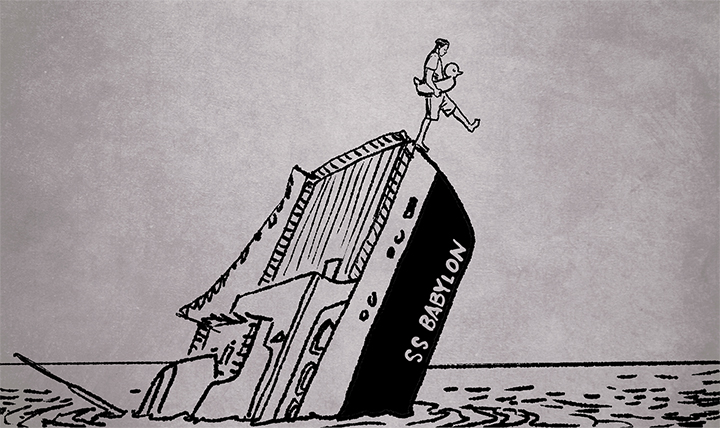
Chapter 18 provides us with a more detailed account of Babylon’s demise. Babylon, as we presented last week, is a code word in the Bible to describe humanity’s efforts to create a society and ethos apart from God. Paradise without a Creator. Those systems are bound for failure, and invariably create more torment and pain than they ever resolve.

What details are brought out about Babylon in chapter 18? Who is lamenting over her? What do they cry about? What does that tell us about the symbolism of adultery and prostitution? It might help to contextualize this imagery if you read Jeremiah 51 (especially v6-8 and v60-64).

When we get to chapter 19, we find a contrasting action to the lament and weeping of chapter 18. Four distinct HALLELUJAHS (Praise the Lord in the NLT) are sounded. What reasons are stated for praising God in those four sections? At one point we are told about the “wedding feast of the Lamb”. What does the imagery of a “bride” conjure up concerning our relationship to Christ as His people? What can we learn about being a follower of Jesus in 21st Century America from this section?

Hope to see you on Sunday!

By the Waters of Babylon

Most of us are familiar with the archetypal trope of the femme fatale. The term is French for fatal woman. She is usually presented as a temptress, driven, manipulative and shrewd. She is often very dangerous to the men she tangles with, usually being cast as a villain in the story. From the Bible to Arthurian tales, to Shakespeare, to modern film-noir we encounter this archetype. Certainly there are stories with men who fit the pattern as well; the homme fatale. A handsome, mysteriously seductive, yet dangerous man. I suppose the female version is more prominent because it overturns and threatens the formerly normalized power dynamics, making for a more intriguing story. That’s my theory anyway.

As we continue our study of Revelation we’ll be reading chapter 17 and we will encounter an archetypal femme fatale: the harlot described as Babylon. Revelation is all written in symbolic language, remember, so what is really being described has nothing to do with women or prostitution, but rather, fidelity to God.

The woman is described as sitting on the Beast we encountered earlier, in chapter 13. When you read over her description, what might the various details about the scarlet clothes, the jewelry and what it is that she is drunk on be symbolizing? If we remember the last time this sort of imagery was employed, in chapter 2, when the church in Thyatira was rebuked for committing adultery with Jezebel, it was most likely addressing a compromise of convictions in the church. What might this woman in chapter 17 be representing?

When the Beast is described, attention is paid to his heads and horns, with cryptic significance assigned to them. We’ll cover the various theories about what they might be representing on Sunday.

If this imagery is describing the systems of power and popular ethos in our world, what warning might we take away from it? What encouragement could it give?

The chapter is filled with vivid and disturbing images – hopefully we’ll be able to get a handle on the message it conveys. See you Sunday!

Right Undoing Wrong

Related imageThis Sunday we’re going to spend a significant amount of time talking about judgement and wrath, specifically, God’s judgement and wrath. We’ll be continuing our study in Revelation, covering chapters 15-16. It’s not very often that an entire message finds judgement as its focal point, but this is the nature of the two chapters we’ll be reading and we wouldn’t be treating the text honestly nor honorably if we were to skim past it. So buckle up because we’re going to look squarely at this subject…and believe it or not, I think it may prove to be encouraging.

God’s judgement is one of those unfortunate concepts that falls into two extremes in the history of church doctrine. Some elements of the church get so focused on judgement and wrath that a caricature is created of God, one that resembles pagan concepts more than biblical ones. On the other hand, some in the church are so concerned that talk of God judging might undermine the message of his grace that they also create a caricature of God; one of a doting old grandparent who just winks and smiles in the face of all that’s wrong.

But what are we to make of wrath and judgement ascribed to God, not only in the Old Testament, but also in the New, as in the chapters we’ll be reading this Sunday?

I believe without reservation that God is not mad at humanity. I believe the message of the Gospel, that God so LOVED the world he sent Jesus, his son, as an atoning sacrifice. I also believe what the bible says about God’s wrath. The main issue is the focus of that wrath. This is something we’ll talk about at length on Sunday.

For now, just consider this: what comes to mind when you hear the word “wrath”? When you think of judgment, what do you envision? In what ways could God’s judgement be a positive thing that compels the nations to worship God, as is described in chapter 15:4?

Don’t get nervous – I think it’s important to talk about these ideas and do our best to grapple with them. If we observe this rightly, it’s very possible to come away from a teaching like this with a whole new sense of hope. See you on Sunday!

Destinations in View

Do you remember being a child and watching scary movies? Sometimes, when the monster was about to attack or the action got really tense, it seemed prudent to hide under a blanket, or cover your eyes, or suddenly get interested in something else until the tension eased in the story. Who am I kidding…I’m still like that. However, as a young tyke, I can remember my mom noticing my worry and reminding me: “it’s just a movie, it’s not real”. If it were a movie she had already seen, she would sometimes let me know how it ended: “It’s okay, they’ll stop the monster, I’ve seen this”. I don’t think people cared about spoilers then as much as they do now.

Anyway, as we are returning to our study in Revelation this Sunday, we’ll be reading chapter 14, where we’ll be getting some reassurance in the midst of some really tense images. The chapter intends to remind those who follow Jesus about their destination. (spoiler) There’s a good ending for those who believe.

In v1-5 we are greeted with some familiar characters – the Lamb and the 144,000 followers of the Lamb. We first met these 144K back in chapter 7, and we concluded that they were most likely a symbolic representation of God’s redeemed people throughout time. They showed up as an interlude between the 6th and 7th seal…a quick look at God’s protection of his people, right before we saw the finale of history.

As we look at how these people are described in v4-5, what significance do we assign to each of these symbolic characteristics?

v 6-12 has a vision of three angels, or messengers, each declaring invitations and warnings. The first angel has the invitation of the gospel. To whom is that gospel offered? What similarities do you see between those people and the people of chapter 13? What does this tell us about God’s heart?

This chapter is pretty loaded with disturbing pictures and forecasts – most of which we’ll try to unpack and explore on Sunday. Hopefully, we’ll see you then!