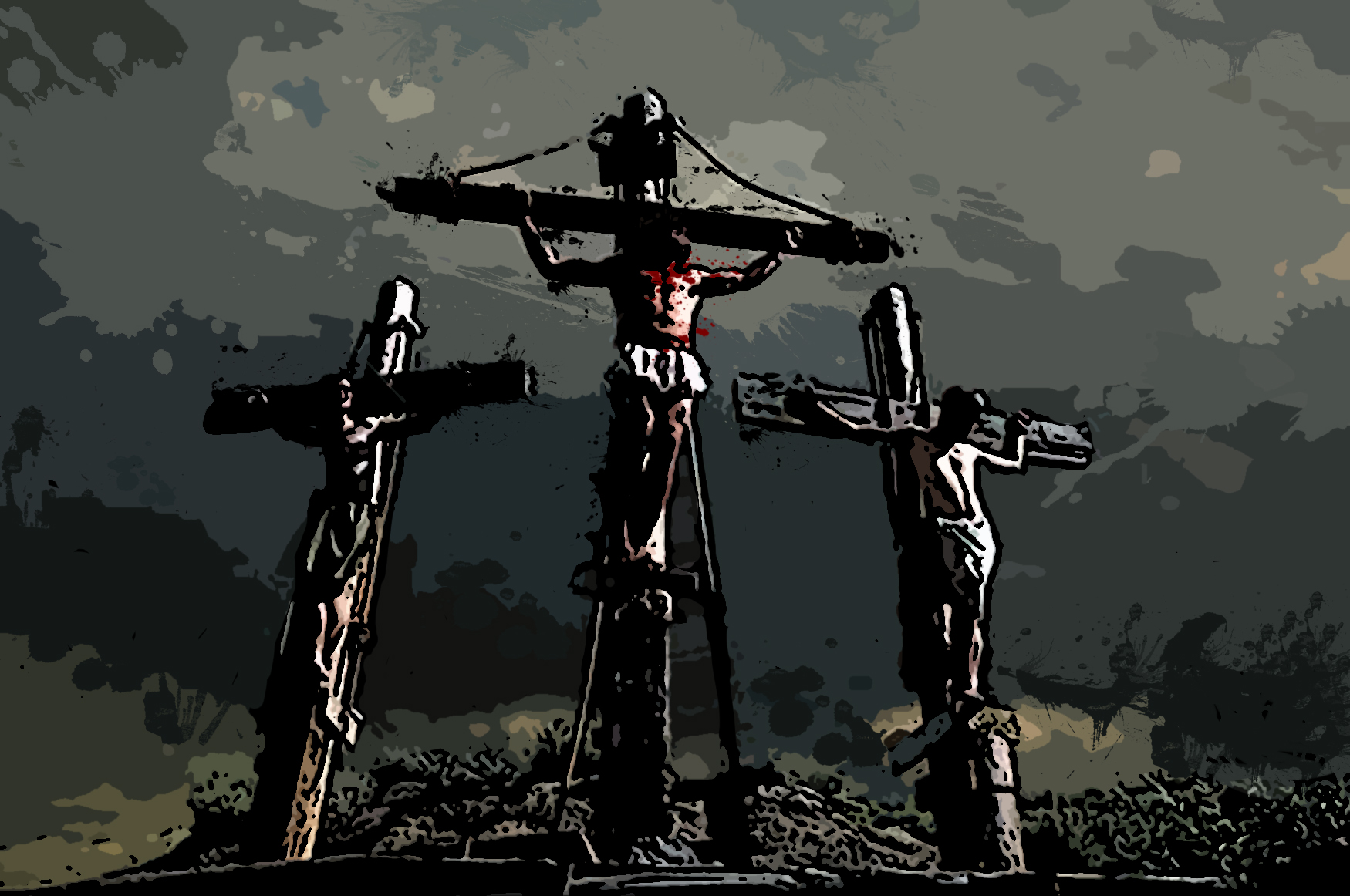
The Great Convergence

We will be reading the events that surround Christ’s crucifixion this Sunday.  There is no way to cover that much text and subject matter and do a thorough job of exegesis…so suffice it to say that we will be looking at the major themes of what the cross means to us as followers of Christ.

As I read it, all of the sacrifices, prophecies and narratives of the Old Testament lead in a line, converging at the cross of Christ.  All of the effects and consequences of mankind’s great rebellion against God and His plan converge there as well.  In the crucifixion of Jesus, we have pictured not only the judgment and pain of sin, but also the grace and forgiveness of God.  It is a literal cross-hair on which the meaning of life is focused.

As you read this account, you’ll see a wide variety of characters in Luke’s narrative.  From mourners to soldiers to religious leaders to crooks.  If you try any of these characters on for size, which ones can you relate to your own life and response to God?  Which character’s interaction with Jesus upsets you?  Which one comforts you, and why?

What comes across so clearly to me is the sheer magnitude of God’s grace revealed in the cross.  I’ve been contemplating the sacrifice of Jesus a lot this week.  I once questioned a friend’s destructive and self-destructive choices in light of their Christian confession, and the person reprimanded me saying “Remember what you teach Rob, it’s not about being legalistic, it’s about grace!”

As I think about what Jesus suffered in paying the price for my sins…I’ve been contemplating a right response to his love.  His love is never in question…and I will never move from the torn curtain of God’s grace.  But what should OUR response be to that love?  Does our response reveal anything about what we believe and what we consider real?  If I’m a rebel forgiven by great love, is further rebellion a reasonable reaction?  I guess my question is, where’s the love?  Guess I’m just thinking out loud.

Hope to see you Sunday.   Leader’s guide for small groups can be found here: leaders guide 23-26-49

God in the Hands of Angry Sinners

Have you ever dealt with a really obstinate person – a person whose mind is made up and no amount of reasoning or arguing will ever change it? How do you feel when faced with that kind of exchange…what do you do?

In our study of the Gospel of Luke this week we’ll be reading chapter 22:63-71. It’s the account of Jesus’ trial before the Sanhedrin, the highest Jewish authority of the time.

Much is revealed about the nature of who Jesus is in this account, yet surprisingly Jesus says very few words.  He’s beaten by soldiers and interrogated by religious leaders – both groups doing their best to provoke a desired reaction from him, both failing.  What IS revealed is that there are actually two courtroom scenes in this section, one seen and one invisible to the naked eye. In a masterful literary setup, Luke presents the irony of one group assuming a position of power over One who is actually judge of all.  Jesus makes the statement in v69 that identifies him as one holding equal power and right to rule with God, and that seals his fate in their minds.  Its a strange scene where God is in the hands of angry sinners (with apologies to Jonathan Edwards).

Hebrews 12:3 says ” Consider him who endured from sinners such hostility against himself, so that you may not grow weary or fainthearted.”  – in other words, look at Jesus’ example of how he behaved when faced with closed minded, intolerant people, and learn how you can handle people like that.  As you look at Jesus’ behavior during this unjust trial, what do you observe about him and how he did or didn’t react?  Who’s opinion of him does he point to as having ultimate importance? – that is, who’s opinion of him matters most?  What can we learn from that when people don’t like us or misunderstand us or have a low view of our worth?

It should prove an interesting discussion for the home groups this week. A leader’s guide for this week can be found here: leaders guide 22-63-71

Stuff to think about.  Hope to see you Sunday!

Livin’ Large

Greatness.

Most people wouldn’t admit to trying to be great, unless they are Muhammad Ali in the 60’s, but most people are trying to find greatness if we define it as the best life we can live.  For us as American consumers, if we were to ask people what the best life we can live looks like, it would most likely be described as one where we have all the possessions we want and are free from discomfort.  I could guarantee that nobody would exclaim that the best life results from doing extra work for somebody else for no immediate rewards.

Yet oddly enough — that’s exactly what Jesus described as the pathway to greatness. We’re going to be reading Luke 22:24-30 this Sunday. It is still Luke’s account of Jesus observing the Passover meal with his disciples, and the final words he gives to them.

In this passage, an argument breaks out about who is the most awesome of Jesus’ disciples, right on the heels of Him explaining how he’s going to be betrayed and sacrificed for everyone.  It’s downright cringe worthy.  Ever do that?  Ever find yourself fixated on your own self-centric interests even in the face of someone else’s greater dilemmas?  I have, way more often than I’m willing to admit to.

Jesus corrects his disciples by inviting them into a “descent into greatness”.  He points toward a focus that is others-centered as the means of true satisfaction.  Jesus pointed toward himself as our example for this kind of life.  In what ways was Jesus a servant – and how can we use that as a template for our own lives? When is it most difficult to BE a servant, and how can we change our attitudes about that?

I love how Jesus finishes off the section by commending his disciples, promising them that they’ll be sharing his kingdom with him.  It gives me such great hope. Here these goons have been vying for the disciple of the month award, in the face of Jesus’ great sacrifice – – and yet….THESE are the same guys he’s been longing to eat this meal with.  These are the guys he likes, and wants to hang with.  I’m encouraged by that.  God’s grace super-abounds in spite of our human frailties.  Pretty cool, huh?

Hope to see you Sunday!

The New Table

There is nothing quite like getting together with friends over a meal, is there?  Somehow, the process of sharing food and sharing conversation blend together in a way that seems to enlarge life. Sharing meals is a big part of the Biblical narrative.  In the gospel of Luke, there are more accounts of Jesus having meals than in any other record (something like ten in all).


In our passage this Sunday, we’ll be looking at Luke 22:1-23, where Jesus shares the Passover meal with his disciples.

The first few verses provide the backdrop for our story…the wicked scheming that occurs behind the scenes on the eve of Israel’s celebration of national salvation. You get the feeling of chess pieces being moved on a board, as this cosmic conflict unfolds between God and “satanas” – the enemy.

When I get to v15, it really strikes me. Jesus expresses such a strong desire to share a meal with his disciples. It’s the strongest word he can use, and he literally says “I have desired with desire…”. When you imagine your relationship with Jesus, do you ever think of him longing to be around you? How do you react internally to the idea that Jesus wants to hang out with you — that Jesus likes you?

During the observance of the Passover Seder, Jesus took two elements and refashioned them into what amounts to a new table – we could say, a new way in which God and man relate and have relationship.  He used the afikoman bread and the cup of redemption as new symbols of how salvation occurs. Did he point to anything else as the means of salvation? How do you think Christ feels about any attempt we make to set something else on his table – like our efforts or our good works?

This new table is a table of grace set by a God who invites us because he wants us.  He wants us – as we are, not as we should be.  What sort of response does that inspire in your own heart?

Share your thoughts about this passage, I’d love to read them.  See you Sunday!

The Good Ending

“And they lived happily ever after.”

That was the commonly expected end line to any given fairy tale read to us when we were growing up.  All good stories come to an end, and the stories that warmed our hearts and sparked our imaginations as children always had a good ending.  I know that there is a more jaded view of life that seems predominant in story telling lately, but still the most popular of stories resolve with a good ending.  For all the loss and pain that built during Harry Potter’s time at Hogwarts, the final ending was one of peace and hope and love.  In fact, it was the darkest moments of Voldemort’s successes in his  return that made the light shine that much brighter when he was finally defeated for good.

All the best stories have a good ending.

The Bible is no different, and this Sunday as we continue our study in Luke, Jesus will give us a glimpse of the good ending God has in store.  It’s just that, before we get to that end, things will get pretty dark.  We’ll be reading Luke 21:20-38.

Jesus describes things that, if they happen literally, would be very frightening – signs in the sky and panic on the earth. But v28 tells us what response God is hoping for from us, and why.  What is the response, and why would we give that response?

Redemption is the end goal.  Rescue is what God’s big plan is all about. The problem is, if life is pretty good and our own little kingdom is doing pretty well, its sort of hard to want God’s kingdom to come, isn’t it?  Redemption sounds like really good news to people whose lives have gotten really bad.  That sort of brings a new understanding to some of the dark times faced on earth, doesn’t it? Light dawning is always sweet for those who sit in darkness.  When Pharaoh took away the straw to make bricks, the wilderness looked pretty good to the Israelites as a path to the promised land of freedom.

Still, it’s been 2,000 years since Jesus made this promising prediction.  2,000 years is a long time to sit on the edge of your seat without settling back and trying to get comfortable.  That presents us with a danger which Jesus alerts us to. I am certain that Jesus’ words were not meant to inspire a fear that we might miss the rapture if we misbehave, but rather, inspire a HOPE that would bring out what’s best in us while we wait for him. If we live with a certainty of hope – if we live right now believing that the world will one day be set right, how might it change the way we live?  What does life look like when lived with a sure belief that justice, peace, kindness and grace will one day prevail?  What kind of life emerges from the unshakable conviction that love will win the day?

I’d be interested to hear your thoughts on this passage.  Hope your Thanksgiving weekend is all you had hoped it would be – and I pray that grace surrounds you always!  See you Sunday.

Keeping Your Cool When the World Heats Up

I grew up in an evangelical home.  From the time I was just a little kid, I can remember wrestling with fears about getting left behind from the rapture, and whether this or that conflict that had started in the Middle East was going to ignite Armageddon. Our house had books around that outlined just how bad it was going to be for people during the Great Tribulation, and warning us all about the rise of technology which fulfills all the apocalyptic prophecies of the Bible.  My mom stockpiled freeze-dried food in a storage closet.  She bought property in Northern Florida, twenty acres of land which could be turned into a self sufficient, off the grid haven of refuge for those escaping from the Antichrist…because clearly, the Antichrist wont look for people in the woods.

It’s a wonder I’m sane at all. (I know…that point is debatable, but please do it behind my back and let me feel okay about myself)

What emotional attitude do you think is most dominant when it comes to speculation about the end of the world?  Jesus was asked about the end of the world in the passage we’re going to read this Sunday – Luke 21:6-19

As you read this (and I mean REALLY read what he says…don’t just insert all the adjustments and qualifiers that seem to always go along with what he said)…Do you think Jesus was trying to incite fear in his followers?  When he described events that were going to happen, what did he say about those events?  More pointedly, if you imagined Jesus writing a book about how to live during the last days….what do you think it would say?

How do you react to the idea of the world coming to an end?  Fear, anxiety, anticipation, excited expectation? Share your thoughts.

Hope to see you on Sunday.

What is God up to in Life?

This Sunday we’ll be reading Luke 20:41-21:4.

It’s three somewhat disconnected stories that actually give us an insight into what God is up to in a general sense concerning our lives and our purpose in the Kingdom of God.  As you look at these three vignettes, what principles do you glean as priorities from God’s side for life?

Short and sweet this week…sorry it was so late.  Hope to see you Sunday.

Life After Life Now

Hey everybody…after a few weeks away from it, we’re going to get back into our exploration of the gospel of Luke this Sunday.  We’ll be reading ch 20:27-40 .

It’s an odd little encounter that Jesus has with a group of Sadducees. They were sort of like Bizarro Pharisees…they were the opposite of them in most areas of life and faith.  A quick overview of the various sects during Jesus’ time can be read HERE.

Because the Sadducees don’t believe in an afterlife at all, they pose a riddle that is supposed to show the absurdity of the concept.

They learn the first lesson they needed to learn…never argue religion with Jesus (you’ll get yer’ butt handed to you).  Jesus dismantles their proposition very simply…how does he do it…how does he indicate to them that they aren’t starting from the right premise?

Is there anything about what he says about relationships in the afterlife that either bothers you or gets you stoked? (Your answer will determine if you need marriage counseling…just so you know.) Do you think that Jesus was setting out to describe in detail how life will be after this life, or is there a deeper point you think he’s making?

The hope of an afterlife is actually a very meaningful influence on this present life, isn’t it?  I would say that the hope of an afterlife will radicalize our present life.  What are some of the positive ways an eternal hope can have on present life…and what could be some negative ways?  How can we, as followers of Christ who have a hope of resurrection and redemption maintain the positive influence of that hope, and not succumb to the negative tendencies?

I’ll be interested to hear your input.  See yaz Sunday!

The Shared Life Imperative

Hey all…this coming Sunday we’re taking a short detour from Luke, to discuss the importance of community to the Christian walk. We’re also going to be announcing some new initiatives we’re taking to see new small groups develop in our church.

A passage we’ll be looking at is 1 John 1:1-7…at least sections of it – v 2 and v7 are key to our discussion.

What is John’s reason for writing to the start up church he’s writing to, according to verse 2?  What is the result of this life of light, as v7 describes it?

When you think of your life of following Jesus, how important of a role does community play in your thinking?  Think about living a life in harmony with God.  What role do the people in your life play in living the life you just imagined?  How easy is it for you to make friends…and how many close friends do you have in your experience of church?

These are really important issues…hope you can be there!

Also…Oct 30th we’ll be having a special morning service, with a performance by David Payne of “The Prisoner of Passion”.  This should be an outstanding event, please make plans to be there!  Children’s classes will begin at 9am and 11am, as there will not be a worship service.  Kids are welcome to see the performance, but we’re asking that they sit with parents, and not near the front – we really want to minimize distractions.  Then, at 7pm that night, he will do a repeat performance of “An Evening With C.S. Lewis”…a really outstanding play.  Again, hope you can make it!

It’s All About Image

Phew…where’d THIS week go?

This Sunday we’ll be reading Luke 20:20-26 – the famous passage where Jesus is questioned about paying taxes (feel free to hum the Beatles “Taxman” song here – oh, and you’re welcome for the earworm).

The overriding theme here has to do with image.  Religion has an image, presented in v 20-22 – how would you characterize it?

Jesus mentions Caesar’s image on the coin he’s shown.  What do you think he meant by “give back to Caesar the things that are Caesar’s”?  How do you interpret that for your own life?

Jesus also says to give to God the things that are God’s.  What bear’s God’s image that we would give back to him?

As you read this passage, do you think Jesus was trying to establish new laws that govern a fair tax code?  Do you think Jesus was making a political statement?  Who brought the subject up in this story, and why?  Does that inform your idea about Jesus’ priorities in this?

Well…we’ll explore it all together this Sunday…hope to see you there!