Diagnosing Dragon Sickness

“The old Master had come to a bad end. Bard had given him much gold for the help of the Lake-people, but being of the kind that easily catches such disease he fell under the dragon-sickness, and took most of the gold and fled with it, and died of starvation in the Waste, deserted by his companions.” ~ The Hobbit, J.R.R. Tolkien

Greed is a often broached subject in Scripture, I suppose because we are so susceptible to it as humans. In the passage we’ll be looking at this Sunday (Luke 12:13-21 ), Jesus will address that issue as it touches his followers.

In this section, Jesus refuses to be an advocate for a guy looking for part of an inheritance…and then he launches into a warning about greed (covetousness). Why do you suppose Jesus refused this guy’s request?

The story that Jesus tells about the Barn Builder provides an enlargement of his warning.  Living a life of greed will leave us empty in the end…its pretty straightforward.  As we contemplate this warning…how do you apply it to your own life?  If I were going to be honest, I’d say that I get uncomfortable with this subject because I know there is still some dragon-sickness lingering in my soul.  As much as I like to promote simplifying…I still love all the nifty techno-gadgets that seem to become available every day. I start to get shifty at the thought of getting behind the curve on those things…and I have to wonder if my sense of contentment has shifted from God to stuff. An honest inventory of my emotional reactions in life usually reveal a LOT of areas where stuff is still controlling me.

How about you?  Do you still struggle with the temptation to define yourself by what you own…or by what you feel you lack?  What do you do about it?  I’d also be interested in what you believe Jesus meant by being “rich toward God”.

Ok…hope to see you Sunday!

Do You Know How Valuable You Are?

Last summer I was called up for jury duty.  I was in the pool of potential jurors, and had to listen to the three days of proceedings as the jury was selected.  The trial was going to be a civil lawsuit about medical malpractice, and a question that was posed to each of the jurors was “Can you put a monetary number on the value of a human life?”  Most people stammered mumbled answers in the negative, but of course, that didn’t stop lawyers from coming up with a tidy nine figure number for compensation.

What is my value as a human being?  If I have value, what is it?  For most of us, that nagging question hangs in uncertainty for a lot of our lives.  We want to be valuable…we want acceptance and a sense of belonging.  We intrinsically know we aren’t complete in and of ourselves; we even coin phrases like “no man is an island” to emphasize our need.

Sadly, for many of us, our chief attempt to find affirmation and value comes through our attempt to gain acceptance and approval from our peers.  This, in the immortal words of Admiral Akbar, is a trap!

In our study this Sunday, we’ll read Luke 12:1-12 .  Jesus warns his disciples about hypocrisy and the desire to please our fellow human beings over a desire to please God.

According to this passage, what is the central danger of hypocrisy (projecting a false persona)?  Why do people do that, and what does it say about where they derive their sense of self-worth?

Whose opinion is most important, according to this passage, and why?  In v4, Jesus calls the disciples something he hasn’t called them before in this gospel. coupling that with v 6-7, where should we derive our sense of value and self- worth?

Do you believe you are valuable to God?  If you do, what response does that inspire in you?  For all of it’s references to things like fear and hell…I found this passage to be hugely encouraging.  I hope you will too!


Why Legalism Sucks

It’s been a strange week for me.  I’ve really fought hard, wrestling with the verses we’ll be covering this Sunday.  I find it so important not to take the easy route of pointing fingers everywhere else when dealing with the subject of empty religion or legalism.  I honestly believe these are constant struggles that all of us, no matter how nobly we begin our journey, have to guard against.  I have a wealth of old anecdotes about how legalism oppressed me or twisted my thinking…yet the real challenge is to not live in the past, but have an eye on the present.  How do these issues effect Eastgate, or myself personally?  That’s where things get dicey…I’m more than happy to offend myself, but I hate the thought of offending someone else.  Unlike Jesus,who, in our text, let loose with a full on Ultimate Fighting Cage Match against religious stupidity with no apparent hang-ups about making Pharisees cry .

We’re going to be reading Luke 11:44-54 this Sunday, finally finishing up the chapter.  I probably could have broken this section into two parts as well…but I don’t want to belabor the point.

This section tells us that lawyers not get in on the discussion, which is never a good thing.

Actually though, the “lawyers” in this section are not lawyers like the one’s on Law and Order…it’s another term for Scribes.  They were experts on the Law of Moses, as well as the Talmud.  They learn right away it is not wise to pick a religious fight with Jesus.

Four more woes are leveled at legalistic religion.  If you were to summarize each woe, what would you say the warnings are?  v47-51 create a serious accusation against …saying that experts on religion as an end in itself are guilty of innocent blood all the way back to Abel.

Whoa, that’s a pretty serious woe.  But what do you think it means?  Why Abel?

What ways can you think of that will guard our hearts against legalism and empty religion?  How do you keep the main thing the main thing?

Stuff to gnaw on ’till Sunday.

Jesus Does the Dishes

This Sunday we’ll be reading from  Luke 11:37-54…as it stands right now, we’ll probably have to explore this in two parts.

In this account, Jesus goes toe to toe with the Pharisees, and confronts the legalism of their movement.  He declares six woes on their movement, or we could say, he gives us six reasons why legalism sucks.

Legalism is still an issue for many churches and Christian groups today.  It certainly didn’t stop with the Pharisees.  There are many modern day incarnations of this Pharisaical attitude that Jesus resisted.  I know I’ve had my share of both being a Pharisee and being under the scrutiny and buffeting of them.  Out of curiosity, what have YOUR experiences been.  It would be interesting to hear your stories of experiences with legalism in the church.  If you have time, tell me the goofiest rules you’ve encountered in the context of church.  Tell me your personal experiences.  This isn’t intended to bash anyone…just to be able to laugh at our human condition when it comes to religion.

I’ve never denied that I’m a recovering legalist.  I still find areas, after nearly 20 years of pursuing grace, where I’ve been blind to a legalistic approach to things…whether its with my kids or my church…I still have to remember the keep the Main Thing the main thing.

Anyway…tell me your stories….quick, before Sunday so I can share ’em in my teaching!

Oh…and please don’t forget about the prayer meeting Saturday for Sudan…the particulars are in the post below.  Thanks!

The Only Sign

This Sunday we’ll be coming back to Luke 11, and we’ll be reading vs 29-36.

The context is carried over from last week…that of Jesus addressing those who were rejecting him either through direct opposition and criticism, or through apathy.  Jesus challenged those who heard him to make a decision, one way or the other, and neutrality is not an option.  Carrying the theme through,  Jesus knew there were a lot of people wanting more proof that he was Messiah via some supernatural sign from heaven, so he did what any self-respecting Messiah would do; he called them all evil.  Kinda’ cool if you think about what terrible marketing that is.

Jesus mentions the “sign of Jonah”, which has had a lot of people theorizing about its meaning for the last 2,000 years.  There are some obvious parallels between Jonah and Jesus, which Matthew’s gospel points out in Matt 12.  What do you think the “sign of Jonah” is?

Why would the people of Nineveh and the Queen of the South, both pagan, gentile peoples, have a place to condemn Jesus’ generation of chosen people?

The following verses are a commentary in word pictures about the spiritual blindness of the religious people of Jesus’ day.  What do you think was the cause of their blindness…why do you think they were prone to reject Jesus as Messiah?

Stuff to ponder ’till Sunday.  See yer’ then!

More Than a Friend

It’s hard to believe I’ve been back in the States for almost two weeks.  I feel as though its only been a few days and I’m still trying to reorient myself…but I also hit the ground running when I came home, so that may be part of it.  I’m still struggling to get my bearings on a fast approaching Christmas.  Aagh!

But…aside from that…this Sunday we’ll be continuing our study in Luke. (“What? No Christmas message?”… “No, Christmas is a week away, and we’ll be having our Christmas Eve Burning House Mash Up on Dec 24th at 6:30pm, so you can get your Christmas on then.”)  This Sunday, we’ll be reading Luke 11:5-13.  Its a continuation of our study from last week, as we consider Jesus’ instructions on prayer.

In the first part of the chapter, the disciples wanted to learn how to pray.  So Jesus provided a model, a guide for what should characterize our prayers, and then, in v5-13, he elaborates on the idea of prayer by telling a couple of story examples.

The story of the friend at midnight, or more appropriately the story of the grumpy, sleepy neighbor, is an odd story to tell when elaborating on prayer.  Many people see this parable as an encouragement to be bold and persistent in prayer.  I’m not so convinced…and I’ll elaborate on why this Sunday.  What if we were to look at this story as a contrast?  I’ll leave it at that…do you have any thoughts on the subject?

As you read what Jesus says in the context of teaching us how to pray…what does he spend the majority of time talking about, in you opinion?

Why do you suppose He ties the whole thing up saying the Father will give the Holy Spirit to those who ask Him?  What does that have to do with anything that he’s said so far?

I hope this will be an encouraging, provocative time of exploring the Scriptures.  See you Sunday!  Also, since our subject is prayer, take some time to visit the Prayer Wall of this site…there are many needs the people of our community have, which we want to keep before God in prayer.  God is our hope, and He will make the difference, so I encourage us all to pray.

Recovering the Native Tongue (thoughts on prayer)

Hey everyone – it’s great to be home again.  As you think about it, please keep Tom Randles in your prayers, and if you’d like, send him an encouraging email at thomas.randles@gmail.com – just to let him know that others are thinking of him and appreciate what he’s doing now.

Now that we’re back, its time to get back into our study in the Gospel of Luke.  This Sunday we’ll be reading Luke 11:1-4, and exploring the model prayer that Jesus provided for us.  It’s interesting that guys who grew up in Jewish households would want instruction on how to pray.  They grew up with prayers as a major part of their heritage.  Why do you think they wanted Jesus to teach them to pray?

As you read Jesus’ guide for prayer, what things strike you about it?  What seems to characterize this prayer?  If you were to divide it into parts, what part comes first and what comes second?

We need a guide for prayer.  Left to ourselves, we tend to make a mess of things as important as this.  I hope this Sunday we can gain some insight about the “hows” and “whys” of our communication with God.  Hope to see you then!

One Important Thing

We’ll be finishing Luke chapter 10 this Sunday, reading verses 38-42.

It’s a familiar story to most of us.  Mary is sitting at Jesus’ feet whilst Martha is to her elbows in dishwater.  We normally read it as a contrast between busy and contemplative people.  There’s a lot going on in this very concise story.   Some of the lessons it teaches are not the most obvious things we read into it.

Who do you feel like you are in life?  Mary or Martha?  Do you ever wonder if Martha were to sit down with Mary, who would keep an eye on the roast so it doesn’t burn?  If Martha doesn’t serve, no one is eating.  But as we read it…is Jesus really correcting Martha for serving dinner…or is it something else?

We’ll explore it all together this Sunday…hope to see you there!

Also – Dave Peirce, Tom Randels and myself are leaving this coming Wednesday for the Sudan to be with Sabet and Suzy Kuj, of In Deed and Truth Ministries.  We’ve been supporting Sabet and Suzy for several years (we met them when they had fellowshiped with us during a year when they had to be in the states).  They facilitate a medical clinic as their outreach to the Sudanese people – hence the two doctors (Dave and Tom) are going out to help out, and I’m going along to teach a class in the Bible school Sabet has begun to train local pastors in the Word.  Dave and I will stay for two weeks, and Tom will remain for at least a year as the resident physician.  It’s pretty exciting stuff, and God’s wonderful grace is all over the whole thing.

All that to say, this will be my last Wonderwhat post until the 2nd week of December, as I’ll be gone for two Sundays.  Please support those who are filling in for me, since the priority is the Word, not the personality that shares it…right?  Please pray for Dave, Tom and I as we travel – that God will use us for His glory, and that we will return safely home.

Ok, that’s that.  Peace.

Won’t You Be My Neighbor?

What a great discussion we had here last week.  I really appreciate the time and consideration so many of you gave in posting your thoughts.   Having said that, I’m not trying to put anyone under pressure to make comments now…I’m just sayin’ it was cool last week.

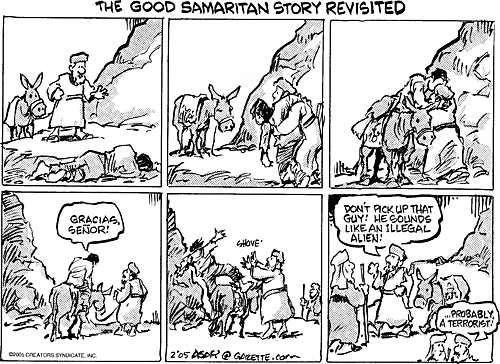
This Sunday we’ll be reading Luke 10:25-37, the story of the Good Samaritan.

Why do you think the Scribe (Lawyer) was testing Jesus on this point?  Think about where they are and what has happened in the first part of the chapter.  The Scribe is concerned with how one achieves eternal life.  That is, how does a person get in on the Kingdom of God when it gets revealed (keeping in mind what the 1st century Jewish view of the Kingdom of God).   He’s basically asking “what is the core of our faith, what is our highest priority?”.  It all boils down to two things…what two things are of highest importance?

Notice that Jesus never answers the Scribe’s questions directly, but answers with a question, or tells a story followed by a question.  Who then provides all the definitions in this story?

Samaritans were hated by the Jewish people.  They were the traditional bad guys.  If you were to put this story on a contemporary stage, who would the Samaritan be to you?  Why do you suppose Jesus turned the tables like this, what was his point?

Applying this parable to real life, how does it challenge you?

Looking forward to exploring this on Sunday!  See you then.

We Got a Reason to be Stoked

Do you ever find yourself just going through the motions of what you perceive is expected of you as a Christian?  Ever find yourself in a joyless funk where you feel like you’re just going through the motions of faith?  Every once in a while, its really good to get back to the heart of what this life of following Christ really has going for it…to sort of shake us out of our malaise and reignite our passion and excitement for the kingdom project Jesus started whilst on earth.

Our passage in Luke will be chapter 10:17-24 this Sunday.

As the 72 (or 70, your choice) return from their mission, they are pretty stoked.  They give a reason for that joy, and Jesus affirms it, and that is…Jesus WINS.  If Jesus wins, who loses?  Why is that a reason to be joyful?

We do have Jesus qualifying their stokedness…reminding them that they don’t want to look at what they’ve done, nor even what they may do as being the SOURCE of their joy…what IS the source?  Why is that a reason to be joyful?

In so many ways, this journey Jesus takes from Galilee to Jerusalem is a picture of the church age, and even the end of the story.  It’s a good ending, an ending prophets and kings were longing to see fulfilled in their day.  If the story has a good ending, then all adversity that happens in the meantime is simply part of the adventure.  To me, that seems like a good source of joy. What about you?