Leadership 101

Sorry about not posting here last week.  That is…if anyone is still reading this and finding it useful.  That’s an odd conundrum, isn’t it?  If you’re not reading this, you don’t know I wrote it, and there’s no way you could tell me I should stop.  Just let me say, if you’re not reading this don’t worry about it.  Don’t give it a second thought, which of course you don’t because you haven’t read it.

This Sunday we’ll be reading 1 Timothy 5:17-15  (the message version here)

Paul has a lot to say about leadership.  How to treat them, how to correct them, how to appoint them and what to expect from them.  There’s part of me that feels really uncomfortable dealing with this passage…I almost wondered at one point if I should have asked someone else to teach it.  I decided in the end that I’m called to explore all of the Scriptures, not just the stuff that I’m comfortable with.  It’s there in the text, so we’ll deal with it.

Do you feel like there is anything in this passage that applies to your own life or responsibilities?  V23 is quite the topic.  Do you have any ideas on what Paul is telling Timothy in that verse?

Being Who You Were Meant to Be

graveMichael Jackson is dead.  So is Farrah Fawcett.  And Ed McMahon.  For a guy my age, the icons are crumbling and blowing away from our present view.  I was reading Ubahleeob’s blog this morning, and thinking about his thoughts on mortality.  And I wonder…are we living the life we were meant to live?

This Sunday we’ll be looking at that very thing, as Paul continues instructing Timothy, in 1 Timothy 4:11-16 (and in the Message).

Tim was young, and that was an obstacle in his culture, that stood in the way of his being the leader God wanted him to be.  What obstacles are in your way, that prevent you from being the person God intended you to be?  Read the passage and consider the various ways these verses can point us toward living a life according to God’s plan.

Having a Healthy Spiritual Worldview

This Sunday we’ll be looking at 1 Timothy 4:1-10.  (the Message)

Paul is once again being blunt about his views on some of those who had been teaching the church in Ephesus.  Our culture has mostly adopted a pluralistic view about truth.  There is no one truth, our culture maintains, but all claims of spirituality are equally valid.  Paul gives his perception about some claims of spirituality.  What is his view?  Does this challenge your own thinking about the claims of other religions?

In v3-5, Paul outlines some specific difficulties he has with what some teachers are enforcing on members of the church.  What seems to be his point, why are these requirements an error?

V6-10 provide a few positive directions for us to follow in searching for a healthy spiritual worldview.  What is the basis for a good spiritual worldview according to v6?  What do we need to do with the truth we have, according to v7-8?

What we believe matters.  While we never want to join bashing tactics of the so  called “discernment ministries”, we do need to recognize the need for a clear, Scriptural framework from which we make the choices of life.  This should be an interesting exploration of that concept.

See ya’ Sundee.

What is the Church Anyway?

Our text this Sunday will be 1 Tim 3:14-16 (In the Message)

Just a few short verses, in which Paul gives an explanation about why he’s writing this letter in the first place.  In his explanation, he gives some very interesting insights about the nature of the church gathering.  How does v15 describe the church?  What three descriptors does he use?  What do those mean to you?

The context is the church, yet what does v16 seem to be talking about?  What do you see as the connection?

Short…to the point…yet a lot to think about.  See youse Sunday.

Quality Control for Leaders

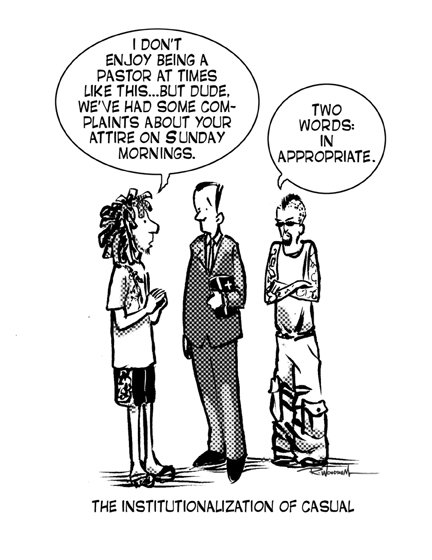
casual-1Phew…glad last week is over.  Happily, it didn’t stir nary a trace of controversy, which is awesome, since the verses we dealt with are so traditionally controversial.

This Sunday we’ll be looking at 1 Timothy 3:1-13. (the Message)

Any group of people that seek to unite and accomplish a common goal are going to, by necessity, have leaders within the group.  Even on game shows like Survivor, we see how people naturally fall into roles and leaders eventually emerge among the tribes.  An old axiom says, “If everyone is in charge, then no one is.” .  We had to learn those lessons early on in trying to re-imagine our approach to church in Eastgate.  Leaders are part of the deal.

Paul provides lists of character traits that the leadership of the church should embody.  Why do you think it’s important for those who lead the church community to embody these moral characteristics?  Is it a double standard…that is, should these traits only characterize the leadership, or is there something else to this?

The word Paul uses for “Bishop” is episkope, and it means someone who watches over things and investigates them…it is commonly called “an overseer”.  Many denominations have created an office hierarchy out of this word…but the text doesn’t seem to support that.  Words like “pastor/shepherd”, “elder” and “bishop/overseer” are more than likely describing the different functions of those who lead the local church.  Read 1 Peter 5:1-2 …do you notice anything about those terms in this verse?

The other designation for leadership is “deacon”, which in the Greek is diakonos, and it literally means “servant”.  I suppose this is any function in the church community that serves the specific needs a community has…including what the cultural developments require.  Things like teaching the children, music ministry, making coffee, doing media stuff….these would be included, in my thinking, as we make the generational and cultural leap to the 21st century.

Traditional formations of the church have created an elaborate hierarchy from passages like these…do you get any sense of an elevated class of people from what Paul says here?  What is the overall sense of Paul’s instructions….and how would you apply it to church as you know it?

Interesting stuff to chew on…huh?

See yers’ Sunday

How To Make a Difference

Hey!  I was out of town last week, hence the lack of an update.  But now I’m back (insert cheers or boos here, your choice).

Happy Mom’s day!  Be sure to buy your Mom some flowers and a card…or give her cash, that should shock her. 

hand_to_heaven_180x180This Sunday we’ll be reading 1 Timothy 2:1-7.  (In the Message).  We’re looking at 1&2 Timothy with the theme of discovering what Church life should look like in real life.  Paul started off his letter with instructions about keeping the Gospel streamlined…not adding sensational stories or heavy-handed rules.  From doctrine, he moves to practical instructions about the church’s place in this world, and our primary means of making a difference.

In v1-2, Paul gives specific instructions about how we are to deal with our fellow human beings…from our neighbors to our president.  What is his instruction?  Why does he make that such a priority?

V2 even tells us about the priorities of our lifestyle.  What should characterize the Christian life in relationship to the world around us?  HERE is the literal Greek word for the last word used to describe the Christian lifestyle in v2.  Does this characterize your life?  How does Paul’s instructions in v1 connect with v2?

In v3-7 Paul describes the ultimate way we as the church make a difference in this world.  In light of the prevalent call to political activism, these last verses seem to temper our understanding about what the church is called to do and represent.  What does that mean about our primary mission in the world?

Looking forward to exploring this together on Sunday!  See yez’ then!

Church Life in Real Life

churchinreallifeThis Sunday we’ll be starting a new series called “Church Life in Real Life”, and we’ll be exploring the books of 1 & 2 Timothy.  There’s a pretty good commentary which covers at least 1 Tim online at Bible Gateway…you can find it and read it HERE (if you’re so inclined). 

Both the letters to Timothy as well as Titus have become known as the “pastoral epistles”, because they deal so much with church structure.  Some people assert that their only real purpose is to set up church policy and government, but I beg to differ.  It seems to me, that while the regulation of leaders and doctrine brackets the whole work, the real import of the message is how the gospel is supposed to effect our lives with REAL change.  Change that gets evidenced in the lives we live.  Church life should merely be a reflection of our everyday life, not a different aspect of life we reserve for Sundays and Wednesdays.  Church life should be in real life and visa versa.  Anyway…we’ll unpack that a bit more as we go along.

This week as we introduce the book, we’ll be reading chapter 1:1-11  (Also in the Message), and considering Paul’s “War on Error”.

After his greetings, Paul jumps right into correcting teachers in Ephesus (Where Tim is living and working, helping get the church there established), warning them that they’re veering off the path Paul originally pointed to.  What are some of the things he warns against in v4? 

So…what’s the big deal Paul?  Why is doctrine such a sticky issue with you?  What does it matter what some people believe?  Those kinds of questions seem appropriate…so what does v4 say about the results of what is being taught in Ephesus?  What does that tell us about the importance of maintaining a healthy doctrinal understanding?

The issue seems to be a slide into mysticism, and another attempt to introduce the Old Testament law into New Testament living.  Who does Paul say the the law is for?  How do we understand this, in light of Paul’s message of salvation and life in Jesus Christ?

Should be an interesting foray into a very timely epistle!  See yaz Sundee.

Responsibility…what’s that? Responsibility, not quite yet!

Running late this week, per usual.  Don’t forget that Burning House is this Sunday…and Save the Ship will be leading worship and providing original music!  Do NOT miss this.

This Sunday we’ll be finishing up our teaching in 1&2 Thessalonians…and we’ll be reading 2 Thes 3:6-18. (Also in The Message)

It appears as though end time fever got the best of some of the people in Thessalonica…and they quit showing up to work and just sat around looking for Jesus to come back.  Every met anyone like that?  Ever done that yourself?  I heard a phrase once, that said “Live as though it were your last moment on earth, but plan as though you’ll be here 100 more years.”….or something like that.  I actually used that very unromantic phrase when I proposed to Robbie…but that’s a whole ‘nother story.

In reading these verses, we should tie v6 to v14-15, because those latter two revisit what is said in v6.  How do you interpret what Paul is saying there…and even more, how would you actually carry that out in real life?

Paul uses himself as and example in v7-9.  What do we learn from his example?

In v10-13, Paul makes a two fold challenge…one is to the slackers…the other is to those who have been trying their best to do the good that endures.  What is the message to these two groups?

He finishes it all off reminding of something very encoruaging…v16….what is it?

See you guys Sunday…and don’t forget to make room for Burning House!

“Priorities Under Pressure”

When times are hard, and life seems to have the pressure set at “11”, it’s easy sometimes to forget what comes first.  I know in my own experiences, whenever there’s a problem, I have a tendency to fixate on that problem, and treat it as though it’s the most important thing in the world, until it gets solved.  But is that the right procedure for handling life’s difficulties?

We’re going to continue our study in 2 Thessalonians, and read v1-5 of chapter 3.  (In the Message)

In the first verse, Paul asks the Thessalonians to do something…pray.  What does that tell us about our priorities during times of stress?  What obstacles are in our way to praying?

Combining v1-2…what does Paul ask them to pray about?  What does THAT tell us about our priorities in life?  What is the most important thing in the world for the Christ follower?

In v3-4, Paul expresses his confidence in God, that he will continue doing his work in the people of the Thessalonian church.  Based on what he says, what else is our priority as a Christ follower?

Finally, v5 has Paul praying for them again.  Its a neat kind of rhythm to this…like breathing, or a heartbeat, how the prayer goes from one to the other.  What is his final request for the Christians there?  What is OUR priority, based on his hope for them?

Stuff to ponder.

Hanging in There

Ever need a good pep talk?  Clearly, Peyton Manning is probably not the place to start looking for one, but all of us need a good encouraging word now and anon.

This Sunday we’ll be looking at 2 Thes 2:13-16 (and in the Message), and I believe that’s what Paul is doing with his closing thoughts to the church in Thessalonica…giving them a pep talk.  Mind you, it’s a pep talk that’s pretty deep and rife with theological implications that have been studied and debated for 2,000 years…but a pep talk none the  less.  In a way, Paul is saying “look, I know that times are hard for you, and people keep predicting the end of the world for you…but hang in there.”  Then he gives them some reasons and ways to hang on.

In v13-14, Paul sets up the foundational encouragement for them.  What do you get as encouragement from these two verses?  Based on these verses, what can you remind yourself of when times are tough and you need something to hang on to?

V15 gives us a straightforward encouragement to do something in our “hanging on”.  What is it?  What do you think Paul is talking about, and how would we apply it to our day and age?

V16-17 tells us that God is the source of something to us?  What is it?  What should it result in concerning our state of mind and heart?

Ok…stuff to chew on.  We’ll talk about it more on Sunday.