Famous Last Words

(note: based on the current tracking models for Nate, we will plan to have our meetings as usual since we’re just under a TS watch. However, should the storm start tracking East, or if we find ourselves facing full-on tropical storm conditions or worse, we will cancel our meetings. If that is the case, stay home and stay safe. We will post on Facebook and through email if we cancel our services.)
rev_FB Graphic

Well – it had to happen at some point, right? This Sunday (Lord willing), we will begin a new Bible study on the last book of the Bible – The Revelation! I know for some this has been something they’ve been hoping for for quite some time. It is literally the last book of the New Testament for me to teach through.

Now I know that the world was supposed to end a few weeks ago and some people got really caught up in the hype of that. We have had a lot of cosmic-like events happening lately, a solar eclipse cut across North America, multiple devastating hurricanes and earthquakes have done catastrophic damage around the world and a violent madman unleashed automatic gunfire into a crowd of innocent concert-goers. So many terrible things happening that we could start wondering if these are signs that the end is near.

The Revelation that John wrote will address that, as Jesus did in Matthew 24. I can tell you now, that yes, these are signs of the end. From the time that Jesus was raised and ascended into heaven until he returns again the world is in it’s last stage. It’s lasted a lot longer than anyone anticipated, but these last 2,000-plus years have been the last days. Jesus told us plainly that what will characterize the world in the interim of his two advents will be wind and waves, diseases, earthquakes, wars and rumors of wars. The world will continue in violent upheaval that are like birth-pangs, waiting for a new world to be born. So, yes, the horrible things we are seeing daily on the news are indications that we are in that time Jesus spoke of, but it’s just another day in a broken world as well.

So the natural question Christians and the church have asked throughout the ages has been, “If we claim that Jesus is Lord and ruling all things, why is all this terrible stuff still happening? Why do Caesars and Hitlers and Kim Jong-Uns still exercise their tyranny and hurt so many people? Why does the world seem like its full of monsters?”

The Revelation was written to answer that question. It was intended to pull back the cosmic curtain and remind us that there is more going on than meets the eye. God has a plan and purpose that he continues to fulfill, no matter what it may look like on the surface.

Let me warn you that I will not be offering charts of sequential events or providing formulas for how to calculate when the end will occur. We won’t be describing ways in which we can spot the Antichrist or set a date for the rapture. What we will be doing is reading The Revelation to discover what it tells us about today, and how we can find hope in Jesus in our present lives. I believe this book has a lot to offer in our ongoing discovery of Jesus! In fact…I’m SUPER stoked about this book as I’ve been re-studying it over the last several months!

As we begin our study, we’ll be reading v 1-8 as an introduction.

It may help if you have an acquaintance with the genre of Apocalyptic Literature.

I also can’t say enough good about The Bible Project’s videos – and it would really be helpful to your understanding of The Revelation if you had an overview of the book of Daniel in your mind – so watch this short video to get that:

I hope we have our services on Sunday – I hope we all stay safe – pray for the people of Louisiana and Mississippi – as well as all the regions that have been in harms way lately. Pray for a return to stability and for life to be preserved – and always be on the lookout for ways we can be the Good News in this world!


Whose Kingdom?

Has someone ever taken something that belonged to you – or at least you felt belonged to you? How did that make you feel?

Have you ever been in charge of something and someone else starts stepping all over your authority? What feelings does that incur? What do you want to do? We’re going to be thinking about things like that This Sunday as we continue our study in Matthew, reading chapter 21:33-46.

Jesus tells a parable that traditionally is referred to as “the parable of the wicked tenants”…but it could be more accurately called “the story of the renters from hell”.

Read the parable over.  Who do the vinedressers who are renting the property represent?  Who would they represent as we try to understand this parable for our own lives?

Who does the Landowner represent?  What do we learn from about Him from His responses to the growing tensions?

What was the last straw in this stand-off?  What drove the Landowner to action?  What can we learn from this story about our own lives and the choices and responses we have?

It will be a challenging, yet encouraging study, I think.

Christ in Confession and Action

Related image

Back in the 1970’s there was a Broadway musical that was quite controversial while it piqued the spiritual interests of the culture. It was the rock opera Jesus Christ, Superstar. I was enamored with that body of work as a young kid. I tried my adolescent best to pull off the same screams that Ian Gillian could emit. Never worked.

Anyway, the controversy centered around Tim Rice’s portrayal of Jesus through the lyrics of  the songs, as well as the omission of the resurrection from the story (albeit, I still insist the movie version has a subtle resurrection implication…but honestly, who cares?) The complaints weren’t really without some merit.

The title song, however, posed a question that got the nation talking. I think that’s a good thing.

Jesus Christ, Jesus Christ

who are you what have you sacrificed?

Jesus Christ, Superstar

Do you think you are what they say you are?

That’s such an important question to pose to Jesus. Who are you? That’s going to be the main subject we’ll be covering in portion of the narrative we’ll be reading this Sunday, Matthew 16:13-28.

Who do people of our day and age say that Jesus is? What differences can you detect between churches and who they see Jesus as being?

More importantly, who do you understand Jesus to be? Peter gives his great confession and Jesus validates both him and his words. In fact, I believe it’s this very confession that Jesus says he’ll build his church on. How does that inform you about what the church is?

As the narrative goes on, Jesus outlines his mission as Messiah. How do you think this fit with what the disciples expected Messiah to come and do? When Peter resists, Jesus begins a rebuke that mirrors his blessing from the previous verses, but goes the opposite way. How does that help us understand the distinction between the ways we pursue victory in this broken world over against the way God’s kingdom operates?

Worse yet, Jesus tells his disciples (that would be us, too) that our calling is to follow in his steps and take up our cross. The challenge is huge, but the stakes are high. To give up the advancement of our own will and ego in order to be conformed to Christ’s self-sacrificial love. What aspects of self-will are the most difficult for you to imagine releasing? On the other hand, what would be more important than finding wholeness in life God’s way?

I really love Eugene Peterson’s version of this section – I’ll leave you with that:

“Anyone who intends to come with me has to let me lead. You’re not in the driver’s seat; I am. Don’t run from suffering; embrace it. Follow me and I’ll show you how. Self-help is no help at all. Self-sacrifice is the way, my way, to finding yourself, your true self. What kind of deal is it to get everything you want but lose yourself? What could you ever trade your soul for? “Don’t be in such a hurry to go into business for yourself. Before you know it the Son of Man will arrive with all the splendor of his Father, accompanied by an army of angels. You’ll get everything you have coming to you, a personal gift.”

The God-Begotten Life


Born again. It’s a phrase used so commonly, research done a few years back indicated that a large percentage of Americans identified as “born again Christians”, but also indicated that most had no concept of what that meant. It’s as though “born again” is a team name, and that’s the team a person chooses and roots for on Sundays.

But being born anew in God has got to mean more than that…doesn’t it?

This Sunday we’ll be reading 1 John 5:1-13 as we come to our final few studies in this epistle. The last fourteen verses of chapter 4 (covered last week) are the centerpiece of everything John had written up to that point, and the remaining verses will all flow from that thought. God is love. Love. It all starts, is sustained and culminates with love. So everything God is doing and planning and developing in this world and in our lives is going to bear that characteristic. Chapter five begins with John expounding on the results of that love, indicating what a God-birthed life looks like.

In v1-3 he talks about how our love for God will be revealed in obedience to God’s purposes. Verse one uses two words to capsulize what obedience looks like. What two words does he use? How do those two words relate to the other areas of our lives?

The word “overcome” – victory, conquering – is used again in v4-5. Given how gnarly the world is and our circumstances can sometimes be, what do you think it is that we conquer and are victorious over in this life? What about the life to come?

v6-9 are just worded weirdly. It really helps to read it in the Message version. We can figure out what the blood is – the water is another deal altogether. Interpretations range from it being symbolic of Jesus’ incarnational birth to it being a reference to the water and blood that flowed from the wound in his side. I think most interpreters tend to view it as symbolic of Christ’s baptism and the inauguration of his earthly ministry – because the Holy Spirit bore witness at that moment (in the form of a dove) and also at his death (in the resurrection).  No matter how we interpret it – the point is that our acceptance and belief in this testimony is paramount to our new life. Christ is to be our focal point. Why do you think that is important?

John then tips his hand as to exactly why he’s writing this letter in v10-13…v 13 especially. In contrast to the gnostic teachers who were coaching people to try and find eternal life through some mysterious process of gaining secret knowledge – the Elder says plainly and boldly – in God’s son, we HAVE eternal life if we’ll believe it. Eternal life, remember, isn’t just heaven in the end. It begins now. How do you believe eternal life is manifest in our present lives?

This will be one of those “thinking cap” studies – but I believe it will be well worthwhile. Hope to see you Sunday!


Getting Real

Research psychologists have found there are at least three situations when we are not ourselves. First, the average person puts on airs when she/he visits the lobby of a fancy hotel. Next, the average person will try to hide their emotions and impress the salesman when entering a new car showroom. Can you guess what the third environment is where we are not ourselves? According to this same psychological study, it’s when we enter into a church.

Does that strike you as odd? It does me, though it isn’t foreign to me…just odd.

It is a common human dynamic to place a great emphasis on outward appearances. Sadly, the church has not been immune to this propensity throughout its history. There has always been, and will always be, an imperative for us as God’s people to get real when it comes to our journey into life.

We’re going to be looking at 1 John 1:8-2:2 this Sunday – and I believe John is urging us as the church to get real.

Everything about what John is encouraging in this section is emphasizing honesty. In what ways can we as Christians end up acting as though we have “no sin”? How can projecting an image of perfection lead to self-deception?

In what ways do you consider confession to be cleansing in your relationship with God?

Based on chapter 2, v 1-2, why should we have no fear in being honest and open before God and everyone else, for that matter? What can fear end up doing to us relationally?

Should be a provocative study – hope to see you Sunday!

Some Only Heard Thunder

Have you ever heard an audible voice from heaven giving you direction? I never have – though I know people who have had that experience. I used to think that if I could just hear God shouting out of the clouds letting me know he was there that I would never doubt again.

We’re going to see from our passage this Sunday that its really not that simple. Well be reading John 12:27-43. This passage includes a supernatural event like I described above, but it certainly doesn’t have the result one would expect.

As we read this passage let’s consider the reactions of the people towards Jesus. I believe there are some pitfalls we can observe and try to sidestep in our own journey to discover more of God and his ways.

For one thing – there were three distinct reactions to the voice from heaven. One, of course, was John who obviously heard the voice of God clearly enough to record for us what the voice said. What were the other two reactions? What do you suppose made the difference in what people heard in that noise? I find it interesting that there is often so much ambiguity when we encounter the divine. I think if a person is determined to do so, he or she can always find a way to rationalize what others perceive as a supernatural event. God seems intent on moving in such a way that he’s easily hidden if someone doesn’t want to see him. I also think there’s a bit of heart-testing in that ambiguity. How open minded are you when it comes to God encounters?

The other thing that I notice in v34-36 is a doctrinal barrier. In v34, the people don’t actually say “the Law says“…what do they say instead? How would you explain their problem with Jesus and the law? How well do you know the doctrines that you hold to absolutely? What are your doctrinal convictions based on – what is written, or what you’ve learned? In what ways could God get obscured by our doctrines. How can we be faithful to our convictions and still be open minded?

Finally, the last verse of this section (v43) is very telling. How can loving the praise or glory that comes from men (that is, the validation and affirmation that we crave so deeply) end up interfering with our loyalty to God? What measures can we take to prevent that from happening in our own experiences?

Should be an interesting study – hope to see you then!

Jesus Throws a Temple Tantrum

It’s hard to fully grasp the events that took place that morning that Jesus walked into the temple grounds in Jerusalem and started throwing people out. But that’s what we’ll be tackling this Sunday as we explore John 2:13-25.

It’s easy for us to immediately assign the guilt in this scene to the people who are crassly selling the accouterments of worship at the temple. How dare they sell sacrificial animals like a commercial enterprise…and yet…there was a legitimate purpose that these vendors served. Imagine living a long ways from Jerusalem and hauling the required sacrifice with you. Imagine that a dog nips at it’s heel along the way, or worse, a wolf takes a bite out of it’s ear. The sacrifice won’t be accepted and the expenditure of time and food for the trip would be for naught. It actually makes sense to provide a place right at the temple to buy a pre-approved animal to sacrifice.

There was actually something else going on that morning. A disruption and a replacement was being made.

If Jesus was replacing the temple – what are the implications of that as you read it? What can it mean to us today, as his followers in 21st century America?

This should prove to be a compelling study – hope you can make it!

Final Words

Final words are easy to miss.  When we sense that a speaker is finishing up, we can wander – close our notebook, put away the pen, think about what’s for lunch.  But many times, final words can provide clarity for what has been said before.  

This Sunday we will be finishing the study in 2 Peter. We’ll be reading 3:14-18.  Peter covers several ideas which we’ll look at.  But his final words I believe provide a clarity to help us properly interpret the call to holiness and godliness; and a stability that can enable us to endue difficulties.

Lets look forward to exploring this passage together.

See you Sunday

A Sermon in Paint

I watched an elderly gentleman walk past the room where I was working. His slender frame glided past the door in a sort of graceful shuffle, and our eyes met. I smiled and nodded but his expression never changed as he shifted his focus from me to the path in front of him, as though the next few steps were effort enough without having to entertain strangers along the way. I watched him go by, wearing the burden of his life like a sack of stones across his shoulders.

It’s been two years since I was last in Tonj. Things have gotten exponentially better in terms of living conditions for the mission and clinic. But life is still very hard in South Sudan, and almost everything that gets accomplished is done so with a great deal of difficulty and strain. That’s why it’s great to have people on your team who have practical skills. Matt, Garrett and Blake have been working machinery to make huge piles of bricks for the new clinic. I watch them come in from the field covered in cement dust, bone tired but laughing. Robbie has been busy helping Suzy organize supplies and helping in the pharmacy. Of course, our three medical personnel, Dave, Marqueta and Lauren hit the ground running, treating the never ending stream of suffering that comes to this place.

I’m a pastor, which makes my skill set very narrow and of debatable practicality. But under the thin veneer of “pastor”, you actually find a cartoonist, and you realize that it’s worse than you thought. One of the things we had thought about doing was painting some murals to brighten some of the walls up. Sabet took me to what he called the observation room, where patients could stay on cots and the doctors could monitor them. “It would be nice to have something colorful here.”

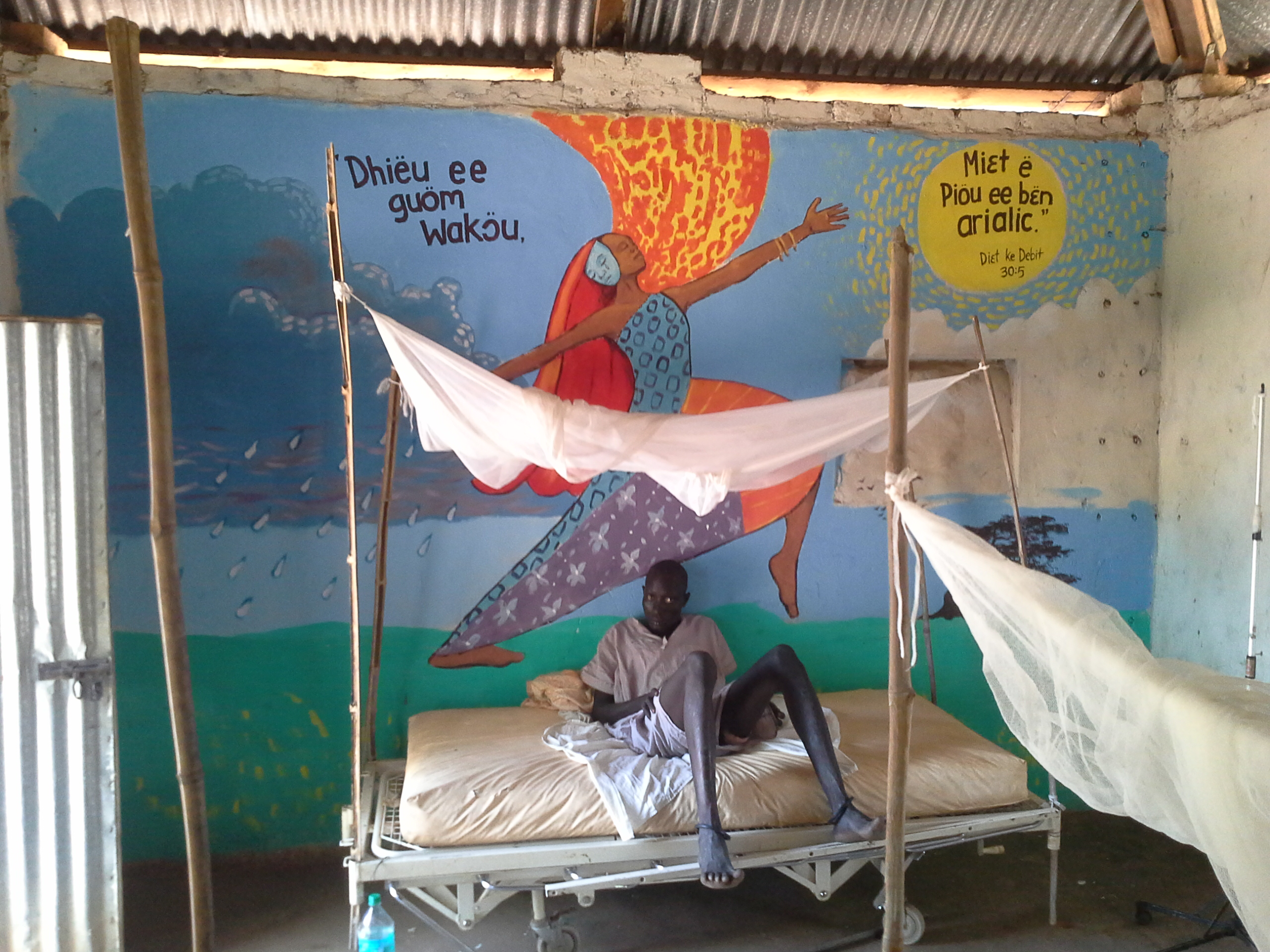
Looking around the room I saw men and women and children, all lying down in quiet misery. That’s not to say it was quiet, there were plenty of babies crying, but the tone of the room carried a sense of people subdued by suffering. Ayak is in that room. Her arm had been amputated because of cancer – but not before it had metastasized to her lungs. Her suffering is beyond my ability or emotional resource to describe right now. I lay in bed that night wondering what I could paint in that room, and wondering more what difference it could possibly make. Just as I was starting to drift off to sleep, Psalm 30:5 came to mind, ” weeping may endure for a night, but joy comes in the morning.”

The next two days I spent in the observation room, painting a mural meant to capture the essence of that verse. Wrestling with chalky, flat paints of suspicious durability, I painted away. In 80 plus degrees and surrounded by feted smells and moans, I painted what I believe is truth. While I worked I listened to Sam and Judah, local pastors as they shared the gospel with the patients. “Jesus will forgive you, but it is VITAL that you forgive the man who speared you.” It’s just not something you hear everyday.

When the mural was done I was deeply dissatisfied with the artwork. It didn’t look like what I had in my head…but my artwork rarely does. Still, it did what it was intended to do. Andrew is a worker for In Deed and Truth’s radio transponder…he was my helper and translator the day I finished the wall. He came in and looked at it and exclaimed “It’s wonderful!” The patients in the room asked what the painting meant, and he explained, “At night, when you are hurting and it is SO hard, you cry and feel all alone, but when the sun rises, you see people coming in to minister to you and show you the love of Christ, and you feel joy because you remember that God loves you.” And then he told me, “They will tell the next patients who come in what this means.”

And I guess that’s is how it works. The message of the Kingdom goes out, and God shares his love even through paint.

Are We a Line or a Circle?


“Let the children come to me. Don’t stop them! For the Kingdom of God belongs to those who are like these children” -Jesus (Luke 18:16 NLT)

Family gatherings often have their best moments of connection and reconnection at the dinner table. When there are too many people and not enough chairs the standard operating procedure seems to be to create a kid’s table. This way the adults can have their own conversations unhindered. Besides, the kids usually want to be on their own anyways! Inevitably, this leads to two different tables with two different experiences.

Sounds like the church, doesn’t it? We tend to have adult church and kid’s classes. The result tends to be kids that graduate from high school without knowing the church. Research continues to show that the more integrated a child is in the adult church, the better likelihood he or she has of maintaining that status once graduated. Essentially, research says that while it is still appropriate and necessary to have youth meetings, real and full community must cross age demographics.

Real, full community isn’t just acknowledging that children come to Eastgate, rather it means investing time and effort into their lives. It means inviting them into your circle rather than just sitting shoulder-to-shoulder in rows and lines on Sunday mornings. Real, full community isn’t passive, rather it is actively and intentionally seeking out ways to participate in the lives of each other-including children.

Youth are scary. It is totally okay to admit that. They dress funny, they walk funny, and they listen to funny music. They smell weird, they talk weird, and they act strangely. We can feel ill-prepared or ill-suited to be in their lives. But, as followers of Jesus, it is our responsibility to be in their lives. Their lives may even be dependent upon it.

Wednesday we will take a look at why we should do this and how we can do this. We will examine the difference between community in a line and community in a circle. Hopefully, we will be a church family willing to invite the kids over to our table and to our experiences. And hopefully we will be better equipped and more confident to respond to God’s call for us to neighbors and siblings to the demographic most often avoided.

Kids, parents, grandparents, childless friends, and all will hopefully leave with a more full view of community and a more pragmatic take on creatively living within the construct of this community.

Looking forward to conversing with you all about this!

Cole