The Best Life of All

According to an article on Insounder.org, love is the all-time most common theme of song lyrics, followed by life and death. Love is such an elusive concept for so many people, which is probably why it dominates our thoughts.

Of all the people in the world, I would think that followers of Jesus would have some pretty important insights into the nature and meaning of love. The Bible talks about love around 750 times, depending on the translation, about 300 of those mentions appear in the New Testament. That’s what I would consider to be an emphasis.

Strangely, that emphasis doesn’t seem to carry over into how the church has represented itself throughout history, and especially in our contemporary American culture. I often wonder about that. Why is it such a struggle to keep our eye on this massive target the Scriptures present?

This Sunday we will be reading one of Scriptures most famous, and certainly most beautiful poem about love. We’ll be reading 1 Cor 13, the famous love chapter.

This passage usually finds its way into wedding ceremonies, which is great…but not that’s really the context or point the author was trying to make. The context is one that spills over from ch11-12, how we attend to our services and abilities as the church. As you read v1-3, how much importance does Paul place on having love as a motive for what we do in service to Christ? Do you think Paul would agree that “the end justifies the means”?

V 4-7 Paul describes what love looks like in action. Where do feelings fit in with his descriptions? What sort of lesson can we take away from his picture of love?

Here’s something: we’ve said before that if we want to know what God is like, we look at Jesus. Try substituting the name Jesus for the word “love” in v4-7. Does it seem to fit? If so, what do we learn about God’s nature from this?

In v8-13 Paul points out the eternal nature of love. In the NLT v113  says that “three things will last forever” – I don’t think that’s a great translation. Most other translations word it: “three things abide” or “remain” – basically it means stay and wait with us. Faith, hope and love, but the greatest is love. When might faith or hope be completed? What would bring love to its conclusion? Does that give any insight as to why Paul said love is the greatest?

Of all the teachings in this series, I just think this one is the most vital for our day and age. I really hope you can join us this Sunday as we dig into Scripture together.

Staying Free

One major fear that gets posed whenever Christian freedom is discussed is the concern that it can lead to an antinomian lifestyle – a life with no constraint, living lawlessly. I’ve heard that fear expressed to me many times over the years. Martin Lloyd Jones, the old Welsh minister, famously said that if we aren’t accused of preaching lawlessness, we aren’t preaching grace the way Paul did. He’s right – Paul got accused of that a lot, and had to qualify his emphasis on grace many times in his letters.

This Sunday we’ll be reading Paul’s great rallying cry that boldly proclaims the main theme of his letter to the Galatians. We’ll be starting chapter 5, reading vs 1-12.

Paul states his main thesis in v1a – We are FREE! That’s a statement that carries a lot with it – first, it assumes that at one point, we were not free. Think back through the letter to the Galatians – what has Paul been emphasizing our freedom concerning? Read ch 1:4 to get one perspective of our rescue. Ch 3:10-13 gives another aspect of what we are freed from.

Freedom is sort of a loaded word. Loaded, I should say, with our pre-determined definitions of what it means. Our country, the United States has freedom as it’s centerpiece. How do we as Americans normally define freedom? How would you characterize freedom based on what Paul says we are free from? What differences, if any, can you identify? Which sort of freedom should take precedence in our lives as Christ Followers?

In v1b, Paul exhorts us in light of the thesis. What does he tell us we must do concerning our freedom?

In vs 2-12 of the chapter, Paul elaborates on how we can go about fulfilling that exhortation. As you read those verses, what jumps out to you as practical advice for living free in Christ? The last part of v6 is terribly important. It’s the way that antinomianism, lawlessness, is counteracted when it comes to our freedom.

What do you believe it means that our faith is expressed in love? Love for whom? What will that look like when lived out in real life situations?

I think this will be a really challenging study – I hope you can join us, either in person or online via Facebook or YouTube. We are no longer requiring pre-registrations – but we are asking that we continue wearing masks during the singing portion of our service.

The danger is still real, as we see in the recent development with our President. Please keep him in prayer for a full recovery.

A Visible Truth

A few years ago a neighbor came to my door to talk to me about how one of my sons had really hurt his son’s feelings. Now he was a big strong navy seal, not a doting mother, telling me how my son had hurt his son’s feelings so badly that he had come to him crying and beside himself about it. I knew it was serious. His son was a good friend of my kids, so much so that he was at our house on a daily basis. He was probably the most kind-hearted, compassionate child I have ever met and I loved him like my own. So to hear that my son had hurt him to the point of going to his father in tears broke my heart. Not so much because I expected perfection out of my son but because of my love for the other child.

It felt as if I had some part in causing his pain, because my son who is a part of me, a reflection of my heart had hurt him.

I got to thinking about that and was immediately convicted. How many times had I poorly reflected my heavenly father’s love for someone in my own less than compassionate interactions with people? God’s emphasis on us loving people suddenly become more clear. We are His children. We’re called to represent his values, his heart in our broken world When we hurt others it pains His heart as well.

In our study in 2 Chronicles this week we considered what people might think about God as a result of their interactions with us…It’s a great question to ponder, a good thing to remember as we walk out our lives professing Christianity..

We’ll be picking up in the epistle of 3rd John this week. It’s the second book in our 3 book series that discusses the importance of discerning truth. This week John will point out several characters who were actually really good at revealing the truth of God’s character. Their lives, in other words, reflected a visible truth.

How did Gaius reveal the truth of the Gospel in vs 5-6? In that ancient culture hospitality was considered almost a duty even on the secular side. Because of the lack of public accommodations, traveling ministers were dependent on the hospitality of others to house and feed them as they went around spreading the good news. Would you consider opening your home to help a traveling minister or someone in need? We certainly live in a different day and culture today. What might prevent you from doing so? How might we be able to be generous in this regard today?

Our next character isn’t so hospitable. He provides a sharp contrast with the goodness seen in Gaius. What does John suggest the church do in regards to his behavior in vs 11? It’s suggested that Gaius and Diotrephes were part of the same church there in Asia and that Gaius could have been a victim of one of Diotrephes’ excommunications. What does John do in vs 9-10 in light of Diotrephes’ obvious offenses? What doesn’t he suggest or do? In our prior epistle John had warned the church pretty seriously about allowing false teachers to share in their churches. Is it possible Diotrephes was just protecting them from that sort of thing? What do you think is the goal of John’s open rebuke? There was clearly some disunity developing there in the church. What do we learn from the way John handled this about maintaining unity in our own community? How can we rightly represent God’s character in community to a watching world ?

The third character introduced in our text is Demetrius. While the details we have of his life are brief they speak volumes. Who does he obtain a good report from in vs 12? Is there a person or persons or situation where other’s assessments of your character wouldn’t be so glowing? Why do you think it would be important that our character be consistent with everyone? Romans 5:8 says that while we were still sinners, Jesus died for us. In other words while we were still hating, resisting and cursing him he gave everything, his very life, to reveal Gods love to us. How hard is it to treat those who mistreat us with that kind of self giving love? What would it reveal if we were able to love in the face of hate?

It will be a challenging study for sure. Hope to see ya’ll there!!

A Love for Truth

 Last summer I was struggling with my weed-eater. I had come to the conclusion that the spool which held the string was old and faulty and needed to be replaced. I tore the whole assembly off the handle and ripped open the packaging on the replacement head and started trying to attach it to the trimmer. Sweat was pouring down my face and into my eyes as I tried and tried to align the new spool properly onto the shaft of the trimmer, but it just wouldn’t work. Then it dawned on me. I had the wrong replacement part. I had wasted hours and expended so much energy, only to realize I was trying to attach the wrong thing.
Ever been there? Hopefully not – I trust you’re smarter than I. There’s nothing worse than putting a lot of effort into something and realizing, too late, that it was all for naught.

That’s something John will be warning us about on a spiritual level as we finish out 2 John in our study called Truth or Consequences. We’ll be reading 2nd John 1:7-13.

John spent the first part of his letter encouraging us to live in love – then the last part of his letter seems to get a little harsh. How can we reconcile his defense of the gospel of Jesus and his challenge to be loving? Does loving others require us to abandon a claim to a singular truth? Why or why not?

What does John encourage us to “watch” in v8? What is his emphasis concerning how his warning is applied? How does that help us understand the balance of loving tolerance and holding the truth?

The deceptive doctrines he’s warning about are most likely ancient forms of “Christian Gnosticism” – it’s good to have a grasp of what his context was.

In the ancient world there were no motels or formal travel accommodations.  Traveling ministers could only spread their message by relying on the hospitality of local churches. They would be housed, fed and blessed – that is, encouraged. If those systems were removed, the teacher would not be able to continue spreading his views.  Given that context, how do we understand what John is telling us about letting false teachers into the home or blessing them?

This study will require some critical thinking on our part as we press some hard questions to the assumptions our present culture has made concerning love, tolerance and truth. Hope to see yez there!

The Truth in Love

truth-consequences-FB

We will be starting a new study this coming Sunday – a series exploring 2nd and 3rd John , as well as Jude. They are three of the shortest books in the New Testament and we’re lumping them into one study because they all three carry the same theme. Each of them is commending us to the truth, and warning us of the consequences of wandering away from the truth.

Pilate asked Jesus a question that still echoes in the air to this day; “What is truth?” Ours is a world that has learned to be wary of some who declare they have the “truth” because so often they are, in reality, making a power-play. “This is the world as I see it and want it to be, and I will force you into that mold whether you want it or not”. A lot of damage can and has been done in the name of truth.

There are so many different kinds of truth – subjective, propositional, experiential, objective….and with humans being so varied and complex, what qualifies as a universal, meta-truth for all of us?

More importantly, what were the New Testament writers referencing when they declared and rallied their readers around the truth? That’s something we will explore and consider. As you think about what the consistent message of the New Testament writers is, how would you summarize the truth they declared?

We’ll begin our study in 2 John 1:1-6.

Count up how many times the word “truth” appears in the first four verses. What does this frequency intimate about John’s emphasis?

What connection does John make between truth and love? In v3 John is greeting his readers, but he drops a ton of theology in that “hey ya’ll”. What does v 3 tell us that we receive from God by truth and love?

What is the importance of love in relation to truth? What is the importance of truth in relation to love? Do you believe it is possible to have one without the other? Why or why not?

Not to scare you – but come prepared to think this Sunday, we have some fascinating things to consider! Hope to see you then!


Love Actually

love actuallyWe are going to be starting a new series, but not until next week. This Sunday is Valentine’s Day and I thought I might extrapolate a few of the thoughts I presented last week concerning love as the Bible describes it compared to how our present culture seems to view it. What is love? Is it a good feeling? Is it some force of nature which we have no control over? Is love worth the risk we take to express it? How do we grapple with disappointments and disillusionment in love? How can we love those who don’t love us back?

I don’t know if we can answer all of those questions in full, but we certainly can begin to get our bearings about the nature of love and it’s source by going to the Scriptures.

This Sunday we’ll do a short foray into 1 Corinthians 13:4-8, reading Paul’s quintessential poem about the nature of love. Sadly, this section of Scripture often gets relegated to wedding services only, and we miss the depth of what’s revealed about the nature of agape love and how it must be foundation to any other expression of love. The words in this chapter certainly pertain to spousal relationships, but it also pertains to every other relationship we can know. 1 Corinthians 13 isn’t just for married people – it’s for human people, married, single or in-between and effects how we relate to anyone.

Our culture defines love primarily as romance. But romance is more about the dramatic words and experiences we have that heighten the emotional and physical draw between couples. We often think of love as only associated with good feelings. Yet, read Paul’s description of love. How many of his descriptors imply good feelings? How many imply negative feelings?

What does that tell us about the nature of love?

But if love is something that transcends our feelings, how do we muster the initiative to express it? What is the source of our love if it’s not the good feelings found in reciprocal love?

To answer that, we’ll need to look at what the “Apostle of Love” said (sounds like a funk band from the 70’s, doesn’t it?). John, in 1 John 4:7-11, clues us in on the source of love. If our love doesn’t find it’s source in the love returned to us from another human being…where does it come from and how is it sustained?

That’s some serious stuff to think about. We’re going to talk about love, brain secretions, and a bunch of other interesting things this Sunday as we consider what love is, actually.

Hope to see you then!

That Telltale Trait

Capture How can you tell if someone is a follower of Christ? Huge amounts of necklaces and trinkets adorned with crosses on them, as well as T-shirts with recognizable logos that have been retooled into a bible based theme (ouch) are sold each year- often with the motive of “letting the world know that I’m a Christian”.

But is that really how the world will know that we have submitted to the rule of God through Jesus Christ? Some believe that they have to be outspoken about their moral convictions and fight every impure aberration they encounter in order to demonstrate that they are, indeed, a Christian.

Some people are so zealous they could be described as being “in your face” about their faith – all in an attempt to be identified as belonging to Christ. Did Jesus give us any clues about how we could be recognized as his disciples, his followers?

The answer is yes. He told us very clearly, with words that are both ridiculously easy to understand and ridiculously hard to do.

We’re going to be reading John 13:18-38 this Sunday, finishing up the chapter. In this section we have three points – 1) a betrayal is forecast and the betrayer identified, 2) Jesus gives a new commandment, and 3) Jesus forecasts Peter’s denial. Jesus’ command is sandwiched between two revelations of faithlessness – which I believe is intentional to provide a contrast for his command.

When Jesus revealed that someone would betray him, what were the disciples uncertain about? Did they show any predisposition to assume Judas was the betrayer? It seems like Judas blended in with the gang quite well – so with that in mind, how much do you think  an outward show of solidarity has to do with rightly representing Jesus?

When Jesus told them all he was leaving to a place they couldn’t follow, Pete zealously announced that he would go anywhere – he would die for Jesus. Jesus had some disconcerting news for him about events that would happen later that night. How much did outspoken zeal have to do with rightly representing Jesus?

V34-35 – what did Jesus say the telltale trait of his followers would be? Is this romantic love, or sentimental love, or something else? How easy or hard is it for you to love people who are unlovely – who hurt you or offend you? How does loving people like Jesus loves you help you understand how to love? This will be a challenging but hope-filled study – hope you can make it!  ALSO – don’t forget to look at the songs for this Sunday!

The Finder of the Lost

Ever lose anything…like something pretty important?  What was it?  How did you feel, what did you do?  If you found it again, what emotions did you experience?

I lost my dog Shadow once…but I’ll tell that story on Sunday.

Jesus goes toe to toe with Pharisee lame-ness in our passage this Sunday, Luke 15:1-10.

The story opens with Pharisees grumbling because Jesus is hanging out with the wrong crowd, yet again. They specifically are upset because Jesus is eating with decidedly non-spiritually minded people.  What’s the big deal with that, do you suppose?

To answer, Jesus responds the best way he does, with four different parables (not three, as Eugene Peterson points out in his book “Tell it Slant”) about lost-ness. He talks about a lost sheep, lost coin and two lost sons.  We’ll only look at the first two this Sunday.

I love these stories.  What are your thoughts on what Jesus is conveying about the nature of the Kingdom of God advancing in this world?  What does this reveal about God’s heart toward humanity…and what does this reveal about humanity…about YOU?  Read v5 and close your eyes and imagine the scene…what does it evoke in you emotionally?

Man…I love this section.  Hope you can make it this Sunday.  Surf n Grill is this Sunday too!!! Come hang out at St. Andrew’s St Park and we’ll eat and enjoy the beach and baptize a few folks who are “found”…and let’s get stoked!  We still need people to hang late and help clean up…so pray about serving Christ this way!  See you then!

Won’t You Be My Neighbor?

What a great discussion we had here last week.  I really appreciate the time and consideration so many of you gave in posting your thoughts.   Having said that, I’m not trying to put anyone under pressure to make comments now…I’m just sayin’ it was cool last week.

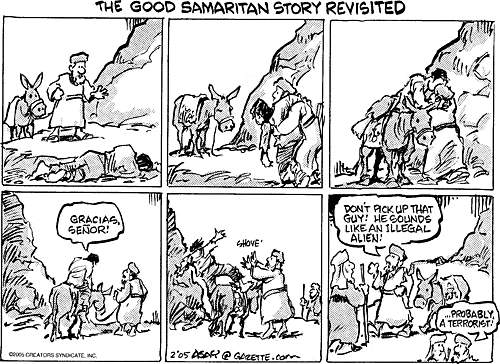
This Sunday we’ll be reading Luke 10:25-37, the story of the Good Samaritan.

Why do you think the Scribe (Lawyer) was testing Jesus on this point?  Think about where they are and what has happened in the first part of the chapter.  The Scribe is concerned with how one achieves eternal life.  That is, how does a person get in on the Kingdom of God when it gets revealed (keeping in mind what the 1st century Jewish view of the Kingdom of God).   He’s basically asking “what is the core of our faith, what is our highest priority?”.  It all boils down to two things…what two things are of highest importance?

Notice that Jesus never answers the Scribe’s questions directly, but answers with a question, or tells a story followed by a question.  Who then provides all the definitions in this story?

Samaritans were hated by the Jewish people.  They were the traditional bad guys.  If you were to put this story on a contemporary stage, who would the Samaritan be to you?  Why do you suppose Jesus turned the tables like this, what was his point?

Applying this parable to real life, how does it challenge you?

Looking forward to exploring this on Sunday!  See you then.