Can I Get a Witness?

This Sunday we’ll be returning to our study in 2 Peter – reading ch 1:16-21.

There are some events that I’ve witnessed in my life that are indelibly etched into my memory. I still remember with distinct clarity watching the TV in horror as the first WTC tower went down. If someone were to come along a few years from now and claim that it never happened…I’d just smile and say, “You’re wrong, I saw it happen”.

But someone could respond “You saw an image on TV, and those can be manipulated”. I’d have to concede that possibility, but then I’d point to all the people in New York that lived through that fateful day – the multitudes of eyewitnesses – their testimony would carry a lot of weight.

By the time Peter is writing this second letter, you get the idea that people are already starting to reevaluate the timetable of Jesus’ kingdom project. This was taking a lot longer than anyone expected it to. Peter is now faced with a fresh crop of teachers, people farther removed from the original events of Jesus’ ministry who are starting to twist and question the veracity of the gospel story.

Peter’s answer to them is “You’re wrong, I saw and heard it all, I was there”.

As we read what Peter says in this text, how would you apply this to your present life? Jesus’ ministry was 2K years ago – so what personal testimony could you give in support of your faith?

Peter talks about the prophetic word, which would probably be talking about the messages we now hold to as the Old and New Testament. If someone asked you if the Bible is true – how would you answer, and what support would you provide for your answer?

These are challenging thoughts – stuff we really NEED to take the time to wrestle with. Hope you can be with us on Sunday….and bring your wrestling shoes as we grapple with some heavyweight thoughts.

Important Reminders

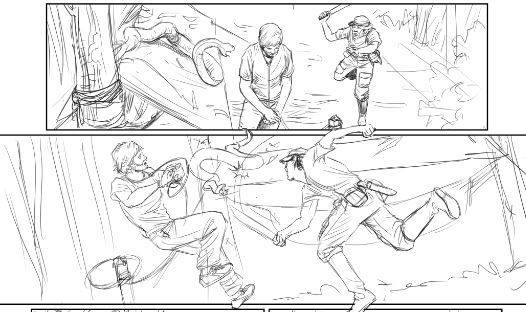
Hey everybody…I thought I’d put a few panels up from the graphic novella I’m working on for Voice of the Martyrs:

panels RTC-1. panels RTC-2.

I’ve penciled 22 of the 28 pages, but I still have to ink and color them…so I’m only a third of the way through.

Anyway…this Sunday we’ll be reading 2 Peter 1:12-15 as we continue our study of that book.

Having spent the first 11 verses sort of laying out the basics of the gospel, Peter then explains why he is repeating stuff that his readers are already familiar with. Why does he say he does this?

Have you ever known someone (or maybe you ARE someone) who repeats a story over and over again, even though everyone’s already heard it multiple times? My mom was famous for that – she would tell some stories from her childhood over and over, and each time she told it like it was breaking news. As a kid it used to irritate me…but now that she’s been gone for nearly 20 years, I’m really glad she repeated them.

There’s more to human communication than just the transferring of information. If we read a poem to gather information, we are missing the point of poetry. Yet poetry does communicate – but on an elemental level. Poetry and stories invite us in to an experience or a feeling – we participate when we listen to or read them. That’s why we go over them again and again, to relive that experience gained through that communication.

How does this apply to what Peter says about repeating the basic truths of the gospel to people already acquainted with those truths?  What benefit do you believe can be derived from the repetition of these basic truths – or do you think there are any?

Come hang out with us Sunday as we carry on Peter’s legacy by repeating some well-worn words of wisdom.

2 Peter – What’s Needed for the Good Life

2 peter webNow that we’ve finished 1 Peter, the only logical thing is to head straight into 2 Peter. They are two very different letters. As far back as the 2nd Century people questioned Peter’s authorship of this letter – and of course we can never prove anything beyond all doubt – but there are lots of pretty good arguments to consider it a genuine work of his.

The overall theme of this letter is an encouragement for followers of Christ to keep on growing and avoid the pitfalls of erroneous teaching that could derail their progress. The tone will be a bit more urgent than his previous letter (written, as best we can tell, about 4 years prior to this).

This Sunday we’ll be reading the first four verses.

Peter starts with the basic greeting, extending a hope that his readers will experience grace and peace from Christ. Those are the two New Testament ideals for the good life, a life as God intended it to be. Filled with favor from God and wholeness in our self-understanding.

As he goes on, he indicates in v4 that we are drawn into this good life through a knowledge of Christ. What ways do we grow in our knowledge of Christ?

Peter says we have these promises that we “partake of the divine nature”. That’s a staggering statement, to me. In union with creator God. What difference does this make, if any, on how you view your meaning and purpose in this world?

Take some time before Sunday to pray and ask God to lead you into a greater knowledge of Christ – and ask him to reveal what it is to partake of the divine nature.

See you Sunday!


Steady As We Go

We’re coming to our final study in 1 Peter – we’ll be reading 1 Pt 5:6-14.

I’ve really learned a lot from Peter’s letter. Navigating through times of suffering is such a timely theme – suffering seems to be a constant companion on this journey of life. It was 2,000 years ago, it is today. But if we can learn to gain a higher perspective on suffering, it can enable us to respond to it in healthy ways.

As Peter closes his letter, he offers a few strategies for handling trouble in this life. V 6-7 are pretty famous verses. Why do you suppose Peter encourages us to be humble before God as a response to anxious circumstances? What connection between our anxieties and humility do you see?

V8-9 are likewise popular verses. Normally the devil is described as a serpent or a dragon. Why do you think Peter uses the metaphor of a lion here, when talking to Christians who faced persecution under Nero’s reign? Are there any other significances you can imply from the lion imagery, in terms of how they hunt or who they target? How would you connect that metaphor to Peter’s warning for the community of church?

What is his final resolve in v10-11? How does he sum this up? How would you sum up what he sums up (say THAT 10 times real fast!)?

I hope this study is encouraging and challenging – see you Sunday!

Leaders in the Community

We’ve said on numerous occasions that church is a pretty dangerous place. The fact is, any time you get a bunch of humans together the potential for everything going stupid always looms large in the wings. When we join to a community of believers, we put so much on the line; like our hope and trust and security.

What I find interesting is that this danger is historically consistent. All the way back to the beginning of the church in the writings of the New Testament we have warnings, instructions and qualifiers meant to minimize the potential risk associated with joining the community of the church.

Our study in 1 Peter will look at those kinds of instructions this Sunday as we read chapter 5:1-5.

If you were to sum up what characteristic the leadership of the church should have, how  would you word it based on this passage? Of these characteristics listed, which do you find most crucial for the well being of the whole community?

What responsibilities does the larger community have when it comes to ensuring that it’s leaders are good leaders?

How can humble cooperation among all the members of the community and it’s leadership help to minimize the potential danger of associating with the church?

It should prove to be an interesting read. Hope to see you on Sunday!


Traveling Between Two Worlds

If you knew the end of the world was going to happen tomorrow…would you do anything differently?

In our study of 1Peter this Sunday we’ll be reading chapter 4:7-11. Pete will start his exhortation with a declaration of the end of the world, followed by a challenge to live accordingly.

What’s interesting to me is what he says we should be doing in light of the end. Not this, or this or even this.

What DOES Peter say we should be all about since this world is passing away?

Do you see a difference between the characteristics Peter mentions here and just normal living as a Christ Follower? What does this tell you?

What connection do you think loving others has with this world ending and a new one beginning?

What connection do you see between loving others and serving others?

Peter says to show hospitality, that is, be welcoming and kind toward others without grumbling or complaining. Have you ever done some act of kindness for someone who didn’t seem to appreciate it at all? How hard was it for you not to complain about it?  Does the motive of serving others for God’s glory help to guide you in your response to a poor reaction to your intended good? If so, how?

I’m stoked about this study…hope to see you Sunday!

Traveling Against the Flow

Have you ever had an experience that really shook you up and resulted in a change in your priorities? Maybe an illness or a car accident that you feared you may not survive? There’s something about facing our own mortality that causes us to re-evaluate our lives – “what have I been doing? Have I been wasting my time?”

When we come into contact with our Creator God through the gospel, we have a similar experience. We brush against something so much bigger than ourselves and begin to examine ourselves.

We’re continuing our study in 1 Peter this Sunday, reading 1 Peter 4:1-6.

In order to face suffering and difficulties in life, Peter says to ARM ourselves with thinking that is like Christ’s. What sort of thinking did Jesus have that enabled him to face suffering in his life? What would that look like in your experience?

In V3, Peter describes a lifestyle that those outside of relationship with Christ embrace. The description sounds a lot like Bacchanalia … or this. Peter’s point seems to be that a lifestyle that lacks self-control is less than what God has in mind for us and a waste of our time. We want to travel against the flow of what many consider normal life. Why is a lifestyle of self-gratification at odds with God’s plan? What if you never did the stuff he describes in this passage, even in your pre-Christ life – what are other ways a self-gratifying lifestyle manifests?

V6 is another puzzling text, but the most reasonable take on this is that Peter is talking about people who heard the gospel preached while they were alive and embraced it, but subsequently died (they were expecting Jesus to return before they would ever die). “Judged in the flesh the way people are” may mean that they were tried for their faith and executed…or it may mean that they died the way people do because of this fallen world. Either way…what is Peter’s point about those who give up the selfish pursuits of this broken world system and follow Christ? Was their choice worth it, and why?

See you all on Sunday!

The Implausible Triumph

Ok…so it’s going to be one of those weeks again. This Sunday we’ll be reading 1 Peter 3:18-22. It goes something like this:

Let me hear all the theories you’ve heard or you have concerning what this text is supposed to be saying. You’ll hear my take (or lack of one) on Sunday!

Have a good weekend…try to stay dry.

Traveling Gracefully through an Unfair World

Have you ever been misunderstood? Like, where you intended one thing but it was misinterpreted and represented as something else. How did you feel in that experience? Frustrated, angry? What did you want to do? Get even, fight for your reputation, argue to set the record straight?

All of those would be natural responses – but if you’re in a situation where the mechanisms of power are geared against you and your arguments are disregarded – then what?

That was the plight of the early church in Asia Minor to whom Peter was writing. This Sunday we’ll be reading 1 Peter 3:13-17 and Peter will be calling his fellow believers to action in the face of unfair treatment and misrepresentation. The call to action is very distinct, yet it carries a host of implications for us to this very day.

As you read the passage, v13 provides the 1st call to action. How would you define “being zealous for what is good“? How would that have any bearing on people misrepresenting you?

The second call to action is found in v15. What preparation do you think is necessary for making a defense for the hope we have? How does Peter say we should present that  defense?

The third call to action in v16 is more internalized. Do you think this is calling for sinless perfection? If not, how can we have a good conscience – what is the most obvious way to prevent the label of hypocrite from sticking?

This should be an interesting study this Sunday! See you there!

Living a Blessed Life

Phew…made it through last week with nary a death threat.

This Sunday will provide a change in subject matter in examining 1 Peter 3:8-12.

If we were to call this The Apostle Peter’s Guide to Living a Happy and Fulfilled Life…what would be the main thrust of his guide?

When we consider how he encourages us to live, we may feel hard pressed to see how being so others-centered could result in blessing. How do you think we are blessed by blessing others? Have you ever intentionally treated someone nicely who was treating you badly? What did you feel at the time…and what did you feel later on, and was there a difference?

It should prove to be an enlightening, albeit challenging study!