Against the Grain of Legalism

Hey…you know what?  15 years ago today, we had our very first Sunday meeting under the moniker of Eastgate Christian Fellowship.  A handful of broken misfits sitting around in a converted dress shop in the Promenade Mall, which has grown into a larger gathering of broken misfits sitting around in a converted gym.  I can remember the trepidation I felt that morning…concerned that I didn’t really know what I was doing.  After 15 years, I’m still waiting for that feeling to subside.  Nevertheless, HAPPY BIRTHDAY Eastgate…I think some good things have come of this experiment, in spite of us!

This Sunday we’ll be reading Luke 6:1-11.

In this passage, Jesus is confronted about the keeping of the Sabbath in two different stories.  V 5 and V9 seem to be the bottom line to each of the encounters.  What do you take from these vignettes?  What is Jesus trying to convey to the religious leaders about the law, Himself and what it means to please God?

When we  think about the Pharisees’ application of the law, what warning can we take to ourselves in our own application of the Gospel?

It should be an interesting study, hope you can make it!

One Touch Cleaning

Hey all…sorry this is late.  This Sunday we’ll be reading Luke 5:12-16, the story of how a man with leprosy got healed.  Jewish law forbade anyone to get too close to a person with leprosy, obviously to curb the spread of contamination.  A person would be considered ceremonially unclean if he were to actually touch a person who had leprosy.

What does Jesus do when a person with this disease approaches him?

What do we learn about ourselves from this…both how Jesus treats us, and how we should treat others?

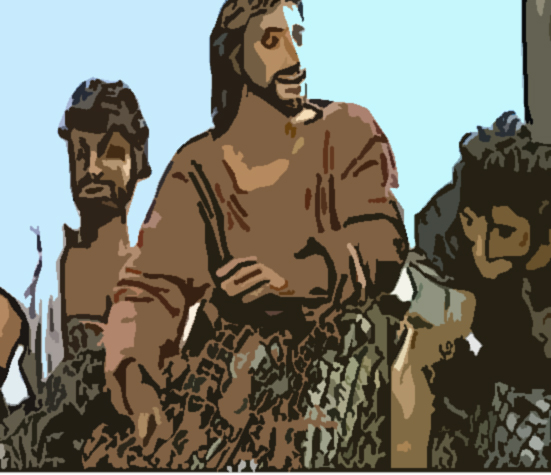
The graphic novel is coming along nicely.  I’m inking page 25 (out of 28) today while Robbie is flatting pages 23-24,—and should only miss the first deadline by a few days.  I’ve been given until the first part of April to get my part done.  Thanks for all the kind words and prayers for this project.  Below are a few examples of inked and colored pages.  Ben Avery is doing the lettering.

Fishing For Disciples

Normally “fishing stories” are associated with exaggerations and misrepresentations…but in our study in Luke 5:1-11, we will see another kind of fish story.

“Fishin’ With Jesus” could have been a cool show for early morning local TV.  Better yet, Discovery could have done a new reality series called “Heaviest Catch”… except it might have gotten a little monotonous after a while.  You’d do interviews and back-stories on the local fishermen shot on location at the local pub, get tours of their fishing vessels and quick instructions on how they go about deciding where and when to fish and what equipment they use.

Then the big moment when Jesus is introduced to them and he goes out on a fishing run with them.  Each show would have a predictable ending, where everything looks like they’re going to get skunked…and then the hand-held cameras start shaking around and you hear shouting and when the lense finally finds it’s stable focus…you see the fishing nets filled to beyond capacity and the boat is listing and Jesus is laughing telling the greenhorn that he has a sister who could pull the net faster than him. Cut to theme song and teaser for next week’s episode.

The thing is, in the story about Jesus and the big catch of fish, we find that miracle is actually only the platform being used to tell another story.  A story that teaches us something about what it means to follow Jesus.  The reason we know this is because in v10, Jesus merges the act of literal fishing with his call on Peter’s life to advance the message of the Kingdom of God, revealing to us that the whole story is a living metaphor.  As best we can make out, a metaphor about following Jesus…being a disciple.

As you read the story, break it up into four parts.  Read v1-3 and think about Simon’s (Peter’s) role.  What Did Jesus ask of him, what did he do…and how can you translate that to YOUR life?

Then read v4-7 and consider the same things concerning Peter and Jesus.  Again, read v8-10 considering the same questions.  Finally, read v11 and re-read it and then read it again, and ask yourself, what does this mean about ME?

I’d be interested in hearing your thoughts.  See yaz Sunday.

The Authority of Christ

This Sunday we’ll be looking at Luke 4:21-44.

Right on the heels of Jesus declaring that the prophecy of Isa 61:1-2a were fulfilled, he goes out and demonstrates just how it is He will be fulfilling His messianic calling.  While the people of Nazareth rejected Jesus, the people to the North-West in Capernaum have a very different reaction.  They are filled with wonder…because of Jesus’ “authority“.

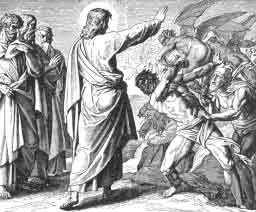
What things does Jesus demonstrate His authority over in this passage?  What can it tell us about our own life specifically?  How often do we ever think about the forces that operate behind what’s seen with the natural eye?  What do we learn from Jesus’ interaction with those forces?

For all of His authority, Jesus also demonstrates submission as well.  What does Jesus submit to, and what does He NOT submit to in the last few verses of this passage?

Good stuff to consider, we’ll unpack it more on Sunday!

Closed Hearts to a Wide Open God

This Sunday we”ll continue in Luke’s gospel, reading chapter 4:14-30.

Many scholars believe Luke’s gospel intentionally reverses Mark’s order of Jesus’ return home and his ministry in Capernaum in order to provide a sort of overview of what will characterize Jesus’ ministry all through the story.  It’s sort of a microcosm of the whole thing.

In the text we’ll read, Jesus is the Homeboy who returns to the neighborhood after generating quite a bit of interest in his ministry while in the larger town of Capernaum in Galilee. As he goes to church with his old friends and neighbors, he is offered the customary honor of being the reader of the Scriptures that day.  The Synagogue of that time was structured in a very similar way to our present day order of any given church service – with songs, prayers, the reading of the Torah and a short talk on how it should be applied to a person’s life.  If a rabbi or honored guest was in town, he was asked to read the Torah for the group, and share any insights he may have.

So, Jesus is handed a scroll (a seemingly random affair which held such huge significance), and he reads from Isaiah 61.  He hands back the scroll, sits in the chair of honor, and with everyone waiting in rapt silence, announces that the prophecy he just read is being fulfilled at that moment.

Cut to pandemonium: Everyone is marching Jesus out of the synagogue toward a cliff outside of town…brandishing pitchforks and baseball bats, crying out for Jesus’ death.

So what happened?  Why did the people of Jesus’ own home town react like this toward him?  As you read it, and consider the place, the people (including their racial heritage)  and the implications of Jesus’ words…what do you think made them so mad?  In wanting to follow Jesus, how would we avoid doing what the fine religious folks of Nazareth did?

Stuff to chew on….see you Sunday.

Temptation: Settling for Less

Hey, hey!  I’m finally back to somewhat normal patterns, which leads me back to Wonderwhat!   I’ll do my best to keep updating with thoughts about our upcoming studies, but I will warn you that for the next month or so, I’ve got a lot on my plate.  For the last year, Ken Raney of Clash Creative has been negotiating with Voice of the Martyrs to do a series of graphic novel adaptations of some of the stories of triumph that have come from Christians who have endured persecution in closed nations.  I was asked to participate in this project, and a few weeks ago, they finally gave the go-ahead.  Needless to say, I have a lot of work ahead of me in laying out, penciling, inking and hopefully coloring said project.  Ben Avery wrote a compelling script…which has had me in tears multiple times as I’ve tried to convey this story through pictures.  Pray for me if you think of it…I need to learn how to draw and fast….I want, with all my heart, to do this story justice.

This Sunday we’ll be looking at Luke 4:1-13.

It’s a fascinating passage about the temptation of Christ in the wilderness.  It provides us food for thought concerning our own struggles with temptation…but it also gives us an amazing insight into just what kind of Messiah Jesus intended to be (and IS).  Jesus had to break with many of the expectations concerning the messiah in His day, and we see that the break from accepted patterns wasn’t just a public thing…it was initiated in the most private of times, alone and unobserved.

Here’s something interesting: if you get the chance, read Deuteronomy 8 and then read Luke 4:1-13 right after it.  What connections do you see?  Do you think there was a point being made in the nature of the temptations recounted in Jesus’ story?  Beyond that, what do we learn about the nature of temptation in general?  If we describe it as settling for less…less than what?  What do we learn about how to resist temptation from Jesus’ story?

This should be an interesting study…hope to see you this Sunday!

Lost and Found

Sunday we’ll be looking at Luke 2:41-52.

This is the one and only account we have of Jesus as an adolescent child.  Many scholars dispute its legitimacy in the text…but frankly, if someone were going to make up a story about Jesus’ childhood and insert it, I would suspect they would make it more exciting than this.  I mean…Jesus gets lost at the mall?  Really?  That’s what someone invented to make the story more interesting?  I just doubt it.

I’m going to dig into three theological truths that we learn about Jesus from this story.  As you read it, what do you learn about Jesus from what he says and does?

I’m also going to draw three parallels from Joseph and Mary’s perspective concerning our own relationship to Jesus.  What parallels do you see to your own journey with Christ in this section?

That’s the stuff to think about until Sunday.  See yaz then!

A New Hope

Hope everyone is having a great Christmas so far!  I know we are…it’s awesome having the kids come home to visit.

We’ll be looking at Luke 2:21-40 this Sunday.

Joseph and Mary follow through with what the Law of Moses required of them concerning a first-born son.  How important do you think it was for them to obey those commands, given the nature of the Son they had?  Do we learn anything from their obedience?

We also get introduced to two other characters in this section…two people who had been waiting a long time for their hope to be realized.  There are lessons for us concerning hope in the lives of these two people…what do you see in their examples that can instruct you about having hope in the face of delay or sorrow or pain?

We’ll unpack it as best as we can this Sunday.  See you then!

God’s Presence; The Christ is Born

Have you ever had a frustrating Christmas?   Sometimes we struggle with feelings of disappointment when the holiday doesn’t provide for us what we thought, or hoped, it might.

There’s something about the birth of Christ that really can remind us about what it means that God is with us.  The presence of God in the world and in our lives is far greater than any other present we may get or give to others.

This Sunday, we’ll be looking at Luke 2:1-20, and we’ll consider what it can mean to us that God is present with us.  As you read the story, what are the challenges that are faced, and what can we learn about the nature of God’s invasion of this earth from them?

See you Sunday!

Benedictus; John Baptizer is Born

As we’ve been going through the gospel of Luke, we’ve found that God seems to go out of His way to turn expectations upside-down.  Our passage this Sunday is no exception, as we finish up chapter 1, verses 57-80.

The fantastic promise made by a cosmic sentinel has come true, Beth has given birth to a son.  As the relatives and friends gather to comply with the Law of Moses, part of the circumcision ceremony entailed the naming of the child.  Everything is going along just fine until this detail…then it all goes out of whack.  What details seem abnormal in this bit of the story?  Why would it matter what name the child had?  As you think about your own role in life, and your identity, what does this story tell you about tradition and custom?

God seems to delight in highlighting the losers.  In this gospel, the people of destiny are not the high profile people, they’re not the ones the world has esteemed as important…they are the outcasts and has-beens.  They are people willing to take the risk of looking ridiculous in the eyes of their neighbors, because they know that something big is in the works.

Zach breaks out in another song (clearly, Luke was wanting this to be the musical version of the gospels), which delights in God’s fulfillment of a promised Savior, and then of his own son’s role in setting the stage for Him.  Zach, again, seems to take the typical nationalistic view of the Messiah’s work, but as he speaks about his son, the premise seems to shift from those normal expectations…and its more about salvation, forgiveness, mercy, light and peace.  Enemies WILL be overthrown, but the last part of the song gives us a clue as to how.

The last verse of the chapter sums up John’s life in one sentence.  What is it about him that is NOT normal?  Obviously, John had a unique ministry, and we wouldn’t use him as a pattern for our own lives per se, but there are principles inherent to his life that we may want to consider as it touches our own journey with God.  What could we learn from John’s lifestyle, and apply to our own?

See you guys Sunday!