Hopeless Predictions

This Sunday we’ll be reading 1 Thes 5:1-11.  (In the Message)exploding-earth1

The church in Thessalonica obviously asked Paul (through Timothy) how much longer until Jesus returned.  Facing the difficulties they were enduring, it only seems natural that they wanted a timeline…a date on the calender that they could fix their hope on. 

The Thessalonians were part of a long line of Christians who became overly fascinated with setting a date for Christ’s return.  People have been setting dates for Christ’s return for about 2,000 years.  None of them have been right, by the way.  Why do you think there is such a desire to do this?  Why do we get so infatuated with knowing when the world will end?  What does Paul say about this kind of intrigue in v1-3?  How does that inspire hope in us?

Paul goes on in v4-7 to make a contrast between people of the day and people of the night.  What do you think his point is in this contrast?  To help interpret  this analogy, we need to consider the twin metaphors of sleep and drunkenness.  The opposite of that would be to live as someone who is awake and sober.  V8 basically explains what that looks like in real life.  What three elements of life does Paul prioritize in v8?  

To live in a way that is ready for Christ’s return…do we need to calculate the days of Daniel’s prophecy…or keep a close eye on the United Nations…or write letters to be sent to loved ones after we are raptured?  What does v8 tell us about a life that is anticipating the end of the age….what should we be doing?

Paul again encourages us to comfort each other with this stuff in v11…and I think v10 gives us a big clue about why this IS comforting.  Does it comfort you?

See you Sunday!

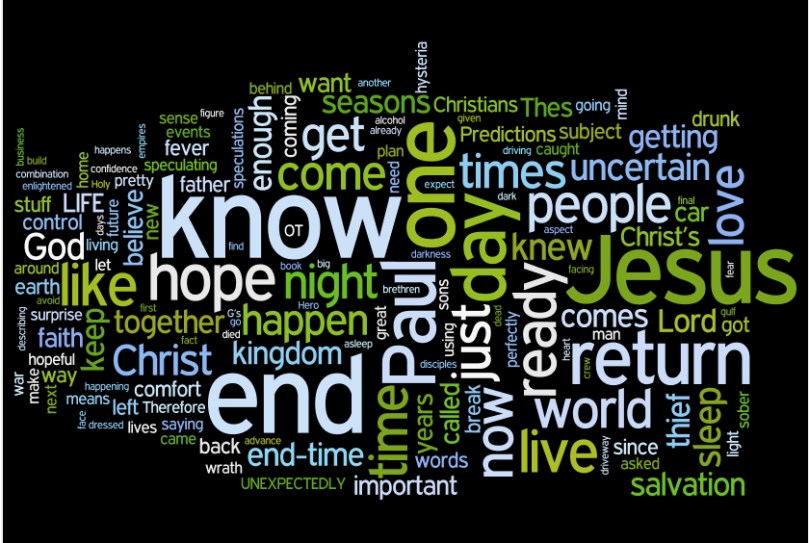
Also…I did a “Wordle” of my finished teaching notes…and this is what came out:

hopeless-predictions

The Ultimate Hope in Uncertain Times

Man…the post below is so encouraging…I love seeing our young people engaged in the exploration of who Christ is.

rapture1This Sunday, we’ll be looking at 1 Thes 4:13-18.  (The Message version)

As we remember, the church in Thessalonica had just been planted, when Paul and company had to leave town under threat of violence.  That meant that these new Christians didn’t have much time to learn a very detailed theology or set of doctrines which could define their faith.  On top of that, they were now facing pressure and persecution for believing in Jesus as the Christ.  When Paul sent Tim to find out how they were doing, we glean from the verses we’ll look at that they had some questions about what they should believe…and what they were waiting for.

The Christians of the early church were all expecting that Jesus was going to return any minute, they had no idea it would take as long as it has.  For them, the pressures they were facing made sense if Jesus were just about ready to burst on the scene.  But then, before Jesus had time to come back, some from their group died.  “Now what?” they may have asked?  Do they miss out?  Did Jesus fail in their case?  Did they mess up somehow?

Paul sets out to answer these questions they apparently posed, and gives them a crash course in eschatology.  In v13-14 Paul says that he doesn’t want them to be sad like people who have no hope.  That small statement is huge in it’s implication!  What is the greatest threat that mankind faces?  What is the strongest threat any tyrant can impose upon a people?  With that quick phrase, Paul tosses finality out the window, and effectively pulls the rug out from under death’s imposing presence.

What does Paul cite as the basis for this hope? (v14)

V15-17 are the foundational verses that support the doctrine of “the rapture” of the church.  How do you interpret what he’s writing there, in light of the context of comforting people who were concerned about their deceased loved ones?   What is the emphasis of v17, in your opinion?

Paul indicates how this doctrine should effect them, in v18.  What effect does the doctrine of the end of this world and Christ’s return have on you?

Stuff to ponder.  See yer’ Sundee.

The Future

Student ministry is a funny beast.  It’s a group of people that range in age from children to adults.  So, as you would expect there is a wide range of drama that goes with working within thit ministry.  It is inevitable that someone broke up with someone else or he has a crush on her, each weekend becomes an interesting roller coast of talks that really amount to mini counseling sessions.  Students love us, then they can’t stand us.  They run in the door to give us a hug and they roll their eyes when we correct them.  Needless to say student ministry can be a challenge, and I wouldn’t change it for the world!

You may not know this, but we have some of the most amazing students in Bay county attending Eastgate.  The range of awesomeness is staggering.  We have swimmers, track stars, wrestlers, brilliant chess players, surfers, readers, guitar players, mixed martial artists, and straight A students.  We have students who wholeheartedly love Jesus and we have students who are trying to figure this whole “faith thing” out.  We have all kinds, and that is an exciting thing for me.  The fact that youth are inviting friends, reaching out to bring truth to their buddies, is a brave and wonderful thing.

Last week we had a record 46 students at Crash.  I snapped the photo above during the worship set.  As you can see we had so many people in the youth room they had to sit on top of one another!

I write this not to brag on how cool our kids are or to tout the number of students who come but to ask you, the faithful of Eastgate, to pray.  In this day and age the Devil runs on full tilt, trying to grab a hold of the youth of this world.  He is cunning, and seemingly beautiful, but in reality he is a murderer of innocence and I don’t want him to get a hold of our kids.

So, if you have a prayer list I ask, no I beg, you to write down the youth of Eastgate.  Writed them down by name if you know any of them, and if you don’t by all means, get to know them because they truly are awesome.

Christians Ain’t Normal

goofy47We’re going to be looking at 1 Thes 4:1-12 this Sunday.  (The Message version)

When Tim came back with his report about the young church in Thessalonica, he obviously saw that they had some things “lacking in their faith”, as Paul stated last chapter.  That is, there were things they weren’t so clear on…things they hadn’t learned yet, or didn’t understand…and even things that needed to be changed in their lifestyles that would more properly reflect the faith that they had embraced.

So, Paul sets about to encourage them.  They were under a lot of pressure from the people of their society to revert back to their former lifestyles.  All Christians face that pressure, even if its just through the constant bombardment of popular media…we are all under pressure to be “normal“.

But Paul reminds the Thessalonians that Christians just ain’t that way…normal, that is.  That’s basically what he’s getting across in v1-3a (especially in 3a).  When you hear the word “sanctification”, what does it make you think of?  That word is intimidating…and I may be way oversimplifying the concept…but it carries the idea of being “set apart” from the normal practices and attitudes of the world, and set apart to God’s character and values.  In other words…we are no longer normal by the world’s standard.  (So…obviously, this means “normal” from the world’s perspective…not God’s)

Now v3-5 Paul talks about how a Christian’s attitude toward sexuality deviates from the normal pattern of the world.  How is it different?  How important does this seem, as you consider Paul’s wording?  Does this seem like a “petty” issue to you, based on these passages?

In v6-8, while the wording in English seems to indicate the same context as the previous verses…the original isn’t quite that clear…and I feel safer taking the straightforward meaning of “defraud” , which means to take advantage of or steal from…or cheat.  We can apply those concepts to sexuality, but not as directly as we could to our business dealings.  I could be wrong…but I think Paul has changed the subject, moving from our attitudes about sex to our attitudes about personal gain.  If that’s the context, how is a Christian’s attitude toward personal gain a deviation from the world’s norm?  Which number does the world tell us to look out for?  Again…does Paul seem to consider these insignificant matters that we can take or leave?

In v8-10 Paul comes back to the subject of brotherly love.  He indicates that they already walk differently from the world’s norms in this area, but he wants them to increase in the expression of it.  Why not just say “good job” and leave it there?

V11-12 provides the last example of how a Christian should live, and it provides another incentive besides just being pleasing to God (which is our primary motive)…what is it?  What does living this way do?

Stuff to ponder….see yer’ Sundee.

Truths About Troubles

Just a quick reminder, we’re having a meeting after 2nd service ( 1-18-08 ) for anyone interested in getting an update on Eastgate finances, hearing our present state and future plans, and meeting the supervisors of the various ministries we have currently in place.  Hope you can make it.

42-21352842This Sunday we’ll be reading all of 1 Thessalonians 3.  Also read it in The Message version.

In this section, Paul is recounting why he sent Timothy to them, what he heard from Timothy that encouraged him, and what his prayers are for them.  In this section, we get an insight into what Paul was concerned about for them as they went through the hardships of persecution for their faith….and I believe his concerns reveal some truths we need to keep in mind concerning the troubles WE face, as 21st Century, American Christians.

In v1-3, Paul is relieved that they weren’t thrown by the fact that they faced troubles.  He reminds them about the reality of hard times…what does he say about them?  How do we apply that to our OWN lives, as we face hardships?

In v4, Paul is relieved that their troubles didn’t result in something undesirable.  What is it?  What does that encourage us to be on guard about when we face difficult circumstances?

In v5-9 Paul goes over the good report that Tim gave him…and in v11-13, he tells the Thessalonians what he’s praying for concerning them.  What is the heart of his prayer, in v12?  What do we take then, as the priority of our journey, even in hard times?

Stuff to think on.  See you Sunday!

The Dynamics of Our Faith

This Sunday we’ll be looking at 1 Thess 2:13-20 as we finish up the chapter. (The Message Version)

Paul will move from talking about how he shared the gospel, to how they received it.  As we examine their response, in light of our own purpose of finding hope in uncertain times, we recognize a few elements that added depth to the faith of the Thessalonian Christians.

In V13, what is Paul stoked about concerning them?  What did he mean, in his writing, by the “Word of God”?  What do we apply to our own lives of faith from this verse?

V14-16 describes some of the things that resulted in believing Paul’s message.  It wasn’t rest on soft pillows…what was it?  Sometimes we can think we did something wrong when we face hard times…but v14 puts a different light on hard times and the struggles we face for our faith.  What comfort can we draw from v14? (read it in the Message)

v17-20 tells of Paul’s great love for the Thessalonians, and his frustration at not being able to return to them.   V18 is a standout in that section.  In one verse, with a few words, Paul indicates the scope of all the events that have unfolded.  This is much bigger than magistrates and Synagogue leaders.  Who opposes Paul?  Who is the enemy?  Does he win?

Stuff to gnaw on.

Peace.

Cody in New York

Hey all…a few weeks ago I asked us to pray for Cody Hudgens, who was heading off to New York city to do missions work with Graffiti church.  Well…she’s there now, and has a blog that she updates fairly regularly.  Check it out HERE.  She’s a good writer, and I think it would really be helpful to her if we could keep up with her exploits, and leave some encouraging comments for her on her blog. Thanks!

Finding Hope in Uncertain Times

wondersplashLast week we started a new study in 1&2 Thessalonians, under the header “Finding Hope in Uncertain Times”.  It should be a timely series.  We covered all of chapter one last Sunday, and what with the all the holiday happs, I didn’t get around to updating this blog.  We should be back on track now though.

This Sunday we’ll be covering 1 Thes 2:1-12 (and in the Message version).

I was talking to an insurance agent who is a believer, who was telling me how the company he represents is by and large trying to pull out of Florida.  This has had the effect of almost wiping his business out.  Yet, the first thing he said was “This is the time when our testimony will shine, because we have a hope that’s not of this world.”  One of the natural by-products of our hope during times of trouble is that we find opportunities to share that hope with other people.  Really…that’s probably the primary focus we as the church should have…to share our hope in Christ with those who have no hope.

As we look at how Paul describes his presentation of the Message of Christ to the Thessalonian people, we can find some insights into how we can be effective in presenting the hope we have with the world around us.

In v 1-2, Paul explains how he had faced a lot of hostility in Phillipi, just before he came to Thessalonica.  He doesn’t go into detail…but he was publicly humiliated in Phillipi…yet he says he still had boldness to speak in their city.  What was the source of his boldness?  Was his confidence in his speaking ability, or his knowledge of theology, or his marketing strategy?  What was Paul confident in ?  What do we learn about being effective in sharing our hope during OUR times of trouble?

In v3-6, Paul describes what he DIDN’T do when sharing his faith.  What does all of that add up to?  How would you summarize his approach?  How does that make our sharing of the hope we have effective in OUR world when times are hard?

In v7-12, Paul really opens up his heart and describes how much the Thessalonians mean to him.  v7 and v9 and 11 provide the adjectives which reveals how he treated them.  What do those adjectives reveal to you?  How would you apply those to your attempts at sharing the hope you have in Christ with the world where you’ve been placed?

Definitely stuff to think about.  See you Sundee’!

Learning to “Talk the Walk”

communicationn-copyYou may think I have the title backward.  “Isn’t it usually ‘walk the talk’, Rob?”  Yes..usually…the idea being that we don’t want to just talk about our beliefs without putting them into practice.  But as we finish our study in Colossians this Sunday, we’ll find that Paul puts an emphasis on talking. 

We’ll be reading all of chapter four, but our focus will largely be on verses 2-6. (The Message version)

We could break v2-6 neatly into two sections: v2-4 and v5-6.  The first kind of talking Paul mentions is talking to God.  Prayer.  It’s often an uncomfortable subject because so many feel inadequate when it comes to prayer…or struggle with a sense of condemnation because they automatically think they don’t “do it enough”.  That’s a brilliant strategy by our enemy, because the results of that is usually the avoidance of prayer on our part, until a crisis happens.

What have your experiences in prayer been?  Have you learned to find a comfortable means of communicating with God?  Everyone’s experience will be different, I’d love to hear yours.

Paul says to “continue” in prayer…that word means to be devoted to, or constantly attentive to something.  Like…when you’re watching a football game, but you have to fix a snack, you work on the sammich, but also listen to and snag glimpses of the game as you pile on the lunch-meat.  Or…maybe a nobler example would be more suitable: if you’re a parent, and your child is sick in another room, you may go about your work and deal with other issues…but there is part of you that is constantly on vigil, attentive to your child’s sounds and possible needs.  Right?

THAT is how Paul said our conversations with God should be.  What does that tell us?

Part of what Paul asks them to pray for is wisdom for him, to know how to talk to people about the gospel (v4).  Does that strike you as interesting, and even a little surprising?  Paul needs to know how to talk about Jesus?  Maybe, or more appropriately, he needs to know how the gospel should be presented?

Which leads us to v5-6, which deal with how WE present ourselves, and communicate with people.  Does anyone else have trouble reconciling a “bullhorn” evangelist with v6?  Maybe it’s just me, but somehow, the two seem incongruent.

As you read Paul’s final, personal greetings, is there anything that catches your attention that you’d like to hear expounded on?  I’m planning on skimming it…but if there’s something of interest in there to someone besides a historian who is intrigued with fitting the puzzle pieces together, I’d be glad to touch on it.

Anyway…hope you’ve enjoyed Colossians.  See yer’ Sunday!