The Planted Seed

Have you ever done any gardening? From the time I was a kid, I was always intrigued by gardens, planting seeds that would take shape over time, becoming something so delightfully different in form from what was planted.

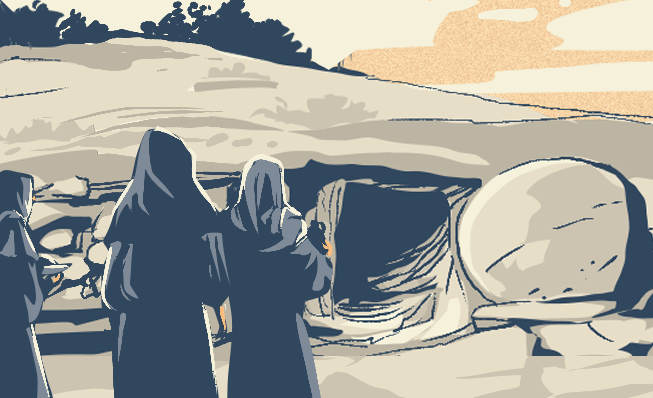
This Sunday as we continue our study in Luke, we’ll be reading about a different kind of planting – the burial of Jesus. We’ll be reading Luke 23:50-56.

In John’s gospel, Jesus made the statement “I tell you the truth, unless a kernel of wheat is planted in the soil and dies, it remains alone. But its death will produce many new kernels—a plentiful harvest of new lives.”

Just like when I was a child, I look at the shape of the seed and wonder what shape the harvest will take. That’s something I believe is forecast in the account of Jesus’ burial. It’s way more than just a connecting passage between Jesus’ death and what’s about to happen (I hate spoiling it for you, but Jesus’ death doesn’t take).

We get introduced to a character named Joseph of Arimathea. He was a member of the Sanhedrin who didn’t go along with their plan to have Jesus executed, which makes him at very least sympathetic with Jesus’ ministry. He asks Pilate for the body to be buried. How might this have been a risky move for him, given what just happened between Pilate and the Sanhedrin during the trial? What does this social, political and even religious risk he takes tell us about the nature of this new life we receive from Christ?

In v 55, who are the followers of Jesus that the narrative focuses on? Do you find it interesting that none of the big names of the disciples are present? In fact, we don’t even find out the names of the women disciples in Luke’s telling of this. A radical upheaval in the order of this broken world’s systems comes into focus here – what do you think it might be?

I think this will be an interesting and encouraging passage to examine together – I hope you can join us this Sunday!

The Unthinkable Throne

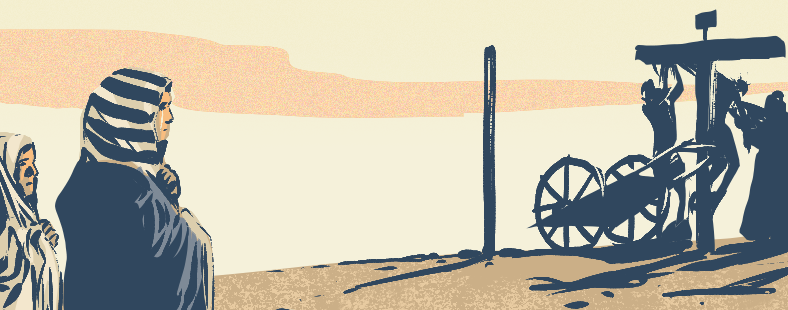
This Sunday we’ll be reading about the crucifixion of Jesus in our study of Luke. We’ll be covering ch 23:32-49.

What emotions do you feel as you read over this passage? The Gospel accounts are meant to instruct us, but they are also intended to engage us on every level. Some truth has to be felt before we could ever come close to contemplating or embracing it. This section is one of those, I think.

As we meditate on the events, there are things that stand out which help to expand our understanding of what Jesus was accomplishing on our behalf.

I v34, Jesus gives his famous response to the mistreatment he suffered. What do we glean about the intended purpose of this sacrifice from those words?

The sign they affix to the cross declares Jesus to be King. It was meant as a mockery, but the rest of the New Testament expounds on the deeper meaning of this, indicating that this was, indeed, Jesus’ moment of triumph (Col 2:15). Jesus is truly King. But what do we make of a King enthroned on a brutal cross? What sort of kingdom is this?

Jesus then extends mercy and the promise of entrance into God’s realm to the criminal being crucified with him in v42-43. What did the criminal do to merit this welcome? How can his example help us to understand the nature of our own relationship with Jesus?

Why do you suppose the sun went dark? Read Genesis 1:1-3. Do you see any correlation between these two events?

The temple in Jerusalem had a heavy curtain which hung as a divider between the main temple and the Holy of Holies – the place of God’s presence. That curtain was torn in two at Jesus’ death, according to v45. What message does the removal of that barrier send to us?

It is a heavy passage to deal with but filled with so much hope as we meditate on it. I look forward to exploring this passage together. Hope you can join us this Sunday!

The Way of the Cross

This Sunday is our annual Water Day (formerly called The Great Big Water Balloon Fight of 2022) – so wear beachy kinds of clothing that you don’t mind getting wet and a towel! We’ll be serving hamburgers and hot-dogs (courtesy of Pineapple Willy’s).

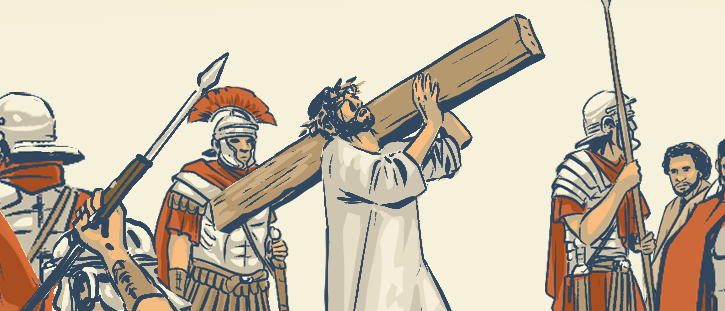
The text we’ll be studying together is Luke 23:26-31 as we continue our reading of Luke’s Gospel. We’re in the final stages of the narrative, and Jesus is now headed to the cross. As he is enroute to his place of execution, we are introduced to a new character who, again, isn’t there to advance the story as much as give insight to its meaning.

Simon of Cyrene (modern day Libya) appears in all three synoptic gospels who, like Barabbas, is named; so its intended that we pay attention to him. He is compelled by the Romans to carry Jesus’ cross since Jesus isn’t able to do so. So he takes Jesus’ cross and follows behind him. What picture does that create for you? Who might he represent? Read Luke 9:23 – does it connect with this scene in your thinking?

Jesus then stops to preach what is considered his final sermon to Israel when he speaks to the grief-stricken women on the road. Most scholars believe this is Jesus making a final forecast of the events that unfolded in 70 AD when Rome destroyed Jerusalem. We’ll do our best to unpack that on Sunday.

What stands out to me is that Jesus lets these women know they didn’t need to weep for him. Considering he’s been beaten and bloodied and on his way to be executed, how does that make sense? Why do you think it wasn’t necessary to weep for Jesus? What sort of resolution is before him?

Given Jesus’ outcome – what might that tell us about following Jesus’ way of the cross? How might it encourage us when His path becomes difficult to follow?

I hope you can join us as we explore this text on Sunday!  

The Substitute

Product sample lady at the store: “Try these kale chips! They’re the perfect substitute for potato chips!”

Me: “You’ve never eaten potato chips have you?”

I’m not always a big fan of substitutes – when I was a kid my mom was fully immersed in the fledgling hippie organic health food world. For a while I wasn’t allowed to eat commercial candies, but my mom gave me carob bars from the health food store which she described as a substitute for the poisonous candy I wanted. It tasted exactly nothing like chocolate.

Trying to substitute something good for something bad doesn’t always work – but there is one substitute for which I will be eternally grateful. In this case, the good was substituted for the bad on a cosmic scale, and because of it, we can breathe deeply the air of freedom.

We’re going to be considering The Substitute in our study of Luke this Sunday – reading chapter 23:13-25. The trial of Jesus continues as he is bounced back and forth between Pilate and Herod then back to Pilate for a verdict. Pilate wants to release Jesus after whipping him.

We know Pilate from history as a corrupt, ambitious and cruel leader who was in continual conflict with the Sanhedrin, the Jewish leaders. Factoring in his character and animosity for the Sanhedrin, why might he have wanted to set Jesus free?

Luke gives us no explanation for Barabbas’ appearance – we have to read Matthew 27:15-17 to get that information.

Barabbas appears in all four gospels at this point of the narrative. That means he’s important to the story – at least as a way of telling us about the story. What picture does Barabbas’ release and Jesus’ condemnation present to us? How does it reveal the nature of the gospel initiative?

Put yourself in the sandals of Barabbas. You’ve been brought from your cell into the sunlight and told someone named Jesus of Nazareth will be dying instead of you, and you will now go free. What do you feel? What goes through your mind; what questions would you ask?

The word “release” is repeated five times in this section of Luke. What does that emphasis imply to you? What does it speak about the nature of our lives after being reconciled to God through Jesus?

This is a dramatic section of the story – I’m really looking forward to digging into this text together! I hope you can join us!

Silence of the Lamb

Have you ever noticed how “noisy” it is?  Not honking cars or screaming ambulances, but opinion served up as fact.  Fact that is rarely precise and often delivered with a self serving side of deceit.  Amplified by 24 hour news broadcasts, and social media platforms, the resulting volume is deafening.  The effect often times drives one to outrage.  We are left feeling hopeless, angry and thinking the world is falling apart.  Nothing seems to be going right.

Well, take heart, there is hope for us!

This week we continue our study in the Gospel of Luke beginning the next chapter reading Luke 23: 1-12.  In this section we continue to read about the trial of Jesus but this time Jesus will be brought in front of Pontius Pilate and Herod Antipas.  The Sanhedrin and the Jewish religious leaders are seeking to have Jesus put to death but need Roman approval so they bring Jesus before the Roman court hoping for a guilty verdict.

As we read through the trial in front of Pilate, think about how each participant is this event felt. What was the driving force behind the Council?  From who’s eyes did they define justice?  Who was being protected by their stewardship of the Jewish law?  How involved does Pilate want to be?  Is this really a Roman issue or is Pilate being manipulated?  Notice the crowd.  How important a role do they play?  What can we learn form Jesus’ actions or inaction?  There is a lot going on here!  As we saw last week, there is a great deal of hypocrisy and self serving ego being exhibited.

As the story progresses, pay special attention to the “contrasts” described.  Why would Herod look forward to seeing Jesus when Antipas wished to see him go?  Notice the crowd’s reactions when contrasted to Jesus.  The crowd is in an uproar and Jesus is silent.  He refuses to defend Himself at all.  Why is that?  

This is a convicting and wonderful section. It challenges us and it sets us free.  There is some real power in the silence of the Lamb and I’m looking forward to sharing it Sunday.  Hope you can join us

Trying Times and Closed Minds

This Sunday as we continue through the book of Luke we’ll be reading ch 22:54-71. Things have taken a dangerous turn in the narrative. Jesus is arrested, beaten, mocked and subjected to an unjust trial. Yet before we get to that, we read an account of Peter who followed Jesus at a distance after his arrest, and who finds himself fulfilling to the word what Jesus predicted he would do that night.

Put yourself in Peter’s sandals. Have you ever been in a situation where hostile people have suddenly turned their attention to you? What did you feel and what did you do in that environment? Peter distances himself from Jesus as a measure of self-protection – have you ever been tempted to do the same? Have you ever thought it might be easier to figure life out on your own with the intention of returning to Christ later? What does Peter’s experience and his response in v62 teach us when it comes to our closeness to Jesus?

Now put yourself in the sandals of the temple guards who were beating and mocking Jesus. Why do you think they felt the need or even the right to do that? Do you see a contrast between the guards and Jesus – and what might that contrast communicate to us about how God’s kingdom operates in this world?

The trial before the Sanhedrin was a master-class in hypocrisy. Many Biblical scholars have pointed out all the ways in which Jewish laws were broken in conducting the trial the way it was. What does it tell us about the religious leaders that they were willing to violate their own laws to accomplish their goal? Jesus makes some strong declarations which we’ll explore on Sunday – but his bold assertion was based on something other than the Sanhedrin’s assessment of him. What perspective did he identify himself from? How might his example lead us to a more stable response when others are hostile towards us?

It will be an intriguing study, I hope you can join us!

The Crisis of Evil

I believe that human beings have an innate sense of justice. Nothing can feel more frustrating than when it seems like wrong behavior prevails over what is right. What do we do in those instances, when our sense of integrity is violated and we feel powerless to stop it?

That’s something we’ll be considering in our study of Luke this Sunday, as we continue reading chapter 22, verses 47-53. Jesus has just finished praying in the Garden of Gethsemane and suddenly an armed crowd, led by Judas, shows up.

Judas was one of Jesus’ disciples – we will always puzzle over what changed in his attitude towards Jesus. What should a greeting with a kiss convey? What do you think Jesus’ question means in v48, “…would you betray me with a kiss”? Why would that betrayal be more significant?

The disciples suggest an armed resistance, even going so far as to strike the first blow. What does Jesus say to this, and what does he do for his captor? How should this guide our response in times when it looks like evil has the upper hand?

Jesus turns his attention to the leading priests who were there to supervise his arrest and calls out their hypocrisy. How is their hypocrisy exposed by what he says?

V 53 provides the theme of the passage – what do you think it means that it was the moment that the power of darkness reigns? How do you understand a moment, and what does that tell us about the staying power of evil? How can that help us navigate those times when evil seems to prevail?

I’m looking forward to reading this together on Sunday – I hope you can join us! We’ll also hear a missions update from In Deed and Truth and the team going over this month. They’ll be doing a fund raiser to finish covering costs – so come ready to buy a bag of kettle corn!

Prayer Under Pressure

This Sunday we’ll be continuing our study in the Gospel of Luke, reading ch 22:39-46. This is the famous account of Jesus’ prayer in the Garden of Gethsemane.

The passage is bracketed by a repeated command/warning to His disciples. what do you think Jesus means about falling into temptation? How do you think prayer can head that off in our experiences? Does the fact that Jesus repeats this warning mean anything to you, and if so, what would it be?

When Jesus prays, what does he ask for? How does he qualify his request? What can we learn from his qualified petition about how we should pray?

Compare what Jesus asked for with the answer he did receive. How can that observation guide our expectations about prayer?

I’m looking forward to digging into this subject together, I hope you can join us!

Our Relationship with Jesus

We were driving along and I half heard her say “Let’s get pizza tonight!”

“That sounds so good! From where?” I replied enthusiastically.

“What? From where we’re going now.” she said slightly annoyed.

“What do you mean? We’re going there now or from where we’re going we’ll go there?” I questioned.

“What are you talking about?”

“You said: ‘let’s get pizza tonight’ and I’m agreeing, but from where will we get it?”

“I said at the next street turn right…and you just missed the turn!”

Sometimes communication is hard. It’s easy to completely misunderstand each other when conversing, especially when you’re convinced you know what the other person is getting at.

I wonder if Jesus got exasperated in the text, we’ll be reading this Sunday in our study of Luke. We’ll be reading ch 22:21-38. Jesus will be giving final instructions to his disciples before his arrest, but they certainly seem to misunderstand him.

First he warns that someone in their group has betrayed him, and their response to this is to start arguing about who should be called the captain of the disciple team. What does that tell us about where their focus is? Have you ever considered how much the idea of reward factors into your trust in Jesus? In response to this, Jesus gives a clear picture of what greatness truly looks like. What do we learn about Christian priorities and leadership from his words?

The final section is a bit perplexing – but keep in mind the idea of misunderstanding. Jesus appears to be speaking figuratively and the disciples seem to interpret it literally. Imagine that v38 isn’t an affirmation of amounts, but a blunt termination of a conversation that is clearly going off the rails. We’ll try to dig in to that a bit on Sunday.

Hope you can join us as we think about what our relationship with Jesus will mean in real life.

The Way of the Bread and Cup

This Sunday we are going to continue in the Gospel of Luke and pick up where we left off in Chapter 22. The verses we’ll cover (vs 7-22) begin the story of the (famous) last supper. In this section, we find Jesus proclaiming that this (the bread) is his body broken for them, and this (the wine) is his blood, poured out for them. He tells the disciples who are sitting with him to do this in remembrance of him.

Sometimes it can be challenging to put ourselves in the place of the disciples, especially when it’s a story we have heard so many times. At first glance of reading these verses, we can easily say, “Yep, I know the story, this is where communion started,” and find nothing else of value.

The challenge for us is to look at these verses and find ways to apply it to our daily lives. How our we challenged with a verse and story we have heard so many times? Is it possible for God to reveal himself yet again, or even in a new way, through a familiar story?

I wonder if the disciples, who were sitting down to celebrate Passover with Jesus, thought something similar. This was an event that the Israelite people celebrated every single year. Were any of them restless and eager for this to be over so they could go back to the real work that they were doing? Or were they aware of how world-changing this holiday meal would be?

Join us this week as we look for God in the expected and unexpected places and examine once again, the (famous) last supper.