Come to the Table – Mark 14:12-26

Wow, we had a great discussion going last week!  Thank you to all who participated.  I might need to mention that I may be lifting some of this conversation and using it in our teaching time, I hope that’s OK.  I think this is a great way to expand the exploration and make it interactive to some degree.  This is putting the technology we have to good use, IMO.

OK…so our passage this week will be Mark 14:12-26.

As we read this passage, we can see the unifying theme to these verses.  What is it?  What is happening all through this section?

If you were to take this section, and break it into chunks, you would have v12-16, v17-21 and v 22-26.  It’s interesting that each of these vignettes tell a different sub-story, yet all together, they describe the whole event.

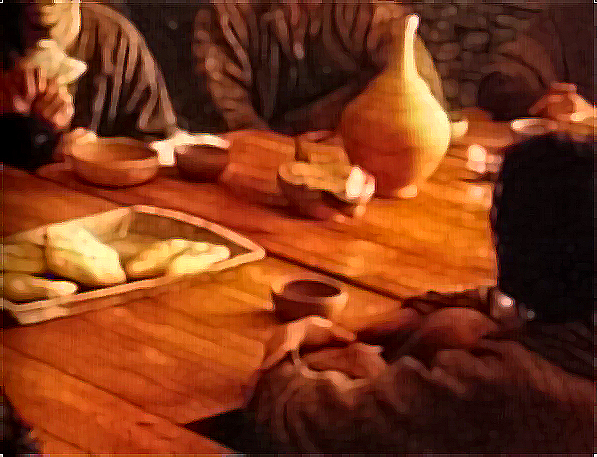
In v12-16, Jesus sends His disciples to get a room prepared for them all to celebrate the Passover.  Mark spends a lot of time on this detail.  One thing that interests me is that they waited so long to get this room.  Jerusalem is swollen with pilgrims from all over the country…it’s like spring break on the beach.  I wonder how easy it is to come down to the beach the night before spring break starts and just get a room?  As we read this…what is this sub-story telling us?  How do we apply what we learn from this story to our own lives?

In v17-21 Jesus breaks the news that not all of the disciples are who they seem to be.  There is a traitor in their midst.  It’s a dire warning, and certainly not what the disciples were expecting for diner conversation.  What is their reaction to this news?  How do they feel, what do they say?  How do we apply this to our own lives?

Finally, in v 22-26 Jesus takes the Passover meal in a whole new direction.  Jesus took portions of the meal and applied them symbolically to Himself, and the events that were about to unfold.  In v24-25, there is a word that gets repeated.  What word is it?  What does it tell us about the effect of Jesus’ death on us?  What is the lesson we learn from the Lord’s Table?

Stuff to think about.  Have a great week, see yer’ Sundee!
 

She Has Done a Good Work for Me – Mark 14:1-11

 Our study this Sunday will start chapter 14 in Mark.  We’ll be reading the first 11 verses.  We are now just a few days out from Jesus’ arrest and crucifixion.  The religious leadership want Jesus out of the way, but in their reasoning, they’ll have to wait until Passover is finished, because they don’t want to cause an uproar.  Interesting that despite their planning…Jesus is still crucified over the Passover weekend.  What does that tell us about who’s really in charge here?

The text tells us that Jesus is staying at the house of a guy named Simon the Leper.  Talk about sorry nick-names.  Many believe this was a man who had been healed from leprosy by Jesus, and was now a follower of Him.  I think that’s reasonable, but we do want to keep in mind that some scholars question the translation, and there is a possibility that it should read Simon the “potter”.  I’m not a language scholar, so I’ll stay out of that debate.

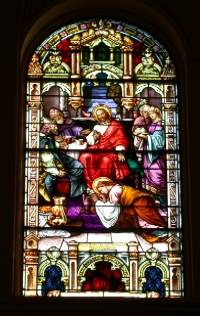
John’s parallel accountof this event tells us that the woman who comes to Jesus is Mary, the sister of Lazarus, whom Jesus raised from the dead just before He came into Jerusalem.  She lived in Bethany too.  Both accounts say that Mary broke open an alabaster flask, or jar of very expensive perfume, and poured it on his head and feet.

John’s account has Judas doing some quick calculations about the cost, which equates to about a year’s wages in that time.  Judas did this quick economics lesson to accuse her, but I’m glad he did it because it gives us a good point of reference to understand what this gesture meant.

When she was accused, she was accused (by Judas, according to John 12) of being wasteful.  Yet Jesus says she “did a good work for ME”….what do you suppose Jesus means by that?  The description of what she does isn’t always what comes to mind when I think of work.   Jesus also says “She has done what she could.”  Jesus is very pleased with her actions.  He defends her, and promises that what she has done will be immortalized, taught synonymously with the gospel.  Wow. 

Obviously, we live in a different culture, so some things are hard to understand in this.  Pouring oil on a guy’s head wouldn’t go over quite so well in our culture (at least since the 1950’s).  In that day and place, taking baths wasn’t something a person had the opportunity to do as often as we do.  People would quickly develop a certain odoriferousness (funk) about them.  So, this sort of thing was a welcome way to put a sheen on the hair and diffuse the funk.

But, Jesus associated it with his burial.  All along Jesus has been warning His disciples that He’s going to be betrayed, handed over to the gentiles, and murdered.  Do you think Mary is the only one who really heard HIm?  Is it possible she is anticipating His death, or is Jesus steering this somewhere?  What would Jesus be doing, if He were tying her activity here to His approaching death?

What other observations do you draw from this passage?  What do we learn from her “work” about our daily lives that we live here and now?

What contrasts do we draw from Judas’ behavior immediately following this event? 

See yer’ Sundee.

Dark Clouds over Mordor; Mark 13:14-37

Forgive the Tolkien reference in the title…sometimes I just can’t help but let my inner geek run amok.  This Sunday we’ll be looking at Mark 13:14-37, and we’ll finish up the chapter.

Remember our introductory remarks about the first thirteen verses…while end time events and prophecy is cool and all, to over emphasize it can be almost as dangerous as ignoring it.  So, while keeping our heads cool and level, we’ll be looking at some of the characteristics that Jesus describes will surround (what I believe to be ) the end of the age.

Jesus begins this section pointing to a prophecy from Daniel 11which references “the abomination of desolation”.  It might be interesting reading to look at this entry from the Jewish Encyclopedia (it’s about a Syrian King named Antiochus).  From the Jewish perspective today, and back in Jesus’ time, this was a historic event, not something yet to be fulfilled.  What does that tell us about Jesus’ statement here? 

In v19, what will the world be like in the time period he’s describing?  What does that tell us about the direction the world is taking…and how does it effect our expectations about the state of the world?

As you read this section over, who or what seems to have the upper hand through it all?  Yet what is the final outcome that Jesus predicts?  It might be helpful to read Daniel 7…or at least v13-14 in that chapter.

Verses 28-31, of Mark 13, tell us that we can expect an intensifying of troubles, leading up to the grand finale…just like we see buds and leaves sprouting and leading into summer and harvest.  In v31, Jesus makes a prediction about his predictions…what is it that he says?  What does that tell us about his predictions?

The final section, v 32-37 sort of put the final qualifier on the issue.  What does He say about these events?  What do we need to factor in because of this qualifier?

That should give us plenty to mull over and chew on this week!  See ya’ Sundee’!

AAAAGH!

CRUD!

You know what I failed to do this week?  I forgot to publish the text for this weeks teaching.  Sometimes life gets the better of me…sorry about that for those who read this.

Well…better late than never.  This week we’ll be looking at the last verses of Mark 12….verses 35-44. Read it here.

Jesus is still in the temple, and it’s still during this final week before the cross.  In v34, Jesus told a Scribe that because he was in agreement with Jesus about the summation of the commands of God (Love God and love people), he was “not far from the Kingdom of God”.  V 35 seems to flow right out of that conversation…even stating that Jesus is “answering” something.  What would He be answering?

In his discussion about the improper understanding the Scribes had about what the Messiah would be, Jesus points something out that had been overlooked…what do we understand about the Messiah from the passage in Psalm 110 that He quotes?  What does it have to do with the Kingdom of God?

Jesus is harsh in his condemnation of the religious leaders.  Do any of His observations sound familiar?  Instead of picking on the obvious caricatures of church leadership, how would we apply his warnings to our own lives and spirituality?

What is Jesus watching at the offering box?  What does this tell us about our spiritual journey from God’s perspective?  What is most important to God, based on these verses?

Anyway…hope you had a good week!  See you Sunday, Lord willing.

Sunday, May 11th; Mark 12:13-34

First off…please remember to check the Prayer Wall and keep the requests there before God.  Golda reminds us to pray for the people of Myanmar in Asia.

Secondly, thank you so much for all the support that was shown after my little state of the community fund talk last Sunday.  I mean support as in resources, but also so many who said such encouraging things to me personally.  It must have been obvious that I was less than comfortable doing that.

Ok…so on to our study.  We’ll be covering a lot of ground, vs 13-34 in chapter 12.  Read it here.

We don’t know if this is the next day, or exactly when this fits into the time-line…but after Jesus has had his initial confrontation with the leaders of the temple, we then have this section where the religious elite try to corner Jesus three more times, seeking to trap him with questions.  We’re going to look at all three of those traps…and we’re going to think about how Jesus evades them…and we’re going to consider ourselves, how WE can avoid the snares of religion on our spiritual journey.

The first section deals with their question about paying taxes, and if God fearing Jewish people are betraying God by paying taxes to a heathen authority.  Jesus’ answer is brilliant, and it makes a very important point about loyalty and commitment.  What does his answer say to you?  What is the most important thing, from Jesus’ perspective (based on his answer)?

In the second section, the religious “scholars” pose an elaborate “theological” question, trying to get him to side with one camp or another, hoping to stir up division based on his answer.  What is the first thing Jesus points out to these guys?  What is it that the so called scholars of his day were mistaken about in their question?  What can we learn from this about avoiding the traps of “religion”?

Thirdly, a less hostile question is asked by someone who really seems to want to hear Jesus’ answer.  But all are watching, probably hoping for ammunition to use against him.  This is a famous passage, where Jesus employs some real reductionism in his response.  Does anything jump out about what Jesus provides as an answer to this possibly complex question?  What do you take away from his response?

I came away with three distinct principles that I think are helpful in keeping our focus on the right things, and not allowing religious behavior and the expectations of church subculture from veering our course.  I hope it all is beneficial as we unpack it.


Sunday, May 4th – Mark 11:27-12:12

We’ve had some good discussion going so far, haven’t we?

This Sunday we’ll be looking at Mark 11:27, and reading all the way through to chapter 12:12.  Read it here.

Don’t you just love how Jesus is always in control of a situation?  Obviously, it’s the next day after Jesus interuped the worship at the temple…and as soon as He shows his mug around that place again, the “authorities” are all over Him.  They ask about what “authority” Jesus is using to do the things He’s done.  What do you think they mean by that?

Jesus pulls another “Jedi-Messiah” trick by turning the trap back on the trappers.  He actually changes the subject, sort of.  The common people of Jerusalem loved John the Baptist.  The elders and leaders were absolutely cornered by Jesus’ question in response.  If they denounced John as a fraud, the crowds would begin to resist them.  But if they said John was of God, the crowds will wonder why they treated John with such skepticism.  It was a no-win situation for them…a guaranteed double play ball.

That leads Jesus to tell the parable He tells in the begining of chapter 12.  Traditionally, it’s refered to as “the parable of the wicked tenants”…but it could be more accurately called “the story of the renters from hell”.

Read the parable over.  Who do the vinedressers who are renting the property represent?  Who would they represent as we try to understand this parable for our own lives?

Who does the Landowner represent?  What do we learn from about Him from His responses to the growing tensions?

What was the last straw in this stand-off?  What drove the Landowner to action?  What can we learn from this story about our own lives and the choices and responses we have?

Let’s discuss.

Sunday, April 27th – Mark 11:12-24

Well…we seemed to have pretty good participation last week with our approach to studying the Gospel of Mark.  No reason to quit doing this now!  It is odd to me that there is such a distinct difference between the first and second service we have at Eastgate.  While the first service seems very animated and willing to interact…second service is so much more reserved.  Why do you suppose that is?

Anyway…this Sunday we’ll be reading Mark 11:12-24.  Again, take some time to read it if you can, and in several different translations. 

In our story, Jesus has entered Jerusalem to a certain amount of fanfare, but left the city that evening and stayed in Bethany.  What we’ll read about are the next day’s events.

Jesus will do two curious things.  First, He passes a fig tree when He’s hungry, but is disappointed to find only foliage, and no fruit.  So He curses the fig tree.  Doesn’t that seem harsh?  The text tells us that its not fig season, yet Jesus curses it because it doesn’t have fruit on it.  Maybe the fake Christians with the signs have it wrong by one vowel…maybe it’s supposed to be “God Hates Figs”?

According to the Jewish Encyclopedia, Fig trees of that region have an early fruit and a later fruit.  The early fruit was considered a delicacy, and it must have been the leaves that were showing on the tree gave a false indication that the early fruit would be there.  If you read the article I linked to, you’ll notice an ominous portent was often associated with the destruciton of a fig tree in Jewish tradition.

When Jesus goes to the temple, his actions there start to shed some light on what this cursing of the fig tree was all about.  What do you think the cursing of the fig tree has in connection with the money changers in the temple?

When we consider the implications of the barren fig tree, we have to start looking to ourselves, and wonder: how important is outward appearance to me?   In this story, the leaves were on display for all to see, but what was being sought out was fruit.  Who was seeking it?  What words were used to describe why there was a search for fruit?  Do those details speak anything to us?

God’s values are on display in these verses.  What does NOT appear to be important to Him?  What DOES?

Anyway…that’s some stuff to chew on…what other observations can be made?

This Sunday: Mark 11:1-11

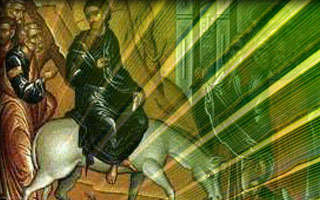
Triumphal entry

So, I’m thinking through ways in which we can be more interactive and engaged in the texts we study on Sunday mornings.  I’m wondering if this blog can be used as a means of achieving those goals as well.

This Sunday, we’re going to continue our study in Mark, and we’ll be starting chapter 11, and we’ll examine the first 11 verses. (Click the link to the left to read the passage at Bible Gateway.  Try reading it in several translations- NIV, NKJ, The Message, etc.)  Let me offer a few thoughts and questions, and maybe we can even get a discussion going in the comments section (if not, no worries, we’re just trying things out here)…all in preparation for corporately examining this passage on Sunday morning.

The whole text is significant in terms of identifying whoJesus is, and what role He has come to fulfill.  As Jesus first arrives in Jerusalem, He is received with great fanfare, and He is in effect, being declared a “king”.  Who is it that is making this declaration?

Within a week, Jesus will be arrested, and the charges brought against Him will be directly related to this very event.  What will Jesus be accused of before the Romans?

In our country, we have very little use for monarchies and kings – why is that?  Does that have any influence on our perception of Jesus as a King?  If we are part of the kingdom of God, what does that mean?  How is Jesus your King? 

What kind of King does Jesus appear to be in this passage?  What things seem evident from the events as they’re described?

Ok.  That’s it.  Let’s see if this works.

Dred-boy!

For those of you who watch American Idol…you may find this interesting.

How about that?  It’s been burning up the blog-o-sphere, so I thought I’d put it here too.  Interesting.

Although…I have to ponder this a bit.  One of the comments on the Youtube page where I found this said: “Love love love that he’s Christian. There is nothing sexier than a hot guy saying “Jesus.” What church does he attend? “

Is there really nothing sexier than a hot guy saying “Jesus”?  This isn’t to say that Jason’s faith is bogus…but something makes me shudder when I see the values of the Christian faith reduced to such shallow statements.  I realize it is probably the ramblings of an adolescent girl…but in some ways, I feel like she has aptly described the undercurrents of our modern American church.

I don’t know.  I like Jason Castro…he seems like a really nice kid, so this is in no way meant to denigrate him…but I’m so not interested in making Jesus “sexy” to appeal to the masses.  Jesus calls us to a radical exchange in values…but I’m not so sure we’re hearing Him.

“What Being a Man is ALL About…”

“You don’t like an old fashioned Bible, that tells you what bein’ a man’s all about?”

That’s a quote from the embedded video below. (WARNING: this video contains words that some will find crude and offensive, even if it’s found in the Bible)  It’s been making the rounds of various church related blogs I read (props to Real Live Preacher), so I figured I might as well feature it too.

Just so you know…I have to make the assumption that this guy is my brother in Christ, even though I wildly disagree with his exegesis on the passage in question (1 Kings 14:10)…and am offended beyond words by the title of another video he’s posted, “Why Billy Graham is going to hell”. (Click here to see my view on people who feel it necessary to preach “against” another minister, presented in comic strip form)

Either way…he’s my brother…so I’m not trying to pick on him…I’m just sort of fascinated by him.  In all honesty, it would be really nice to think that “this is what’s wrong with America”…because solving our problems would be SO simplified.  No more war, no more poverty, no more hatred…all you have to do is stand up to **….well, you should watch the video, and share your thoughts.