Our Relationship with Jesus

We were driving along and I half heard her say “Let’s get pizza tonight!”

“That sounds so good! From where?” I replied enthusiastically.

“What? From where we’re going now.” she said slightly annoyed.

“What do you mean? We’re going there now or from where we’re going we’ll go there?” I questioned.

“What are you talking about?”

“You said: ‘let’s get pizza tonight’ and I’m agreeing, but from where will we get it?”

“I said at the next street turn right…and you just missed the turn!”

Sometimes communication is hard. It’s easy to completely misunderstand each other when conversing, especially when you’re convinced you know what the other person is getting at.

I wonder if Jesus got exasperated in the text, we’ll be reading this Sunday in our study of Luke. We’ll be reading ch 22:21-38. Jesus will be giving final instructions to his disciples before his arrest, but they certainly seem to misunderstand him.

First he warns that someone in their group has betrayed him, and their response to this is to start arguing about who should be called the captain of the disciple team. What does that tell us about where their focus is? Have you ever considered how much the idea of reward factors into your trust in Jesus? In response to this, Jesus gives a clear picture of what greatness truly looks like. What do we learn about Christian priorities and leadership from his words?

The final section is a bit perplexing – but keep in mind the idea of misunderstanding. Jesus appears to be speaking figuratively and the disciples seem to interpret it literally. Imagine that v38 isn’t an affirmation of amounts, but a blunt termination of a conversation that is clearly going off the rails. We’ll try to dig in to that a bit on Sunday.

Hope you can join us as we think about what our relationship with Jesus will mean in real life.

The Way of the Bread and Cup

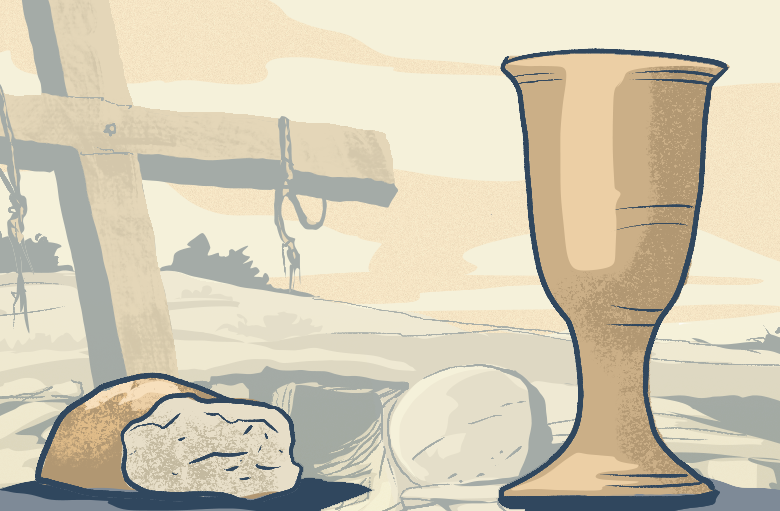
This Sunday we are going to continue in the Gospel of Luke and pick up where we left off in Chapter 22. The verses we’ll cover (vs 7-22) begin the story of the (famous) last supper. In this section, we find Jesus proclaiming that this (the bread) is his body broken for them, and this (the wine) is his blood, poured out for them. He tells the disciples who are sitting with him to do this in remembrance of him.

Sometimes it can be challenging to put ourselves in the place of the disciples, especially when it’s a story we have heard so many times. At first glance of reading these verses, we can easily say, “Yep, I know the story, this is where communion started,” and find nothing else of value.

The challenge for us is to look at these verses and find ways to apply it to our daily lives. How our we challenged with a verse and story we have heard so many times? Is it possible for God to reveal himself yet again, or even in a new way, through a familiar story?

I wonder if the disciples, who were sitting down to celebrate Passover with Jesus, thought something similar. This was an event that the Israelite people celebrated every single year. Were any of them restless and eager for this to be over so they could go back to the real work that they were doing? Or were they aware of how world-changing this holiday meal would be?

Join us this week as we look for God in the expected and unexpected places and examine once again, the (famous) last supper.

Bad Religion

We’re all familiar with bad religion…not the punk band from the 80’s, but the expression of piety that is neither holy nor helpful, but often downright harmful. I don’t know the percentages, but the gospels deal with bad religion a lot. I mean, it was bad religion that got Jesus crucified

One of the regular sayings I hear is that “Christianity isn’t a religion, it’s a relationship” – and I don’t disagree with that statement. Still, technically, Christianity is a religion – just one that doesn’t place an emphasis on ritualistic performance but rather a dynamic bond with our Creator.

In our study of Luke this Sunday we’ll look at some examples of bad religion and consider why it went bad. We’ll be reading a short section from ch 21:37-22:6.

Everyone was in Jerusalem for the annual Passover celebration – and Jesus was camping on the Mount of Olives with his crew. That’s the setting – but the characters we read about are our focus. While everyone was in town to remember the deliverance from slavery and death that God brought to Israel – what are the religious leaders occupied with? What does that contrast convey to you?

They don’t want to arrest Jesus publicly because of how the crowds might react. Where is their focus, and what does that tell us about how their religious pursuit went wrong?

We aren’t really told what motivated Judas to betray Jesus, except for the phrase that “Satan entered into Judas”. “The satan” means accuser or adversary…an enemy. What is this language telling us about what has happened in Judas’ attitude and intention? How does that clue us in as to the ways in which one’s religion might go sour?

This will certainly give us a lot to think about – I hope you can join us this Sunday!

Living in View of the Finish Line

I love touring ancient structures whenever I get the chance; Mayan ruins, ancient Celtic rock circles, the ruins of Vindolanda – I’ve had the opportunity to see them. What I find so fascinating is to touch those ancient stones and imagine the hands who also touched them so very long ago. At one point, these were thriving communities – now they are curious piles of rock. All things come and go – all things have a limited shelf-life, including humans.


Jesus will be talking about the end of an age in the text we’ll be reading in our study of Luke this Sunday. We’ll be reading ch 21:5-36.


It’s a lengthy section, the heading for which is found in v5-7 – Jesus predicts that the temple in Jerusalem will soon be mere ruins. The disciples want to know when this will happen and what they should look for. The disciples were looking for a fast, cataclysmic end to the temple and the world, simultaneously. He indicates in v9 that time will go on, even without the temple, and that time will be characterized by lots of troubling and confusing things. V8 tells us what we should be cautious of. What does he say and how do you understand his warning; what does it apply to?


V13 tells us something else important about all the troubles and possible persecution. What does he say these troubles provide for us? Is that the direction your mind goes when troubles show up or you’re treated unfairly?


Jesus throws a series of hyperlinks into his speech in V20-28 – we’ll go over those more in depth on Sunday. It’s all language intended to convey how serious the events surrounding the temple’s end will be for the people of Jerusalem. V28, again, tells us what these troubling events actually mean for Jesus’ followers. What does he say this is all leading towards in that verse? How might that effect our attitude when the world seems to spin out of control?


V34 is Jesus’ last bit of instruction about how we should live in light of the finish line. What does he say? How might we be tempted to do the opposite when troubles seem to pile on in this life?


We certainly saw how deeply troubled our world is last week in Uvalde Texas – the senselessness and violence that spills out onto the youngest and most vulnerable among us. It’s so heartbreaking – we, of course, must be praying for those left to try and navigate such a horrible losses…I can’t even imagine….word’s completely fail me. Jesus’ words in v28 of our text take on so much more weight…and seem more difficult to follow, when we’re spattered with the blood of innocents.


God have mercy on us, a sinful, prideful people. May we somehow, someway, hear your voice above the clatter of gunfire, and follow your words to sanity and salvation.

Hidden in Plain View

I can’t tell you how many times I’ve looked for some item in our refrigerator at home and turned away declaring “we don’t have any” with absolute confidence…only to have my wife reopen the door and point to said item on the front of the shelf at eye level (and then walk away muttering something about living with an overgrown toddler).

I’m just sayin’, some things seem to hide in plain view.

The reality is, God is often like that. There are things going on and aren’t too easy to spot on the surface, but given time, consideration and prayer, emerge in a fuller detail. In Isaiah 45:15 the prophet declares “Surely, You’re a God who hides Himself!” and I can’t argue with him on that.

We’re going to continue our study in Luke this Sunday, reading ch 20:41- ch 21:4, where we’ll encounter a few “hidden” things. Jesus will pose a riddle, give a rebuke and make an observation about these somewhat obfuscated things.

In 20:41-44 Jesus has his turn to present a riddle – one that quotes Psalm 110 about the promised messianic King – and Jesus asks why David, the ancestor, makes himself subservient to the descendant, instead of the other way around. What do you think Jesus is trying to communicate in this riddle about His own nature? What might be hidden in the person of Jesus that many were overlooking at the time, and many overlook today?

In v 45-47 Jesus rebukes the religious leaders for making an empty show of their spirituality. What might be hiding out behind an emphasis on outward religious performance?

Jesus is people watching in ch 21:1-4 and makes an observation about something that could easily have remain hidden and gone unnoticed. A poor widow gives to the temple treasury out of her poverty and outgives all those who gave from a fraction of their abundance. Take some time to contemplate the lesson of that observation. We usually hear it taught as an impetus to give more to the church…but there is something deeper going on than that. Refer back to Jesus’ rebuke in ch20:47…who were the religious leaders taking advantage of? Think back to what Jesus did when he first entered the temple in ch 19:45-46. What do we make of this woman’s gift and God’s response to it in light of who the recipient of the gift is? That’s something to really ponder for a bit.

This is an intriguing group of texts we’ll be exploring this Sunday – I hope you can join us!

God of the Living

We’re going to continue in our exploration of the gospel of Luke this Sunday.  We’ll be reading ch 20:27-40.

It’s an odd little encounter that Jesus has with a group of Sadducees. Because the Sadducees don’t believe in an afterlife at all, they pose a riddle that is supposed to show the absurdity of the concept.

They learn the first lesson they needed to learn…never argue religion with Jesus.  He dismantles their proposition very simply…how does he do it…how does he indicate to them that they aren’t starting from the right premise?

Is there anything about what he says about relationships in the afterlife that bothers you? Do you think that Jesus was setting out to describe in detail how life will be after this life, or is there a deeper point you think he’s making?

The hope of an afterlife is actually a very meaningful influence on this present life, isn’t it?  I would say that the hope of an afterlife will revolutionize our present life.  What are some of the positive ways an eternal hope can have on present life…and what could be some negative ways?  How can we, as followers of Christ who have a hope of resurrection and redemption maintain the positive influence of that hope, and not succumb to the negative tendencies?

I look forward to exploring this passage together on Sunday!

Image Bearers of God

There is a famous quote, usually attributed to Ben Franklin, though he was actually quoting someone else, that says: “only two things are certain in life….”. I’m sure you know what the quote says. I read a funny Bizarro cartoon that showed the Grim Reaper sitting in an IRS office being audited and the Reaper was saying “I suppose this was inevitable.”. Made me laugh, anyway.

This Sunday as we continue our study in Luke, we’ll be reading ch 20:20-26. In these short six verses we have the makings of a lifelong study. It’s the famous passage where Jesus is asked about paying taxes to Rome, and his answer is both brilliant and thought-provoking.

First and foremost, what do you make of the religious leaders sending spies intending to entrap Jesus and get him in trouble? How does that seem to square with God’s character? What observations might we make about what had happened to the spiritual leaders of Israel?

How do you read Jesus’ answer? He takes an either/or question and turns it into a both/and response. What do you suppose he means to give Caesar what belongs to him? Does that seem to guide us in how we as God’s people understand the role of government, and if so, what guidance does it seem to yield?

The word Jesus used for “image” is significant. It’s the same word the Septuagint (the Greek translation of the Jewish Bible) used for Gen 1:26 – “Let us make man in our own image”. How might that weigh into what Jesus is saying, especially the last part of his answer? In what ways can we give God back whatever it is that bears His image? Again, as I said, thought-provoking stuff that doesn’t seem content to produce one answer alone.

I’m stoked about this passage, it’s really a lot of fun to dig into. I hope you can join us this Sunday as we examine it together!

Problem Tenants

Has someone ever taken something that belonged to you – or at least you felt belonged to you? Have you ever been in charge of something, and someone comes along and undermines your decision or takes over entirely? How did that make you feel?


We’re going to be considering something about God’s kingdom along those lines in our study of Luke this Sunday, reading Luke 20:9-19.


Jesus tells another parable that further explains the motivation behind his shutting down of the temple in our last section. The story is about a group of share-croppers – renters who tend to a landowner’s vineyard – who decide to take the vineyard for themselves. The story takes very commonplace circumstances (for that time and region) and exaggerates the nefarious behavior of the renters to the point of being absurd.


It’s a story that grows out of last week’s question: “By whose authority do you say and do these things?”. Jesus sort of expands the scope, asking “Just exactly whose Kingdom do you suppose this is?”


As you read the parable, consider who the renters might be (remember who he’s been in confrontations with). Who might the son be? Who would the landowner represent? Now, consider the event that set in motion the destruction of the renters. What does that seem to indicate to us? How might we read this parable as 21st Century American Christians and understand it’s import for our present life as God’s representatives?


It may prove to be a challenging story for us to read – but well worthwhile. I hope you can join us this Sunday as we examine it together.

The Temple’s End

Easter was such a wonderful time of remembering the hope we have in Christ through the power of his resurrection. This Sunday we’ll be returning to our study in the Gospel of Luke – even though Easter was a bit of a spoiler on how this story will turn out.

We’ll be reading what may be a familiar passage – what has been traditionally called “the cleansing of the temple”. Our text will be Luke 19:45-20:8. Normally when we hear about Jesus driving out those who were selling sacrificial animals and exchanging money in the temple, we assume his motive is to rebuke commercialism/consumerism within the house of worship. I would say the majority of people read it that way…I know I always did.

This Sunday we’re going to challenge that idea. Jesus was certainly staging a prophetic rebuke…but of what? There is an alternative proposition about what Jesus was doing that I find quite persuasive, and the message if far deeper and heavier than mere consumerism. (Not to excuse a consumer mindset within the sphere of worship – there are other places in Scripture that address that as improper, but I’m not convinced that’s what Jesus was doing in this particular text)

Here’s some homework: read Isaiah 56:6-7 as well as Jeremiah 7:4-6,9-11. These are the passages that Jesus is quoting. If we employ Tim Mackie’s idea of using those references as hyperlinks, what are those passages making a point about? How do they expose what Jesus may be getting at? What might it mean that the temple had become a criminal hideout (den of thieves)?

The next section we’ll read is ch 20:1-8 where the leading authority figures challenge Jesus about his authority to do what he did in the temple. The section is rich in irony, which drives home the point about what the temple had become. When Jesus reverses the question on them, who do they look to for answers? What is it that motivates their response? What does that tell us about their view of authority, and how does that reflect on the temple?

I hope you can join us this Sunday as we dig in to this text together!

The King Who Brings Peace

This Sunday is Palm Sunday – and amazingly, our study of Luke just so happens to be the very section that covers the events of that day! I wish I could say that I was smart enough to plan that out way back when we started…but I think we would all know better than that.

We’ll be reading Luke 19:28-44. There are so many things going on with Jesus’ entrance into Jerusalem. Luke doesn’t mention Palm branches, but John 12:12-13 gives us that detail. This event is pointing back to ancient prophecies about the Messiah, as well as prior historical events, and all of it is meant to create a contrast between the kingdoms of this world and God’s reign and rule.

Do your best to imagine the scene. How intimidating does someone look riding on a donkey? What message is that meant to convey? Why do you think the Pharisees were upset with the crowds singing about a coming King in Jesus’ direction? What do you suppose the significance of the rocks taking up the song if people were to quit?

The section ends on a somber note. Everyone else is stoked, but Jesus is crying…sobbing even. He sees Israel’s rejection of him as King and the consequence of their future path of violent revolt against Rome. What might that warning be speaking to us, if anything? Does it mean anything to you that Jesus speaks this warning through weeping and tears?

We’ll have a LOT of interesting details and puzzle pieces to arrange together on Sunday! Hope you can join us!