Church is for Losers!

loser

We’re going to continue our series concerning Church Life in Real Life, and read 1 Timothy 1:12-20 this Sunday.  (You should read it in the Message too )

In the opening of chapter 1, Paul launched his war on error, pointing out that some of the leaders there in Ephesus had lost their way and were corrupting the message of the gospel.  The things that he highlighted as being out of sorts gave us clues about what was happening with these leaders.  They were reading into genealogies to create some sense of elevation for themselves…a claim to a higher calling and closer position to God.

Since they were making themselves out to be special…Paul bares his own past, and shows what kind of person he had been, that made him suitable for being a minister of the gospel.  What does he say about his own background in light of his present calling, in v12-17?

When you read his words…do you see yourself there at all?  In light of leaders trying to elevate themselves, what do you think Paul is trying to get across here?  V15 gives one of the most brilliantly succinct summaries of the gospel and it’s message to the world.  A person could spend a lifetime contemplating that verse, and all of it’s implications.  What are your thoughts concerning v15…how do you read it?

Timothy, the one the letter is written to, was a young man Paul had been mentoring.  He’s very likely only in his early 20’s at the writing of this letter.  What is it that Paul points to as a validation of his ministry and calling in v18?  How comfortable would you be, trusting in someone’s qualifications to lead people who was very young, had minimal training, and who’s primary evidence of his calling was a prophecy someone else had spoken over him?  This tells us something about how GOD goes about making someone qualified for the work of His kingdom…and it’s a far cry from the expectations we normally like to place on people.

Paul finishes off the chapter by calling out two guys by name, Hymenaeus and Alexander.  We don’t know anything about them, really.  Hymenaeus is mentioned again in 2 Timothy 2:17, and the “cancerous” teaching they endorse has to do with the claiming that the resurrection had already happened.  Obviously, that’s referring to the resurrection of the saints at the end of the age.  The implications of that message could take believers down many different rabbit holes…to the point where one might say “If the resurrection has already happened, and Jesus isn’t coming back, why would I follow His ways anymore?”.  It’s logical.  Paul “hands them over to Satan”…that is, he’s letting them go their own way unhindered, he’s not going to try force them into truth…if they want to ally themselves with the enemy of God’s plan, let them go for it.  But he has a reason for letting them go…a goal he’s hoping to see accomplished.  What is that goal, in v20?  What does that tell us about our hopes, even for those who seem to have lost their faith?

The Church isn’t a haven for really good people to get together in and pat themselves on the back for how much better they are than everybody else.  The church is for LOSERS…who’ve been rescued by the unrelenting love of God, through Jesus the Hero King.  That sure does make me feel at home there…..how about you?

Church Life in Real Life

churchinreallifeThis Sunday we’ll be starting a new series called “Church Life in Real Life”, and we’ll be exploring the books of 1 & 2 Timothy.  There’s a pretty good commentary which covers at least 1 Tim online at Bible Gateway…you can find it and read it HERE (if you’re so inclined). 
Both the letters to Timothy as well as Titus have become known as the “pastoral epistles”, because they deal so much with church structure.  Some people assert that their only real purpose is to set up church policy and government, but I beg to differ.  It seems to me, that while the regulation of leaders and doctrine brackets the whole work, the real import of the message is how the gospel is supposed to effect our lives with REAL change.  Change that gets evidenced in the lives we live.  Church life should merely be a reflection of our everyday life, not a different aspect of life we reserve for Sundays and Wednesdays.  Church life should be in real life and visa versa.  Anyway…we’ll unpack that a bit more as we go along.

This week as we introduce the book, we’ll be reading chapter 1:1-11  (Also in the Message), and considering Paul’s “War on Error”.

After his greetings, Paul jumps right into correcting teachers in Ephesus (Where Tim is living and working, helping get the church there established), warning them that they’re veering off the path Paul originally pointed to.  What are some of the things he warns against in v4? 

So…what’s the big deal Paul?  Why is doctrine such a sticky issue with you?  What does it matter what some people believe?  Those kinds of questions seem appropriate…so what does v4 say about the results of what is being taught in Ephesus?  What does that tell us about the importance of maintaining a healthy doctrinal understanding?

The issue seems to be a slide into mysticism, and another attempt to introduce the Old Testament law into New Testament living.  Who does Paul say the the law is for?  How do we understand this, in light of Paul’s message of salvation and life in Jesus Christ?

Should be an interesting foray into a very timely epistle!  See yaz Sundee.

Palm Sunday

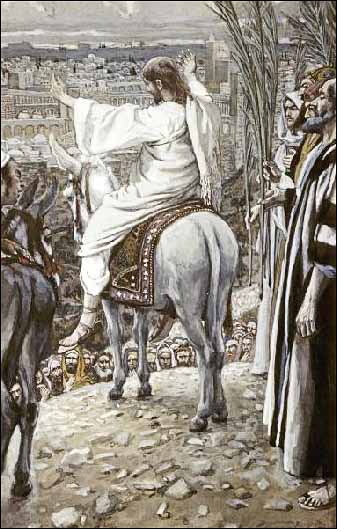
Jesus Beheld the City and Wept over ItThis Sunday is Palm Sunday…and we’ll be reading John 12:12-16.

Palm Sunday is a day when we acknowledge that Jesus is King.  But what does that mean?  How is Jesus king to us, as 21st Century American Christians?  Because of our origins as a nation, the idea of “king” may not play too well with our thinking.  But what does this passage inform us about when it comes to Jesus as our King?

What do you think?  Is the concept of Jesus being a literal King something you relegate to a mystical, spiritual thing…or do you see it as something that directly and presently effects your life?  I’d be interested to hear.

Responsibility…what’s that? Responsibility, not quite yet!

Running late this week, per usual.  Don’t forget that Burning House is this Sunday…and Save the Ship will be leading worship and providing original music!  Do NOT miss this.

This Sunday we’ll be finishing up our teaching in 1&2 Thessalonians…and we’ll be reading 2 Thes 3:6-18. (Also in The Message)

It appears as though end time fever got the best of some of the people in Thessalonica…and they quit showing up to work and just sat around looking for Jesus to come back.  Every met anyone like that?  Ever done that yourself?  I heard a phrase once, that said “Live as though it were your last moment on earth, but plan as though you’ll be here 100 more years.”….or something like that.  I actually used that very unromantic phrase when I proposed to Robbie…but that’s a whole ‘nother story.

In reading these verses, we should tie v6 to v14-15, because those latter two revisit what is said in v6.  How do you interpret what Paul is saying there…and even more, how would you actually carry that out in real life?

Paul uses himself as and example in v7-9.  What do we learn from his example?

In v10-13, Paul makes a two fold challenge…one is to the slackers…the other is to those who have been trying their best to do the good that endures.  What is the message to these two groups?

He finishes it all off reminding of something very encoruaging…v16….what is it?

See you guys Sunday…and don’t forget to make room for Burning House!

“Priorities Under Pressure”

When times are hard, and life seems to have the pressure set at “11”, it’s easy sometimes to forget what comes first.  I know in my own experiences, whenever there’s a problem, I have a tendency to fixate on that problem, and treat it as though it’s the most important thing in the world, until it gets solved.  But is that the right procedure for handling life’s difficulties?

We’re going to continue our study in 2 Thessalonians, and read v1-5 of chapter 3.  (In the Message)

In the first verse, Paul asks the Thessalonians to do something…pray.  What does that tell us about our priorities during times of stress?  What obstacles are in our way to praying?

Combining v1-2…what does Paul ask them to pray about?  What does THAT tell us about our priorities in life?  What is the most important thing in the world for the Christ follower?

In v3-4, Paul expresses his confidence in God, that he will continue doing his work in the people of the Thessalonian church.  Based on what he says, what else is our priority as a Christ follower?

Finally, v5 has Paul praying for them again.  Its a neat kind of rhythm to this…like breathing, or a heartbeat, how the prayer goes from one to the other.  What is his final request for the Christians there?  What is OUR priority, based on his hope for them?

Stuff to ponder.

Hanging in There

Ever need a good pep talk?  Clearly, Peyton Manning is probably not the place to start looking for one, but all of us need a good encouraging word now and anon.

This Sunday we’ll be looking at 2 Thes 2:13-16 (and in the Message), and I believe that’s what Paul is doing with his closing thoughts to the church in Thessalonica…giving them a pep talk.  Mind you, it’s a pep talk that’s pretty deep and rife with theological implications that have been studied and debated for 2,000 years…but a pep talk none the  less.  In a way, Paul is saying “look, I know that times are hard for you, and people keep predicting the end of the world for you…but hang in there.”  Then he gives them some reasons and ways to hang on.

In v13-14, Paul sets up the foundational encouragement for them.  What do you get as encouragement from these two verses?  Based on these verses, what can you remind yourself of when times are tough and you need something to hang on to?

V15 gives us a straightforward encouragement to do something in our “hanging on”.  What is it?  What do you think Paul is talking about, and how would we apply it to our day and age?

V16-17 tells us that God is the source of something to us?  What is it?  What should it result in concerning our state of mind and heart?

Ok…stuff to chew on.  We’ll talk about it more on Sunday.

Don’t Believe the Rumors

Whoops!  Had some skin cancer removed this week…and I’m such a weenie about it, it threw my whole schedule off.  Sorry about that.

Sunday we’ll be reading 2 thes 2:1-12 (the Message)

Once again, Paul is trying to calm the Thessalonians down after they’ve been zapped with end-time fever.  What is it that they are afraid has happened?  Have you ever felt left out of something…if so, what emotions did it inspire in you?  What does Paul do to calm them down…what does he encourage?  As you read the whole 12 verses…who has the upper hand in the events that are going to one day unfold?  What is there in this that can encourage a Christian who is concerned about the end of the age?

See you Sunday.

God is not Mad at You

Cause everybody knows

If you don’t mind your mother’s words

A wicked wind will blow

Your ribbons from your curls

Everybody moan everybody shake

The shankill butchers wanna catch you

Awake

~The Decemberists, “The Shankhill Butchers”

The concept of “retribution” is the fuel that drives almost every pagan religion, ancient or modern.  You find it as the driving force behind the concept of karma, as well as many other forms of religion.  If you do bad things, bad things will happen to you.  If you do good things, good things will happen to you.  A person measures his or her status among the gods or fate by the circumstances they face in life.

The thing is…this kind of mindset has influenced many Christian’s thinking…and often we don’t even realize it.  We’ve incorporated the law of retribution into our understanding of God and the gospel when we start trying to estimate God’s acceptance of us based on what’s happening in our lives.  A great example of it is found in the (waining) “Word/Faith” doctrines.  This teaching says that if you have enough faith in Jesus’ power, you’ll be financially rich, free from sickness and enjoying the good life.  If a person is sick, or struggling financially or in any way, it’s a sign that you don’t have faith, or there is some hidden sinfulness in your life.  It’s a crock.

Even if we don’t fall for egregious errors like the aforementioned…we sometimes slip into this way of thinking in more subtle ways.  We start thinking “God must be happy with me because everyone got the flu but I didn’t”…or conversely, “God must be punishing me because I lost my job.”…a Christian version of Karma.  While it’s true, God will sometimes use our circumstances to guide us, or communicate a message to us (sometimes being very distinct from ALL the time), His acceptance and love for us is an entirely different thing.

A person could point to the Old Covenant and say “Israel was sent into exile because God was mad at them”…but that’s not entirely accurate.  Israel had forsaken their national relationship with God, and God got their attention in a big way through the exile…but it’s made clear that this is for their ultimate benefit.  The book of Job stands as a startling revelation that the law of retribution is not the standard means by which God deals with His people, even though Job’s friends thought it was.

All this to say that this week we’ll be reading 2 Thes 1:1-12, as we continue our series “Looking for Hope in Uncertain Times”. (2 Thes 1 in The Message)

This is the 2nd letter Paul writes to this fledgling church, several months after his first letter.  Things have not gotten better for the Thessalonians, and in fact seem to have grown worse.  Which leads to the inevitable question that most of us would ask…”Is God mad at me?”.  Paul’s opening remarks seem to be trying to put them at ease, letting them know that God isn’t mad at them…and that there are some other ways of looking at trouble that comes into our lives that help us understand why we face those things.

V1-2 provide Paul’s greeting.

In V3, Paul is encouraged because he sees something happening in them, something growing.  This is one of the reasons we face trials…so that we will grow.  What is it that is developing with them, and how would we relate it to our own troubles.

V4-5 indicates something else Paul is aware of concerning this church.  The perseverance they demonstrate during hard times makes something happen…what is it?

Paul warns that Justice will come one day (V6-10), that oppressors will have to answer for their acts of hatred.  So, he’s letting them know that things will be made right one day…and that is the day he points toward to provide them with hope.  What are we looking forward to in v7?  So what does that tell us about life here and now?  Based on what he’s saying here, if bad things happen to us, does it mean God is mad at us?

Finally, in v11-12, Paul makes the most alarming statement in the context of suffering as a Christian I think anyone could make. How would you summarize what he says in these verses?  How would you brace it against your own life and experiences?

See you Sunday!  

Living Our Future Hope – Right Now!

sunriseHey Everybody…sorry, but I’m back from vacation.  I had a great refreshing from our King, and I’m stoked and ready to get to the stuff God’s given us to do.

This week we’re going to finish up 1 Thes, and we’ll study chapter 5, verses 11-28.

Paul is wrapping up his thoughts, and giving his final exhortations to the young church in Thessalonians.  He’s just come off of reminding them about the great future hope we have in Christ’s return to set everything right.  He used Jesus’ resurrection as the basis for our hope…that since Jesus rose from the dead, we know that same kind of restoration is in store for us…so be stoked!  So, we have this past event of the resurrection, and this future hope of restoration…but what do we do in the meantime?  That’s what Paul expounds on.

We, as the church, are called to live lives that reflect and actually demonstrate that future hope right here and now.  Not through big movements or grand outreach schemes…but as Riley and Dan both reminded us of last Sunday and Wednesday, through the everyday activities we pursue as children of that great HOPE!

In v11-13, Paul talks about community.  How should we live out our hope in community?  What will characterize it, according to what Paul says there?

In v14-15 he describes how we look after each other.  If you were to summarize what he’s saying there, how would you do it?  Why does this behavior toward each other represent something different from this fallen world?

V16-18 we are pointed toward a proper understanding of life’s events.  God’s will is revealed for our lives…what is it? 

v19-22 provides instruction about the work that the Holy Spirit is doing in our midst as a community.  Paul warns us not to close Him out…and what is it that the Holy Spirit is doing among us according to these verses?

V23-28 finishes up Paul’s thoughts.  We have a hope in a restoration that has begun at Jesus’ resurrection, and v24 tells us why we can be sure of that hope.  What does it say?  What must we remind ourselves of, when times are tough, and our temporal future is uncertain?  What IS certain?

Looking forward to being back this Sunday!